


Highlights:
①. Gate Intermediate Futures Courses are designed to elevate traders to professional status by developing a robust futures trading system. These courses aim to enhance traders' skills comprehensively, covering investment philosophy, futures trading tools, and trading systems.
②. This article will analyze the cyclical fluctuations of the crypto market in the context of macroeconomic changes. It will explore the fundamentals of the Federal Reserve, examine how its monetary policy impacts the market, and discuss investor responses.
1. Brief introduction to the Federal Reserve
①. Establishment background
In the early days of its founding, the United States was historically uninterested in the concept of a "central bank," leading to repeated failures in attempts to create a "quasi-central bank." Without a central bank, the financial industry expanded chaotically, frequent bank runs occurred, and financial crises were common.
By 1907, the Great Panic made it clear that the United States needed a central bank to serve as the "lender of last resort." However, there were significant disagreements across various sectors about the nature of the central bank to be established. The famous "Aldrich Plan" soon failed, but it laid a solid foundation for the eventual establishment of the Federal Reserve.
To balance the anti-capitalist monopoly and anti-government monopoly demands of different groups, the "Joint Reserve Act" was enacted, proposing a compromise solution: the establishment of a central bank in the form of a federal government entity combined with non-profit institutions.
In 1913, then-President Wilson signed this bill, and on August 10, 1914, the US Federal Reserve System officially began operations, marking the formal establishment of the US central bank.
②. Definition and role of the Federal Reserve
The Federal Reserve, abbreviated of the Federal Reserve System, serves as the central bank of the United States. It is unique among central banks because, while the central banks of many other countries are entirely owned by government departments, the Federal Reserve operates as a public-private partnership system combining federal government oversight with non-profit institutions.
According to the official introduction of the Federal Reserve, it plays the following core functions:
A.Control inflation and maintain price stability
B.Promote employment
C.Support the U.S. economic development
③. The Fed's most important monetary policy tool is called open market operations. The Federal Reserve's plans to raise or lower interest rates and decisions on whether to reduce asset purchases, which are closely watched by the market, are formulated by the Federal Open Market Committee (FOMC).
2. How Does Fed's Monetary Policy Affect Crypto Markets?
①. The correlation between the US stock market and the crypto market
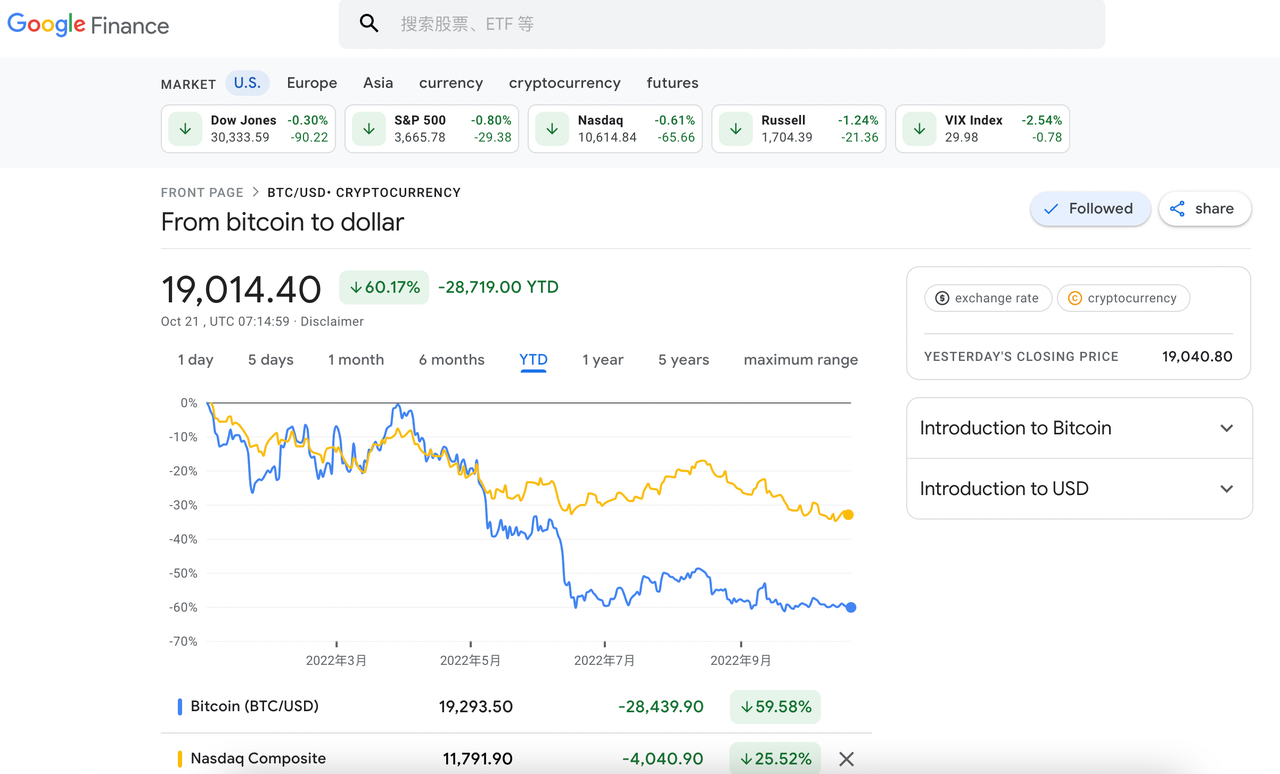
According to Google Finance data, the cryptocurrency market's performance is highly correlated with the U.S. stock market. Since the beginning of 2022, BTC has dropped by $28,719, a decline of 60.17%, while the U.S. Nasdaq Index has fallen by 25.52%. The line chart shows that their price trends are almost synchronized, with the lowest points, highest points, and reversals occurring nearly simultaneously.
The Federal Reserve's impact on the U.S. stock market similarly affects the crypto market. To combat high inflation, the Federal Reserve began an interest rate hike cycle in March this year, raising rates five times in succession, with a total increase of 300 basis points.
②. Historical Data: The Impact of the Federal Reserve's Interest Rate Hikes and Balance Sheet Reduction on the Financial Market
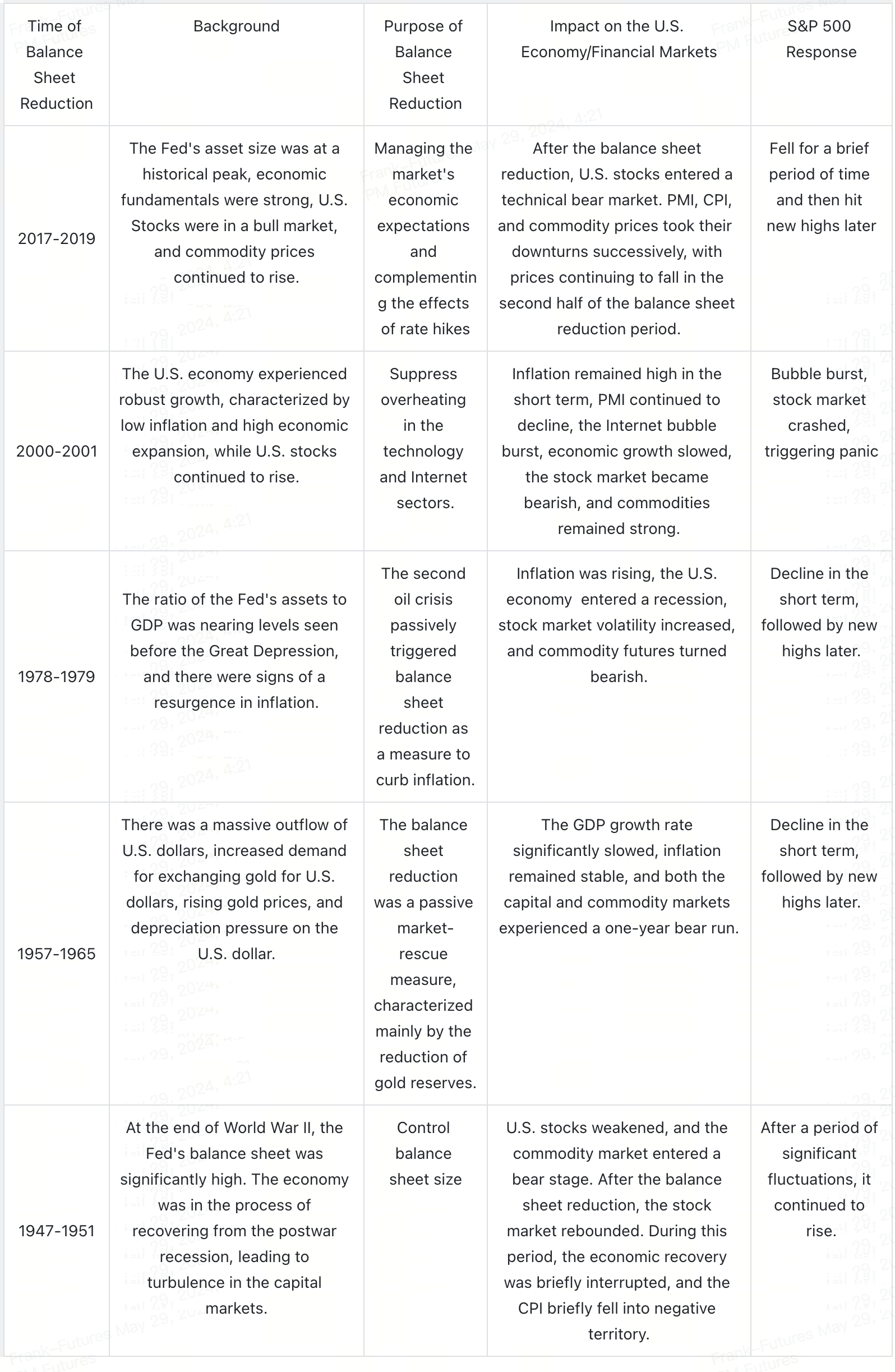
The global financial market has clearly experienced significant volatility during the interest rate hike cycle, with both global stock markets and risky asset markets, like cryptocurrencies, generally declining.
It is a known fact that high interest rate environments and tightening policies adversely affect risky assets. When interest rates are low, it reduces the cost for investors to obtain funds, enabling them to use higher leverage and achieve higher risk returns, thus pushing up the prices of risky assets. As interest rates rise and market liquidity is drained, the asset bubbles previously inflated by leverage burst. This leads risk-averse investors to shift their funds to safe-haven assets. Consequently, high-risk markets, typically represented by the stock market, experience general declines. The crypto asset trading market, as an emerging sector known for its high volatility and reputation as a speculator's paradise due to its 24/7 trading and lack of regulation, is often the first to bear the brunt.
Zhang Lei, founder of Hillhouse Capital, mentioned in his book "Value" that "every bull market emerges from loose liquidity and ends with a shortage of liquidity." Given this, it is likely that the crypto asset trading market will continue to fluctuate and decline over the next year. This situation creates unavoidable risks for short-term traders with multiple orders and challenges long-term investors to wait for a better entry point.
3. How do investors cope with cyclical market fluctuations?
To start with, let's establish a basic fact: the market is always evolving, and the economy cycles through phases of recovery, prosperity, depression, and recession. Understanding which stages the economy is in and the characteristics of various investment tools are essential for developing effective strategies and increasing investment success.
Now, let's introduce an important concept: the Merrill Lynch Clock. This is a set of asset allocation theories proposed by Merrill Lynch, designed to guide investment strategies during different economic stages. Essentially, it provides a framework to help investors identify "What stage are we currently in, and how should we allocate assets at this stage?"
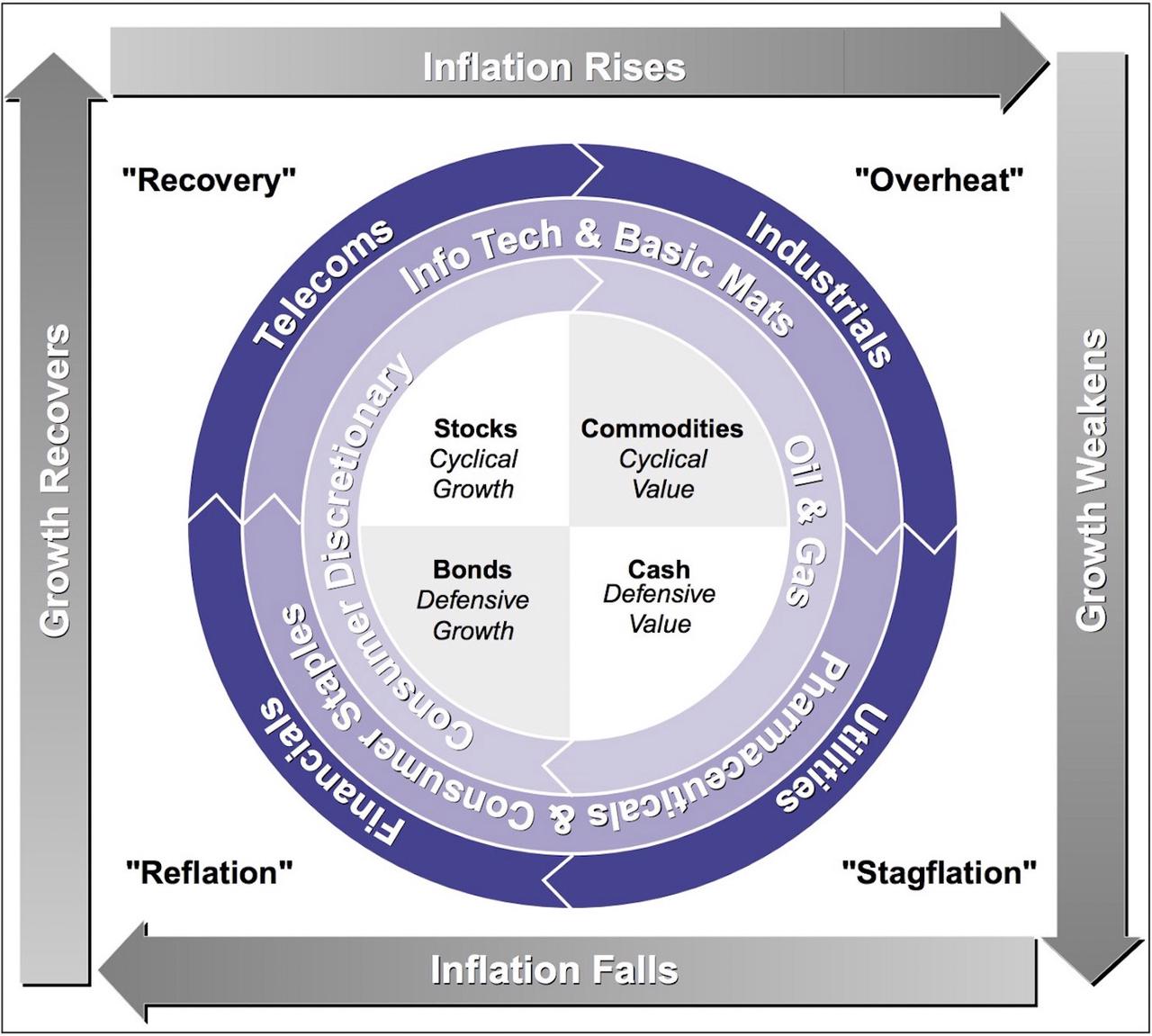
Based on the economic growth rate (GDP) and inflation rate (CPI), the Merrill Lynch Clock divides the economic cycle into four stages: recovery, overheating, stagflation, and recession. As the economy transitions through these stages, the optimal mix of asset allocation changes accordingly.
According to Hong Hao, Managing Director and Head of Research at BoCom International, "The Fed's 25 basis point hike in interest rates will do little to combat high inflation in the United States. Data indicates that the U.S. economy is heading towards a stagflation stage." Stagflation is characterized by a slowdown in economic growth while prices remain high. During this stage, the recommended investment allocation priority is cash > commodities > bonds > stocks. In simpler terms, one should significantly reduce holdings in risk assets and focus on cash or shorting assets.
In the stagflation stage, how should an investment portfolio be allocated? According to the Merrill Lynch Clock asset allocation theory, the priority is: cash>contract short assets > ETF leveraged products > wealth management products > spot. Simply put, when the overall market is bearish, focus on holding USDT cash assets or low-multiple contracts to maintain or increase asset value. A reasonable portion of the portfolio can be invested in low-risk, low-return products such as staking, lending, liquidity mining, and earning platforms. The spot market is the least advised choice due to the high potential for persistent bearish trends. Investors entering the market at this point run a high risk of being locked in, so careful consideration is necessary before getting involved.
Despite both contract trading and leverage trading being ideal choices for short-selling and hedging risks in bear markets, and both improving the efficiency of capital use through leverage, contract trading stands out for several reasons. It offers a better product experience by eliminating the need for funds borrowing and repayment, provides a broader range of product offerings (such as U-margined perpetual futures, currency-margined perpetual futures, and delivery futures), and features simpler operating procedures. These advantages have made contract trading more popular among crypto asset investors.
4. Summary
This piece explains the intrinsic relationship between the Federal Reserve's tightening policy and the crypto market from a macroeconomic perspective. Understanding this connection is crucial for investors to grasp the cyclical bull and bear fluctuations in the crypto market. By understanding the market, following its trends, and adapting to its movements, investors can achieve more stable returns.
For practical trading operations, visit the Gate Futures platform. Register for a Gate account now and begin your contract trading journey!

Disclaimer
This article is for informational purposes only and does not constitute investment advice. Gate is not responsible for any investment decisions you make. Content related to technical analysis, market assessments, trading skills, and traders' insights should not be considered a basis for investment. Investing carries potential risks and uncertainties. This article offers no guarantees or assurances of returns on any type of investment.
Disclaimer
The content provided herein is for reference and educational purposes only and does not constitute any financial, investment, trading, or legal advice, nor does it constitute an offer or solicitation to buy or sell any digital assets. Gate makes no express or implied representations or warranties regarding the accuracy, completeness, or timeliness of the information contained herein. Product features, interfaces, rules, and fee structures may be updated or adjusted at any time. Please refer to the latest announcements and the actual information displayed on the Gate platform for the most accurate details.
Digital asset investments involve significant risk, and prices may fluctuate substantially. You may lose the entire amount of your investment. Please make decisions cautiously based on your own financial situation and risk tolerance after fully understanding the associated risks. If necessary, you are advised to consult an independent professional financial or legal advisor.
For more information about potential risks, please refer to Gate's Risk Disclosure and User Agreement.
