# OilBreaks110

873.47K

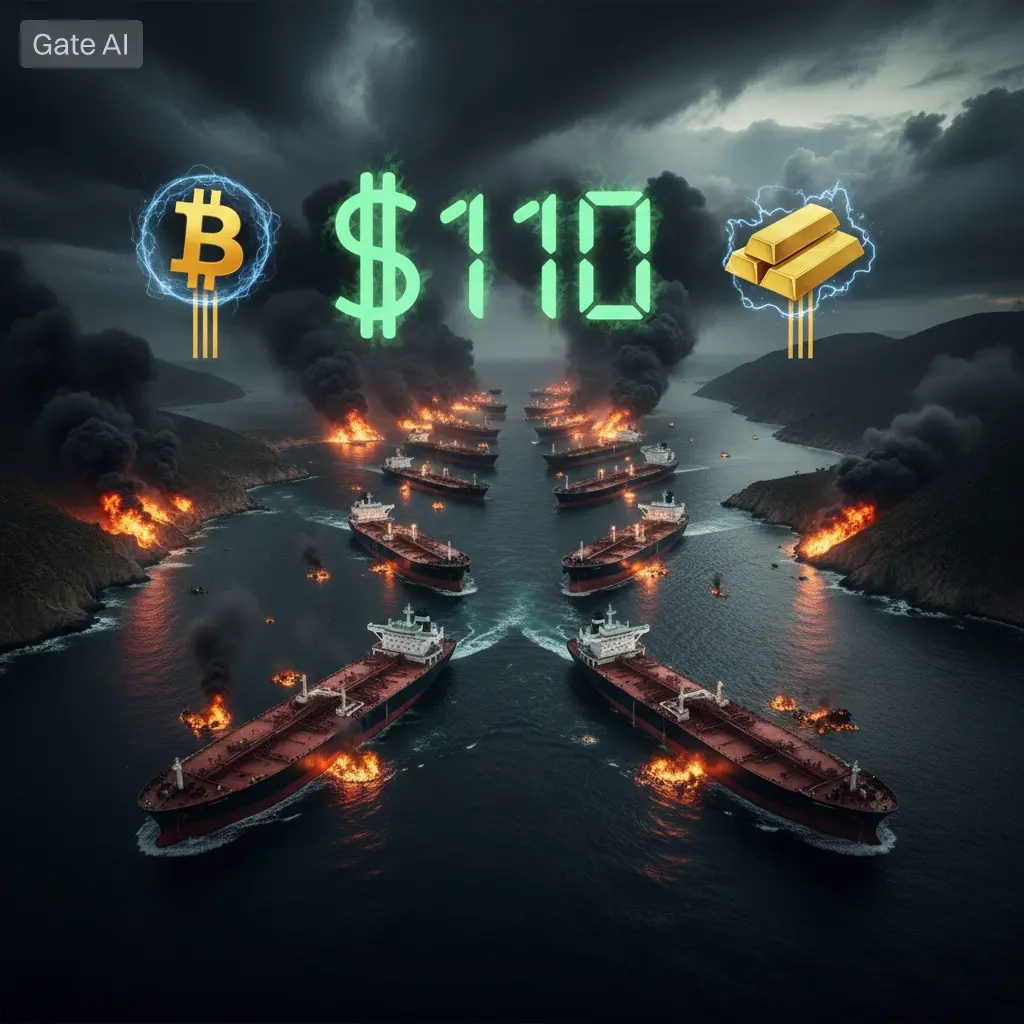
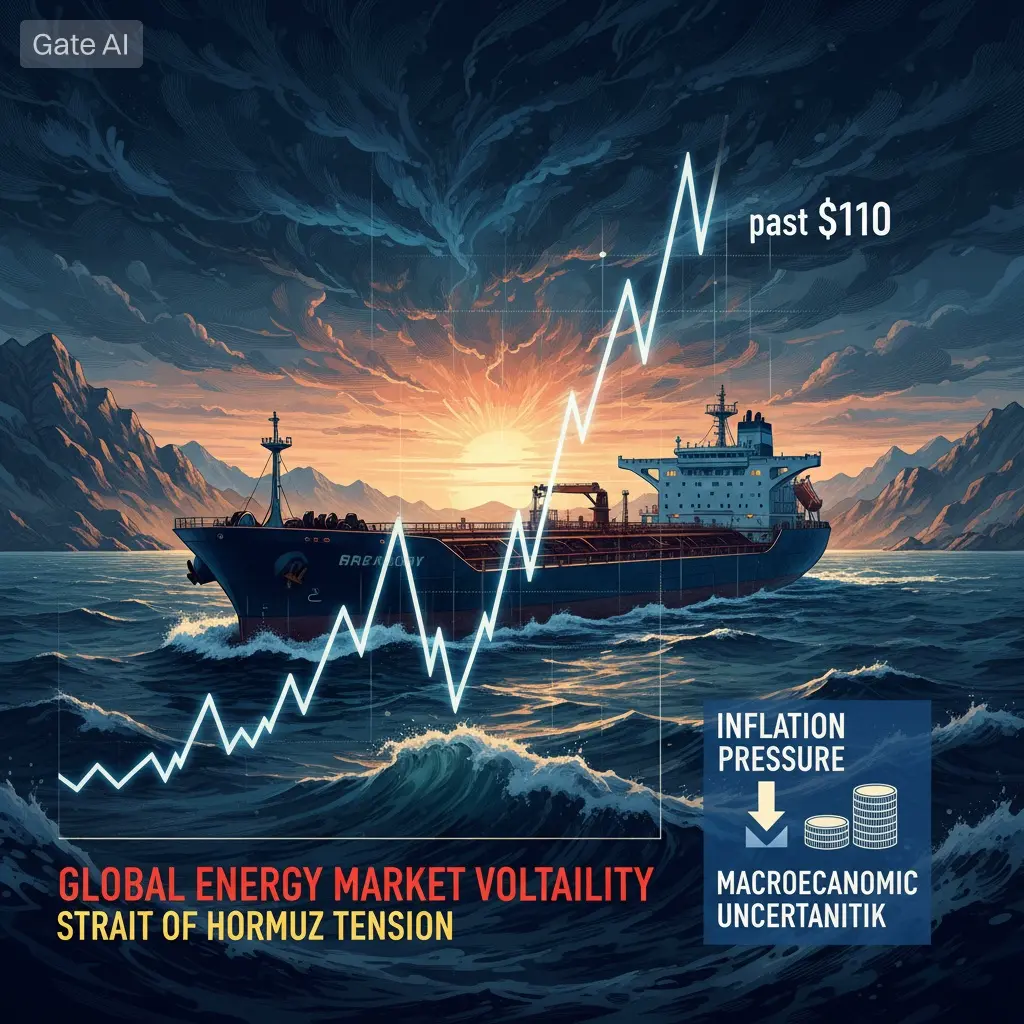
Brent crude briefly surged past 141 a m i d t h e S t r a i t o f H o r m u z b l o c k a d e , n o w t r a d i n g n e a r 141amidtheStraitofHormuzblockade,nowtradingnear111.86. The spike fuels inflation expectations, sharply reducing market bets on Fed rate cuts. Risk assets face pressure from tightening macro liquidity.

#OilBreaks110
Oil crossing $110 is not just another market move — it represents a significant global macro shock that is reshaping inflation expectations, liquidity conditions, and risk sentiment across all major asset classes, including crypto.
What is unfolding now is a supply-driven energy disruption layered on top of already fragile global economic conditions. Brent crude moving above $118 and WTI breaking past $106 signals a clear message: energy markets are once again a dominant force in global macro trading.
The primary trigger is escalating geopolitical tension around the Strait of Ho
BTC0.07%
post-image
  • Reward
  • Comment
  • Repost
  • Share
#OilBreaks110 📢 Gate Square Daily | April 30
1️⃣ Market Update: BTC trades at $75,785, down 0.6% in 24 hours; DOGE bucks the trend with a 5.7% gain; Brent crude hits $116.85/barrel.
2️⃣ Macro Outlook: The Fed holds rates steady at 3.5%–3.75% for the third consecutive time this year, in line with market expectations.
3️⃣ Industry News: Meta partners with Stripe to launch stablecoin payments for creators, supporting USDC on Solana and Polygon — rolling out first in Colombia and the Philippines.
4️⃣ Product News: Hyperliquid unveils zero-fee "Outcome Tokens," accelerating its mainnet launch and
BTC0.07%
DOGE3.08%
SOL-0.2%
CryptoSelf
📢 Gate Square Daily | April 30
1️⃣ Market Update: BTC trades at $75,785, down 0.6% in 24 hours; DOGE bucks the trend with a 5.7% gain; Brent crude hits $116.85/barrel.
2️⃣ Macro Outlook: The Fed holds rates steady at 3.5%–3.75% for the third consecutive time this year, in line with market expectations.
3️⃣ Industry News: Meta partners with Stripe to launch stablecoin payments for creators, supporting USDC on Solana and Polygon — rolling out first in Colombia and the Philippines.
4️⃣ Product News: Hyperliquid unveils zero-fee "Outcome Tokens," accelerating its mainnet launch and taking direct aim at prediction market leaders Polymarket and Kalshi.
5️⃣ AI News: Anthropic is reportedly exploring a new funding round at a valuation exceeding $900 billion.
  • Reward
  • 2
  • Repost
  • Share
MasterChuTheOldDemonMasterChu:
Just charge forward 👊
View More
#OilBreaks110 🔥 Full Macro Shock Breakdown (April 30, 2026)
Crude oil has officially broken above the $110 level, and this is not just another price move —
👉 this is a macro signal with global consequences across inflation, equities, and crypto markets.
---
📊 Current Market Snapshot
Brent Crude Oil: ~$110–$117 range
WTI Crude Oil: approaching $100
Weekly trend: Strong bullish continuation
Market structure: Breakout + momentum expansion
👉 This confirms a high-risk, supply-driven rally
---
🌍 1. Why Oil Breaking $110 Is a Big Deal
The $110 level is not just technical — it’s psychological + m
BTC0.07%
post-image
  • Reward
  • 14
  • Repost
  • Share
MrFlower_XingChen:
To The Moon 🌕
View More
#OilBreaks110
🛢️ Oil just crossed $110 — and the world is NOT ready for what comes next.
This is not a drill. Global energy markets are in full crisis mode right now, and every crypto trader needs to understand exactly why this matters for YOUR portfolio.
Here's the brutal timeline:
Brent crude surged over 6% to close at $118 per barrel after President Trump announced he would maintain the US naval blockade against Iran until they agreed to a nuclear deal. WTI also jumped nearly 7% to settle above $106. CNBC
Then it got worse.
Brent briefly touched $126 per barrel — the highest intraday leve
BTC0.07%
post-image
  • Reward
  • 10
  • Repost
  • Share
discovery:
LFG 🔥
View More
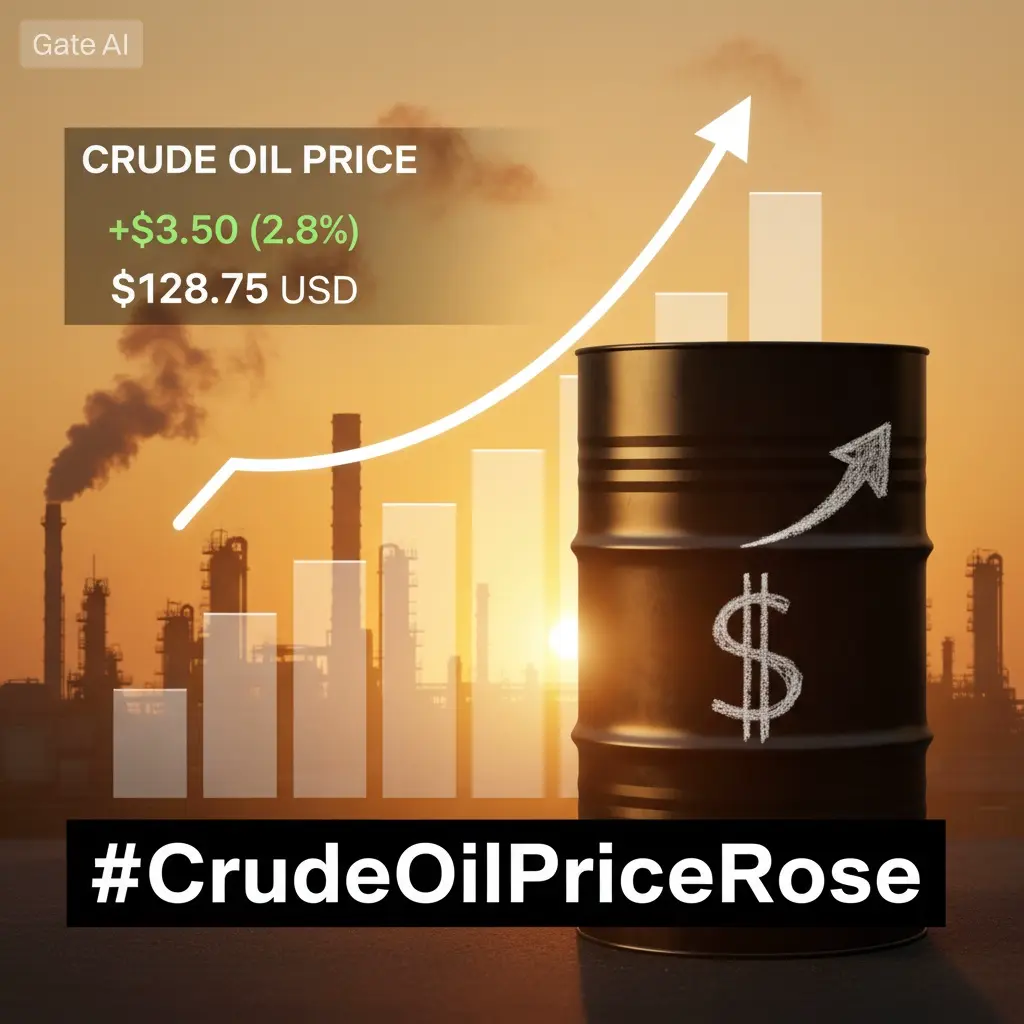
#CrudeOilPriceRose 🌍🔥
Gate Plaza 3/12 | Deep Market Intelligence Report
#原油价格上涨
Global markets have entered a phase where surface-level headlines are no longer enough to understand what’s really happening. What we are witnessing right now is not just a reaction to isolated events—it’s a structural transformation driven by the intersection of geopolitics, energy disruption, and liquidity rotation. Oil, gold, and crypto are no longer behaving as separate entities; they are now part of a deeply interconnected macro system.
At first glance, rising oil prices may appear to be a simple consequence
BTC0.07%
SoominStar
#CrudeOilPriceRose 🌍🔥
Gate Plaza 3/12 | Deep Market Intelligence Report
#原油价格上涨
Global markets have entered a phase where surface-level headlines are no longer enough to understand what’s really happening. What we are witnessing right now is not just a reaction to isolated events—it’s a structural transformation driven by the intersection of geopolitics, energy disruption, and liquidity rotation. Oil, gold, and crypto are no longer behaving as separate entities; they are now part of a deeply interconnected macro system.
At first glance, rising oil prices may appear to be a simple consequence of Middle East tensions. But beneath the surface, the reality is far more complex. This is a multi-layered environment where different stress factors are interacting simultaneously, creating a market that is both volatile and difficult to interpret using traditional frameworks.
🌐 Geopolitical Landscape: A New Type of Risk System
The current Middle East situation has evolved beyond a single-point crisis. It has become a multi-layered risk structure where several components of the oil supply chain are under pressure at the same time. Export terminals, shipping routes, tanker movements, and key maritime corridors are all facing varying degrees of instability.
What makes this situation unique is that a complete shutdown of supply is not required to trigger price increases. Even partial disruptions or uncertainty around logistics are enough to force a repricing of risk. Insurance costs rise, shipping slows down, and buyers begin to hedge aggressively—all of which contribute to higher prices.
In essence, the market is pricing uncertainty, not just actual supply loss. This creates a scenario where perceived risk becomes as influential as physical disruption.
🤝 Diplomatic Misalignment: Iran vs United States
Diplomatic communication between Iran and the United States is ongoing, but the structure of negotiation remains fundamentally misaligned. The issue is not the absence of dialogue, but rather the sequence and conditions attached to it.
Iran is advocating for a phased de-escalation approach. Their priority is to normalize maritime access and restore shipping stability before moving into broader political negotiations. This allows them to ease economic pressure while maintaining strategic leverage.
On the other hand, the United States is focused on immediate compliance without preconditions. Their approach emphasizes enforcement first, followed by negotiation later.
This difference in strategy creates a persistent deadlock. While discussions may continue, meaningful resolution remains delayed—and that delay sustains uncertainty in global markets, particularly in energy pricing.
🛢️ Oil Market Mechanics: The Three-Force Model
To understand current oil price behavior, it’s essential to recognize the three major forces shaping the market.
The first is the geopolitical risk premium. This is the primary driver pushing prices higher, as instability in supply routes and regional tensions increase perceived risk.
The second is strategic reserve intervention. Governments release stored oil to counter inflation and stabilize markets. This acts as a short-term balancing force, preventing prices from rising too aggressively.
The third is demand uncertainty. As oil prices rise, industrial consumption tends to slow, and global growth expectations weaken. This creates downward pressure on long-term demand.
The interaction of these forces results in a non-linear price structure. Instead of smooth trends, the market experiences sharp upward and downward movements, often within short timeframes.
🧠 Market Psychology: The Illusion of Trends
One of the biggest challenges in this environment is the misinterpretation of price action. Many traders are reacting to headlines rather than understanding the underlying structure.
Short-term spikes are often mistaken for sustained breakouts, while sharp pullbacks are misread as trend reversals. In reality, these movements are often just liquidity adjustments within a broader range.
This creates a false signal environment where both bullish and bearish narratives appear valid in the short term but fail to hold over time. The result is confusion and overtrading, particularly among less experienced participants.
₿ Crypto Market Evolution: A Structural Shift
The cryptocurrency market is undergoing a significant transformation in response to these macro conditions. Bitcoin, in particular, is no longer behaving purely as a speculative asset.
Instead, it is increasingly acting as a macro-sensitive instrument, responding to global liquidity conditions and institutional positioning. This marks a critical shift in its role within the financial ecosystem.
Capital flows are now distributed across three key hedging categories. Oil captures immediate geopolitical risk. Gold represents traditional safe-haven demand. Bitcoin, meanwhile, reflects an emerging form of liquidity-based hedging driven by institutional interest.
This transition suggests that Bitcoin is gradually moving toward classification as a macro asset rather than a purely speculative one.
📊 Bitcoin Structure: Compression Before Expansion
Bitcoin is currently trading within a compressed range, characterized by strong support at lower levels and resistance near key psychological thresholds.
This type of structure is often a precursor to significant price movement. The market is essentially building energy, waiting for a catalyst to trigger expansion.
A breakout above resistance could lead to rapid liquidity inflow and short covering, accelerating the move upward. However, short-term conditions also indicate overextension, suggesting that consolidation may occur before any major breakout.
Patience remains essential in this phase, as premature positioning can lead to unnecessary losses.
🏦 Institutional Influence: A Stabilizing Force
Institutional behavior is playing a crucial role in shaping the current market environment. Unlike previous cycles, where panic selling dominated during uncertainty, institutions are now taking a more measured approach.
ETF inflows and long-term accumulation strategies are providing a stabilizing effect. Instead of exiting positions during market stress, institutional investors are gradually increasing exposure during periods of weakness.
This shift reduces downside volatility and introduces a level of structural support that was largely absent in earlier market cycles.
🔮 Forward Scenarios: Mapping the Future
Looking ahead, three primary scenarios could define near-term market direction.
The first is controlled de-escalation. If diplomatic progress is made, oil markets may stabilize, and crypto could continue its gradual upward trajectory supported by improving liquidity conditions.
The second is escalation shock. Increased geopolitical tension could drive oil prices sharply higher, triggering a temporary risk-off reaction in crypto markets, followed by a recovery phase.
The third, and currently the most likely scenario, is a prolonged stalemate. In this case, neither resolution nor escalation dominates, resulting in sustained volatility and range-bound trading across multiple asset classes.
📌 Final Perspective: A Multi-System Market
The global financial system is no longer driven by single narratives. It has evolved into a complex, multi-layered structure where different asset classes reflect different aspects of macro reality.
Oil represents physical supply risk and geopolitical tension.
Gold reflects historical trust and safe-haven demand.
Bitcoin embodies evolving liquidity dynamics and institutional participation.
The key takeaway is clear: success in this environment requires more than reacting to news. It demands an understanding of how multiple systems interact and how liquidity flows between them.
This is not an easy market—but for those who can read the structure beneath the noise, it offers some of the most powerful opportunities we’ve seen in years. 🚀
repost-content-media
  • Reward
  • 3
  • Repost
  • Share
Crypto_Buzz_with_Alex:
2026 GOGOGO 👊
View More
#OilBreaks110
Oil breaking above the 110 level is not just another headline move in commodities—it is a signal that pressure may be building across the entire global financial system. Crude oil remains one of the most influential assets in the modern economy because it affects transportation, manufacturing, logistics, electricity costs in many regions, industrial production, and ultimately the price consumers pay for everyday goods. When oil rises sharply and pushes through a major psychological level like 110, markets around the world immediately take notice. Traders watch it, governments wo
post-image
  • Reward
  • 2
  • Repost
  • Share
discovery:
To The Moon 🌕
View More
#OilBreaks110 Oil Shock Triggered by Hormuz Disruption — Global Markets Enter Fragile Phase
The recent surge in Brent crude above $141 was not just a price move — it was a macro shock event triggered by escalating tensions and temporary disruption around the Strait of Hormuz, one of the most critical oil transit chokepoints globally. Although prices have slightly retraced toward the $111–$112 zone, the structural implications remain deeply embedded across global financial markets.
1. Supply Shock: Why This Move Matters
The Strait of Hormuz handles nearly 20% of global oil shipments, making it
post-image
  • Reward
  • 11
  • Repost
  • Share
tanwarisb:
2026 GOGOGO 👊
View More
#原油价格上涨 #原油价格上涨 – Crude Oil Surges to Multi-Month Highs: 5 Critical Drivers, Global Fallout, and What Comes Next
By [sheen crypto]
Global crude oil prices have broken through key resistance levels, pushing (crude oil price rise) to the top of financial conversations worldwide. This is not a fleeting spike — data suggests structural tightness.
Brent crude now trades at $91.40 per barrel**, up 18% since January. West Texas Intermediate (WTI) follows closely at **$87.90. The last time prices sustained these levels, the world faced an energy crisis. Today, the drivers are different — and in some w
post-image
post-image
  • Reward
  • 11
  • Repost
  • Share
Crypto_Buzz_with_Alex:
2026 GOGOGO 👊
View More
#OilBreaks110
🚨 Oil Market Shock — Geopolitical Spike and Macro Liquidity Repricing🚨
The recent move in oil markets, where Brent crude briefly surged above the 140 level during disruption concerns around the Strait of Hormuz before stabilizing near the 110–112 range, reflects a classic geopolitical liquidity shock rather than a purely demand-driven price expansion. These types of rapid spikes are typically driven by perceived supply risk premiums rather than immediate physical supply destruction, and they tend to create cascading effects across global macro expectations even when the under
post-image
  • Reward
  • 9
  • Repost
  • Share
SoominStar:
LFG 🔥
View More
#OilBreaks110 🚨 #OilBreaks110 — Energy Markets Enter High-Volatility Zone
Crude oil has surged above the $110 per barrel level, marking a key psychological and macroeconomic shift in global energy markets.
Market Impact:
Inflation concerns are strengthening as energy costs rise globally
Central banks may face renewed pressure on interest rate decisions
Equity and crypto markets could see short-term volatility
Import-dependent economies may experience currency and fiscal stress
What Traders Are Watching:
OPEC+ supply policy and potential production adjustments
Global demand recovery vs. slo
post-image
  • Reward
  • 2
  • Repost
  • Share
BeautifulDay:
To The Moon 🌕
View More
Load More