Polkadot (DOT) is a Layer 0 blockchain network focused on cross-chain interoperability. By connecting multiple parachains via the Relay Chain, it enables seamless data and asset transfers across different blockchains. The DOT token is mainly used for network staking, governance voting, and parachain slot auctions. Compared to traditional single-chain architectures, Polkadot delivers greater scalability and a shared security model, though it also faces challenges such as ecosystem competition and higher development complexity.
2026-04-17 01:53:20
Polkadot Parachains are independent blockchains linked to the Relay Chain. Leveraging a shared security mechanism, they process trades in parallel and facilitate cross-chain communication across the Polkadot network. Unlike traditional single-chain blockchains, Parachains deliver superior scalability, reduced security infrastructure costs, and stronger interoperability. As the cornerstone of Polkadot’s multi-chain architecture, Parachains provide the essential foundation for cross-chain expansion.
2026-04-17 01:51:35
Substrate, developed by Parity Technologies, is a modular blockchain framework that enables developers to quickly build custom blockchains and seamlessly integrate with the Polkadot (DOT) network as parachains. Unlike conventional Smart Contract development models, Substrate delivers superior flexibility, robust scalability, and deep chain-level customization. This makes it the central development framework within the Polkadot ecosystem and a key foundation for the efficient scaling of its multi-chain architecture.
2026-04-17 01:50:27
SkyAI (SKYAI) is a protocol dedicated to merging AI with Web3 data infrastructure. By expanding the MCP (Model Context Protocol), aggregating multi-chain data, and enhancing data liquidity mechanisms, it delivers efficient on-chain data services for AI Agents and decentralized applications. Its primary goal is to convert fragmented on-chain data into accessible and tradable resources, enabling AI models to more effectively interpret and leverage blockchain data. With the rapid growth of AI Agents and on-chain automated applications, SkyAI is emerging as a leading force in the AI + Web3 data infrastructure landscape.
2026-04-17 01:32:37
SkyAI delivers high-performance on-chain data services to AI Agents by leveraging the MCP protocol, aggregating multi-chain data, and utilizing the Data Liquidity mechanism. This article provides a comprehensive analysis of SkyAI's technical architecture and its pivotal role within the AI + Web3 data infrastructure.
2026-04-17 01:31:39
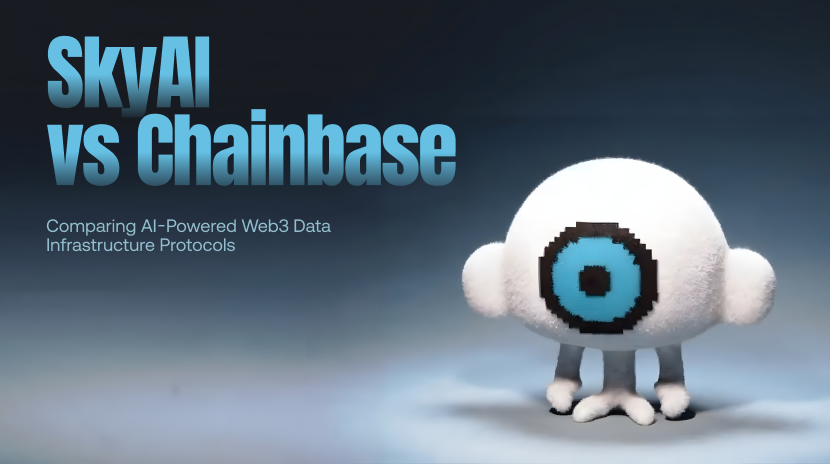
SkyAI and Chainbase are both AI-driven Web3 data infrastructure protocols, but each has a distinct core focus. Chainbase is dedicated to building multi-chain data indexing and standardized data service layers. In contrast, SkyAI introduces the MCP protocol and Data Liquidity mechanism, concentrating on delivering callable and liquid on-chain data resources for AI Agents. In summary, Chainbase addresses the challenge of data accessibility, while SkyAI targets data interactivity and circulation. As AI Agents and Web3 automation applications continue to advance, these two protocols represent divergent development paths within the AI data infrastructure space.
2026-04-17 01:30:55
ST is the core utility token of the Sentio ecosystem, acting as the primary medium for value transfer among developers, data infrastructure, and network participants. As a key component of Sentio’s real-time on-chain data network, ST is used for resource utilization, network incentives, and ecosystem collaboration, supporting the platform in building a sustainable data service model. By implementing the ST token mechanism, Sentio combines network resource usage with ecosystem incentives, allowing developers to access real-time data services more efficiently and strengthening the long-term sustainability of the entire data network.
2026-04-16 16:34:43
Sentio (ST) is a real-time on-chain data infrastructure tailored for the Web3 ecosystem, designed to provide developers and protocols with instant data indexing, visualization analytics, and auto alert services. Unlike traditional on-chain data platforms, Sentio prioritizes real-time data and advanced monitoring capabilities, enabling DeFi protocols, development teams, and on-chain analytics scenarios to rapidly capture on-chain events and generate actionable data insights. Through the integration of real-time indexing, dashboard visualization, and automated alert mechanisms, Sentio offers a more efficient data infrastructure for Web3 applications, playing a critical role in on-chain protocol monitoring, risk alerts, and operational analytics.
2026-04-16 08:22:25
Sentio's real-time data indexing system continuously monitors on-chain events, parsing, processing, and outputting data the moment it is generated to deliver low-latency data monitoring. The real-time data processing workflow consists of four main stages: event monitoring, data parsing, structured processing, and real-time output, providing support for DeFi protocol monitoring, security alerts, and on-chain operations analysis. Unlike traditional on-chain data platforms, Sentio is built around real-time, event-driven processing, allowing raw blockchain logs to be instantly transformed into visual metrics and auto alerts.
2026-04-16 08:20:44
Sentio and The Graph are both platforms for on-chain data indexing, but they differ markedly in their core design goals. The Graph utilizes subgraphs to index on-chain data, focusing mainly on data querying and aggregation needs. Sentio, on the other hand, employs a real-time indexing mechanism that prioritizes low-latency data processing, visualization monitoring, and auto alert features—making it especially well-suited for real-time monitoring and risk warning use cases.
2026-04-16 08:19:35
GENIUS centers its tokenomics around trading activity, using phased airdrops, Season 1 to 3, a points system, and trading rewards to drive user participation across its multi chain trading ecosystem. Its airdrop design gives users two options, claim immediately with a burn penalty, or lock tokens for later release, forcing a choice between short term liquidity and long term holding, and creating an incentive game in the process. On the value capture side, GENIUS ties token distribution directly to trading behavior, using fees, activity levels, and user engagement to build a growth loop.
2026-04-16 06:19:19
Genius’s multi-chain trading mechanism uses a routing engine and liquidity aggregation system to turn a user’s trade request into the most efficient execution path, then completes the asset swap across one or more blockchains. Users only need to initiate a trade through a unified interface, while the system automatically scans liquidity sources across different chains and evaluates factors such as price, slippage, and fees to choose the best route. During execution, same chain trades are usually completed by calling decentralized trading protocols, while cross chain trades rely on bridges or other cross chain infrastructure to transfer and exchange assets across different networks. Although the entire process is seamless from the user’s perspective, it involves several backend steps, including path splitting, trade execution, and final settlement.
2026-04-16 05:51:31
Genius (GENIUS) is a multi-chain trading terminal designed to provide users with a unified onchain trading gateway by aggregating liquidity and trading routes across multiple blockchain networks. As the DeFi ecosystem continues expanding across chains, the complexity of trading and managing assets across different networks has steadily increased. Through route optimization and cross-chain execution mechanisms, Genius lowers operational barriers and improves trading efficiency. Functionally, Genius is not a single decentralized exchange, or DEX, but infrastructure positioned at the trading entry layer. By integrating DEXs, liquidity pools, and cross-chain components, it creates a unified trading interface and execution logic. This design makes it an important bridge connecting the multi-chain DeFi ecosystem.
2026-04-16 05:39:15
The role of idOS in stablecoin ecosystems lies in providing a reusable on-chain identity infrastructure that allows users to share verified identity data across different financial applications. Through encrypted storage and permissioned access, idOS enables stablecoin platforms to verify user identities without requiring repeated KYC processes, reducing compliance costs while improving user experience. By introducing an identity layer, stablecoins can meet regulatory requirements without compromising privacy, serving as a crucial bridge between on-chain finance and the real world.
2026-04-16 02:19:09
The core mechanism of idOS revolves around “encrypted storage plus access authorization (Access Grant).” User identity data is first verified by an issuer and then encrypted and stored within the idOS network. Applications, known as consumers, can only access this data after receiving user authorization. Through this process, idOS enables reusable identity data, protects privacy, and allows secure data portability across applications, making it possible to use sensitive information like KYC across platforms without repeated submissions.
2026-04-16 01:58:36