


Highlights
①. Gate's "Basic Futures Courses" course introduces various methods of technical analysis that are commonly employed in futures trading. These courses aim to help traders establish a comprehensive framework for technical analysis. Covered topics include the basics of Candlestick charts, technical patterns, moving averages, trend lines, and the application of technical indicators.
②. This session will introduce the application of dual moving averages in actual trading scenarios.
1. What is dual moving average?
The dual moving average analysis involves using a shorter-term moving average and a longer-term moving average. The longer-term moving average is primarily used to determine the general market trend, while the shorter-term moving average is utilized for identifying entry and exit points. This identification is based on its position relative to the coin price and the longer-term moving average.
Put simply, the longer-term moving average acts as a trend line, often referred to as the qualitative line, while the shorter-term moving average, known as the quantitative line, is used for pinpointing trading opportunities. The combined use of these two lines offers significant guidance for traders in swing trading and position management. This approach also enables them to monitor both short-to-medium and long-term trends, thereby reducing the likelihood of engaging in counter-trend operations.
2. Classification of Dual Moving Averages
Dual moving average combinations can be classified into three types: short-term, medium-term and long-term, which respectively correspond to Dow Theory's discussion of short-term trends, medium-term trends and long-term trends.
①. Short-term combination: Common combinations include the 5-day and 30-day MA.
②. Medium-term combination: Common combinations include the 5-day and 60-day MA.
③. Long-term combination: Common combinations include the 30-day and 120-day MA.
3. Technical Meanings
-
Signal to buy and hold positions
①. When the coin price breaks above the qualitative line, and the qualitative line is trending upwards, it is time to buy.
②. When the quantitative line crosses above the qualitative line, forming a 'golden cross', it is time to buy.
③. When the coin price falls and faces support on the qualitative line, where it stops the decline and rebounds, it is time to buy.
④. The qualitative line is trending upwards, and the coin price is running above the qualitative line. When the coin price breaks above the quantitative line, it is time to buy.
⑤. When the quantitative line is trending downwards, and faces support on the qualitative line, where it stops declining, and then reverts to trends upwards, it is time to buy.
⑥. The coin price, quantitative line, and qualitative line are aligned in a bullish formation. -
Signal to sell and close positions
①. When the coin price falls below the qualitative line, and the qualitative line is either going flat or has already turned downwards, it is time to sell.
②. When the lines are in a bullish alignment, if the coin price falls below the quantitative line, reduce positions.
③. If the coin price rises rapidly and moves far away from the qualitative line, reduce positions.
④. When the qualitative line is trending downwards, close positions to exit.
4. Application
The following is an example of the use of a medium-term moving average combination of MA5 and MA60 in trading.
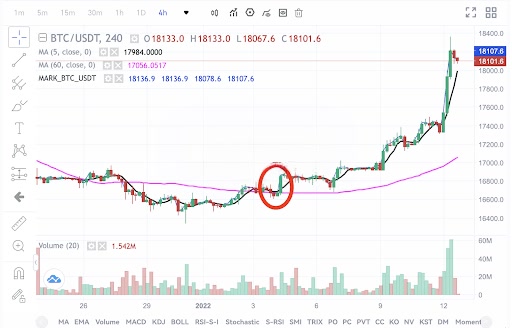
①. When the coin price breaks above the qualitative line and the qualitative line is trending upwards, it acts as a signal to buy assets. As shown below:
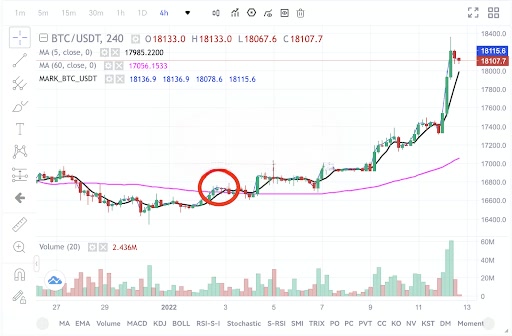
②.When the quantitative line (shorter-term moving average) crosses above the qualitative line (longer-term moving average), forming a 'golden cross', it signals an opportune time to buy assets, as illustrated in the following example:
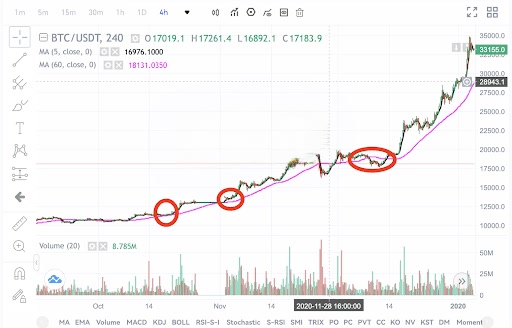
③.When the coin price falls and finds support at the qualitative line (longer-term moving average), where it halts its decline and rebounds, this suggests a buy signal. This scenario is demonstrated in the example below:
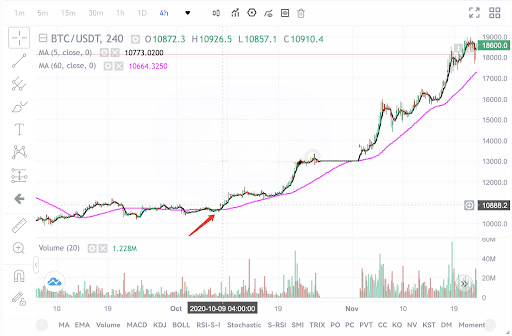
④. The coin price, quantitative line, and qualitative line are arranged in a bullish formation. As shown below:
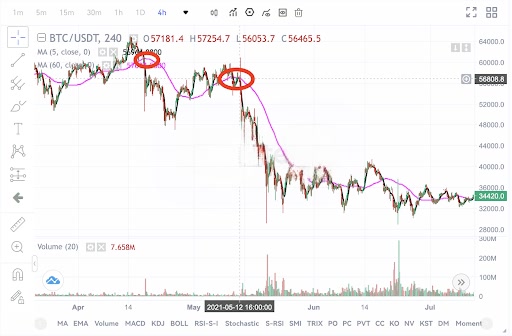
⑤.When the coin price falls below the qualitative line (longer-term moving average), and this qualitative line is either flat or has already begun to trend downwards, it signals an opportune moment to sell assets. This scenario is illustrated in the example below:
5.Important factors
①. Short-term MA (Moving Average) combinations have limited practical significance during sideways consolidations, as they often generate too frequent buy and sell signals, many of which are false.
②. For cryptocurrency market analysis, medium-term MA combinations are more suitable, with the MA5 and MA60 combinations being particularly effective for crypto traders.
③. The 60-day moving average, functioning as a medium-to-long term qualitative trend line, is mainly used to confirm the general market trend. For instance, an upward trending 60-day moving average usually indicates a bullish market, suggesting that traders might consider increasing their positions to capitalize on the rise.
④. Long-term MA combinations tend to exhibit significant lag in reflecting market changes, rendering them of limited practical value in real trading scenarios.
6. Summary
The dual moving average strategy is characterized by its simplicity, reliability, and ease of operation, making it an effective tool for futures trading beginners to enhance their profitability. For beginners, the most recommended moving average combinations are MA5 and MA60. These combinations do not require the complex analysis associated with candlestick patterns but can still significantly outperform trading decisions made solely based on intuition.
Start trading futures by registering on Gate Futures.

Disclaimer
This article is for informational purposes only and does not constitute investment advice. Gate is not responsible for any investment decisions you make. Content related to technical analysis, market assessments, trading skills, and traders' insights should not be considered a basis for investment. Investing carries potential risks and uncertainties. This article offers no guarantees or assurances of returns on any type of investment.
Disclaimer
The content provided herein is for reference and educational purposes only and does not constitute any financial, investment, trading, or legal advice, nor does it constitute an offer or solicitation to buy or sell any digital assets. Gate makes no express or implied representations or warranties regarding the accuracy, completeness, or timeliness of the information contained herein. Product features, interfaces, rules, and fee structures may be updated or adjusted at any time. Please refer to the latest announcements and the actual information displayed on the Gate platform for the most accurate details.
Digital asset investments involve significant risk, and prices may fluctuate substantially. You may lose the entire amount of your investment. Please make decisions cautiously based on your own financial situation and risk tolerance after fully understanding the associated risks. If necessary, you are advised to consult an independent professional financial or legal advisor.
For more information about potential risks, please refer to Gate's Risk Disclosure and User Agreement.
