InvestingWithBrandon

vip
Age 1.4 Yıl
Peak Tier 0
No content yet
Nobody talks about the 9-5 trap honestly.
Here it is.
Your boss pays you just enough so you do not quit.
You work just enough so you do not get fired.
That is the whole relationship in one sentence.
There is a ceiling on every salary.
You cannot negotiate your way to $10M.
You cannot work hard enough to get there.
There are only 24 hours in a day.
With stocks & options there is no ceiling.
You want to make 10x more?
Add a zero behind the trade.
Same amount of time.
Same amount of work.
10x the position.
(of course do in reason and keep ratios in check. My point is it's no more work)
The goa
post-image
  • Reward
  • 1
  • Repost
  • Share
CryptoSpectovip:
To The Moon 🌕
Option Greeks tell you almost nothing useful.
Delta. Theta. Gamma. Vega. Rho.
Here is what delta actually factors in:
Historical volatility.
Time left in contract.
Interest rates.
Directionality.
Here is what delta does NOT factor in:
EPS growth rate.
Revenue trajectory.
Whether the company has a moat.
Whether the market is a bubble.
Whether competition is about to eat the company alive.
You are looking through a microscope at 4 things.
Missing the whole picture.
Warren Buffett probably does not even know what delta is.
He just buys good companies at good prices and is patient.
Delta tells you
post-image
  • Reward
  • Comment
  • Repost
  • Share
I tracked 5 options strategies over 10 years.
Here is how they ranked.
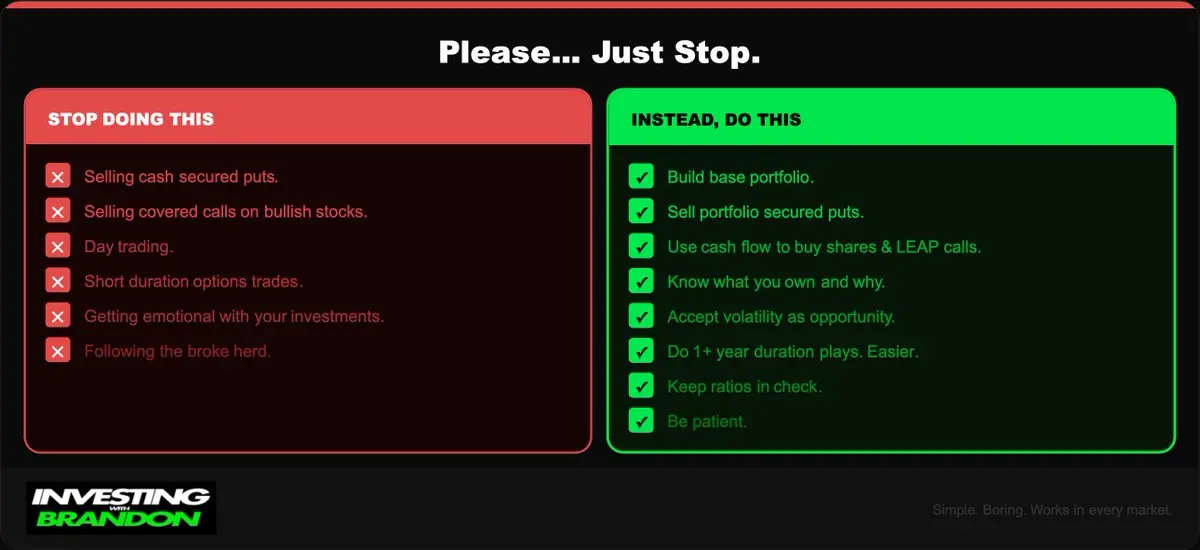
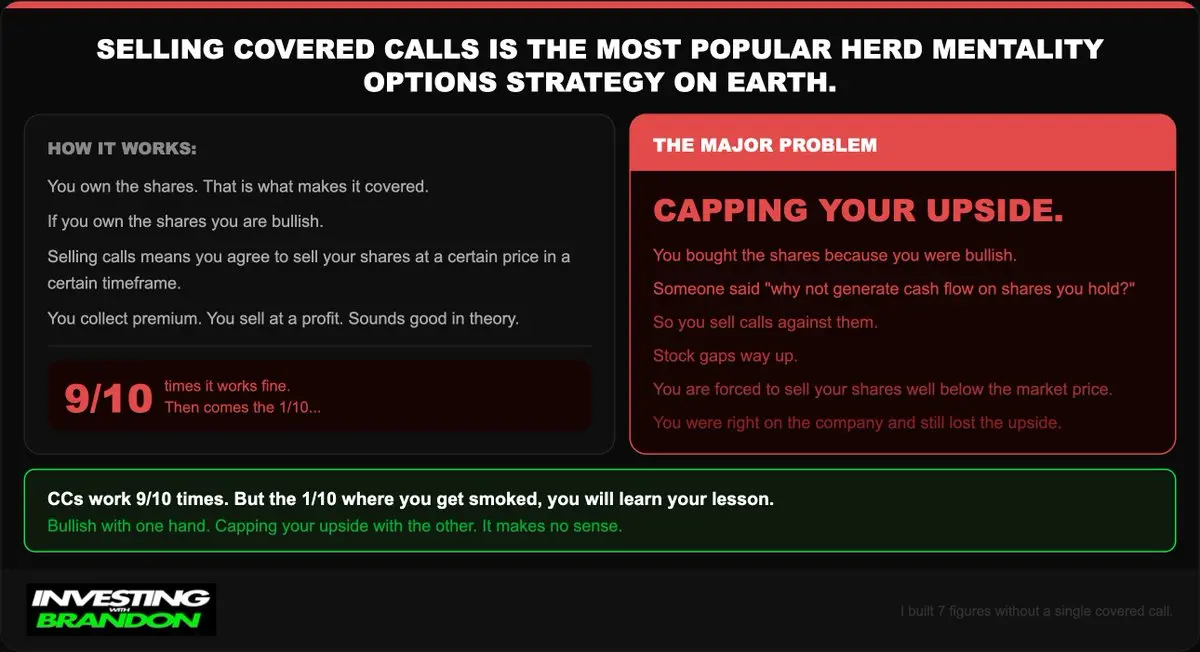
D tier — Covered calls.
Bullish with one hand. Bearish with the other.
You cap your upside on the exact companies you love most.
NVIDIA went up 10x. Covered call sellers missed most of it.
C tier — Cash secured puts.
Right idea. Wrong execution.
All that cash sitting there doing nothing while you are bullish.
B tier — Buying puts.
Hard to be consistently right on timing AND direction.
Theta eats you alive while you wait to be right.
A tier — Buying long duration calls.
Works well when cheap. Still requires timing.
S tier —
post-image
  • Reward
  • Comment
  • Repost
  • Share
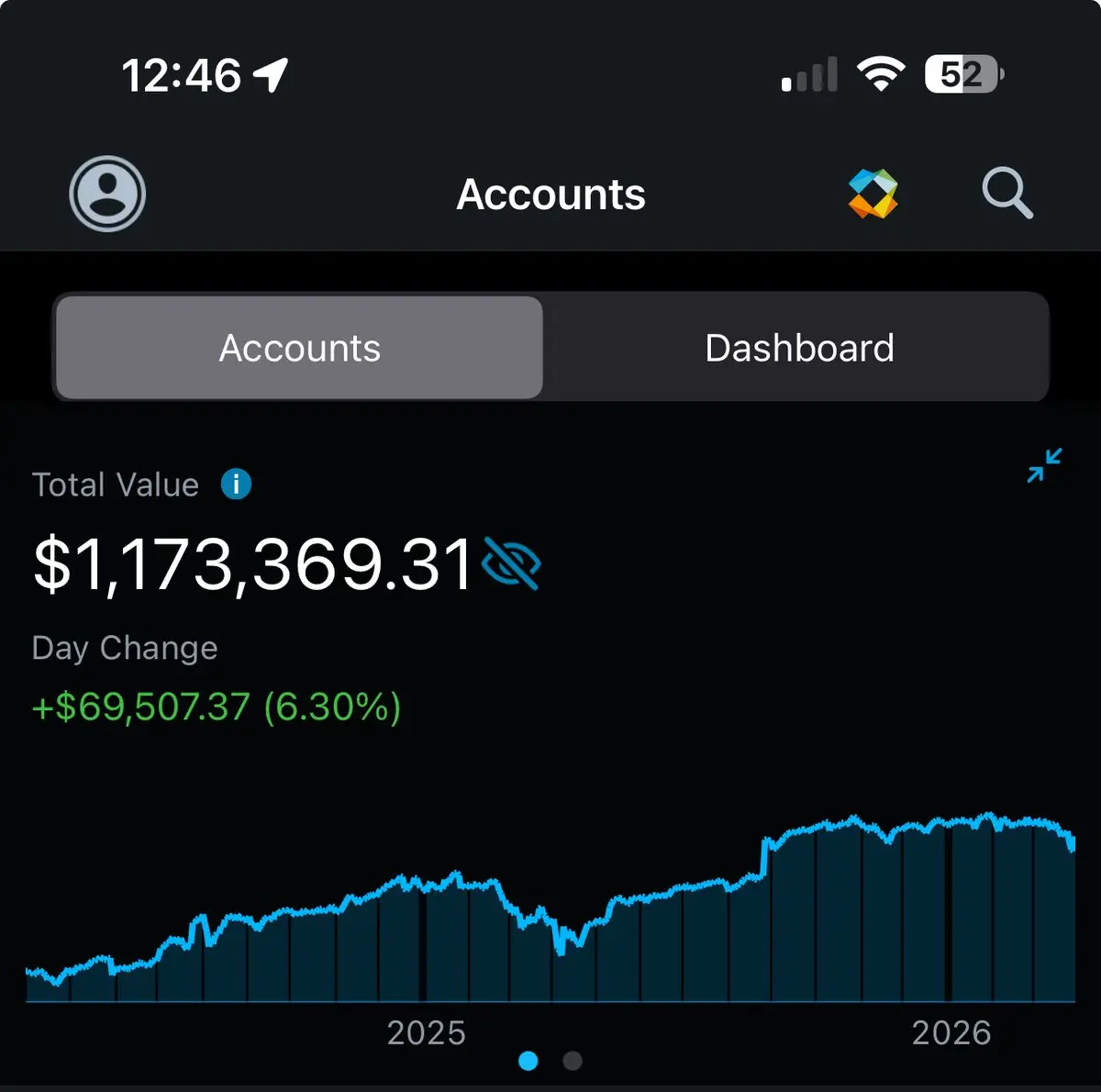
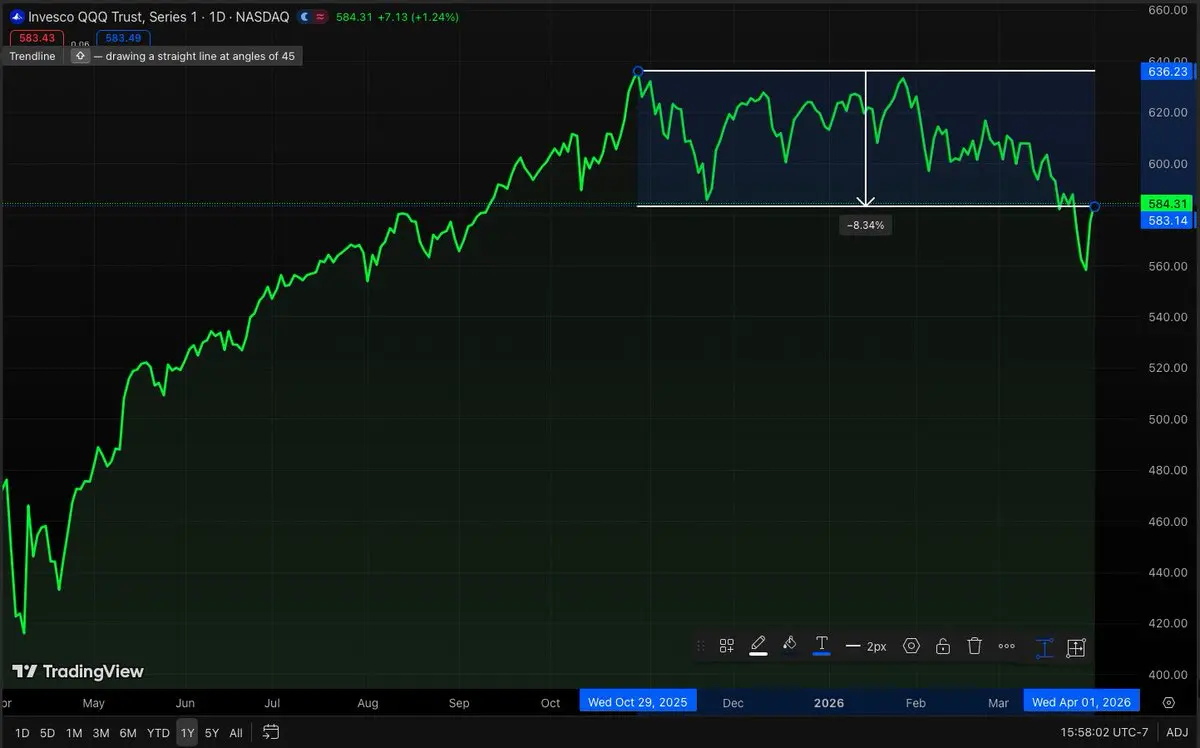
If a 7% dip from ATH when valuations were high to start is shocking you... You need to re assess your investment philosophies.
Take a mental note of all the X accounts posting crazy high beta stocks last year that are now down 75%+
I never forget.
Be an investor, not a speculator.
post-image
  • Reward
  • Comment
  • Repost
  • Share
Price is what you pay.
Value is what you get.
If I sold you a pen for $5,000 that just writes like a normal pen you would say no.
But people do this with stocks every day.
They see a great company.
They buy it no matter what the price is.
Then wonder why it drops 40% after they buy.
A great company at a terrible price is a bad investment.
A great company at a fair price is a good investment.
A great company at a cheap price is where real money is made.
That is why I check intrinsic value before every single trade.
Not because the company is bad.
Because even great things can be overpriced.
post-image
  • Reward
  • Comment
  • Repost
  • Share
Most retail investors doing monthly puts think they are beating me.
Here is the math that ends that argument.
Market gets cheap.
I sell one 2 year put.
Collect $20,000.
You sell monthly puts on the same company.
$1,000 per month average.
You make money in the up months.
You lose in the volatile months.
You have to sell at the top when it is not compelling.
After 8 months you made $8,000.
I made $20,000 in one trade when the market was cheap.
Took the premium.
Bought shares.
Bought calls.
Sat back.
4 months later the market rebounded.
I closed the 2 year puts at 75% profit.
I held them for
post-image
  • Reward
  • Comment
  • Repost
  • Share
94% win rate on my options trades over 10 years.
Here is exactly how.
When the market is expensive:
I de-risk.
Close sold puts.
Take profits on calls.
Maybe buy bonds.
Keep assignment value under 50%.
Let the herd chase calls at the top.
When the market is cheap:
I sell 2 year portfolio secured puts for top dollar.
Everyone is panicking and buying puts
I sell them those puts.
I take the premium and buy shares + calls.
Assignment value goes to 65%+
The herd buys puts for top dollar near bottoms.
I sell the puts for top dollar dear the bottoms.
(max premium received at compelling time)
The d
post-image
  • Reward
  • Comment
  • Repost
  • Share
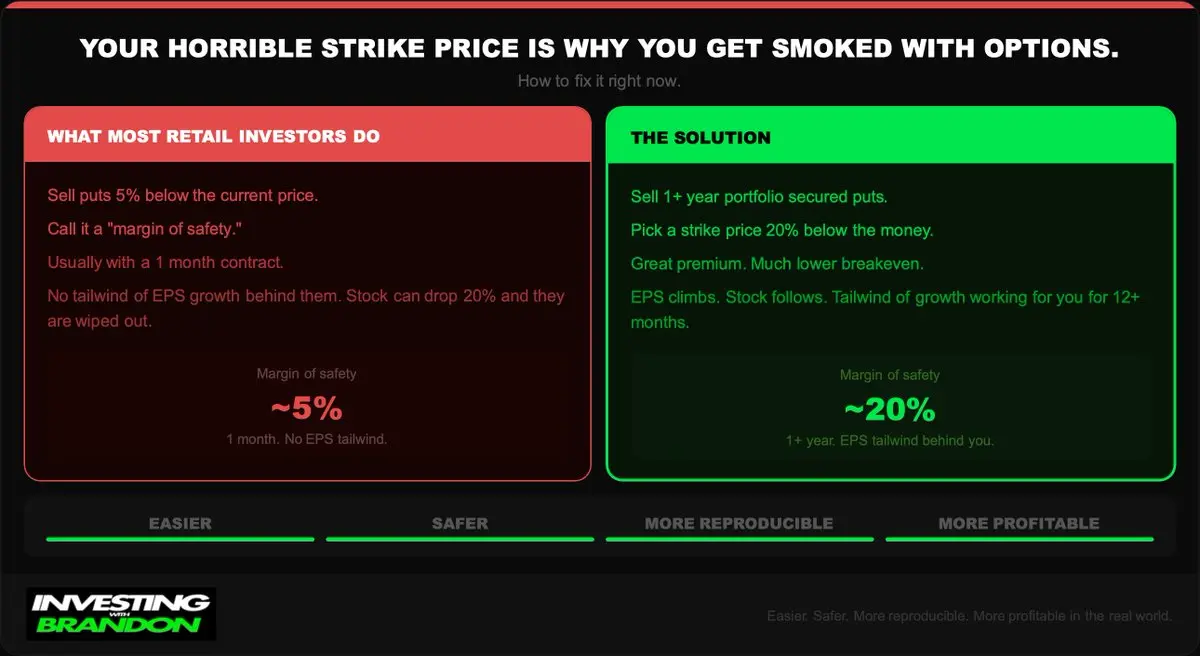
Retail investors pick strike prices completely wrong.
They open the options chain.
They look at delta.
0.32 delta.
32% chance it goes in the money.
"I'll take those odds."
Here is the HUGE problem...
Delta does not factor in:
EPS growth rate.
Revenue trajectory.
Whether the company has a moat.
Whether the market is a bubble.
Whether the Fed is about to hike.
It factors in 4 things and calls it a "probability" but excludes so much of the true needle mover stuff...
Here is how I pick strike prices.
Market/stock is cheap.
Moat/pricing power/competitive advantage/good valuation.
I sell puts 10%
post-image
  • Reward
  • Comment
  • Repost
  • Share
Most investors love dividends.
I prefer share buybacks.
Here is why.
Company has $100 total earnings.
100 shares outstanding.
EPS = $1 per share.
Company buys back 10% of shares.
Now 90 shares outstanding.
Same $100 in earnings.
EPS = $1.11 per share.
That is a 10% boost in EPS without growing revenue by a single dollar.
EPS goes up.
Share price follows.
Always does in the long term.
& the best part?
You pay zero taxes on share price appreciation until you sell.
Dividends hit your tax bill every single quarter whether you spend them or not.
Apple buys back billions in stock every year.
Tha
post-image
  • Reward
  • Comment
  • Repost
  • Share
FOMO is how most people blow up their account.
Your friend tells you about a hot stock at $100.
Day 2: $105.
Day 3: $110.
Day 4: $115.
Day 5: You cannot take it anymore. You buy at $125.
The second you buy...it drops.
This happens to almost every new investor.
Here is the thing about how stocks actually move...
The more a stock stretches above the EPS growth line the more it wants to snap back down.
(reversion to the mean)
When everyone is chasing a stock higher there is no one left to buy.
When there is no one left to buy...it falls.
FOMO is not a strategy.
It is the market taking money fro
post-image
  • Reward
  • Comment
  • Repost
  • Share
Fundamental analysis vs technical analysis.
Technical:
Chart patterns.
Fibonacci.
Moving averages.
RSI.
Bollinger Bands.
Fundamental: revenue.
EPS.
Moat.
Pricing power.
Valuation.
I use fundamentals. Here is why.
Any chart at any given time can be made to look bullish or bearish.
That is not analysis. That is interpretation.
But if a company grows earnings 20% per year for 10 years, the stock follows.
Not because of a chart pattern.
Because profits drive share price. Always have. Always will.
When I look at a company I pretend I am buying the whole thing.
Would you buy an entire busin
post-image
  • Reward
  • Comment
  • Repost
  • Share
You are your environment.
If everyone around you thinks investing is too risky.
You will think investing is too risky.
If everyone around you has a net worth of $5M+.
You will start asking why you do not.
I grew up in a small city in Ohio.
Nobody around me was building wealth.
Nobody was investing.
Nobody was thinking bigger.
I moved to Vegas.
Changed my environment.
Changed my circle.
Started being around people who made me feel behind.
That feeling is worth more than any course you will ever take.
Get in rooms where you are not the smartest person.
Get around people who make you uncomfort
post-image
  • Reward
  • Comment
  • 1
  • Share
Every time the market dips a news headline comes out saying it is going to crash.
Every. Single. Time.
These people publish that article once a month forever.
The one time the market actually crashes they push it everywhere.
CNBC invites them on stage.
"Meet the man who predicted the crash."
Then he pitches you his ETF with 2% fees.
Here is the truth.
The S&P was $2,300 in 2017.
It is $6,000+ now.
Every single person who sold because of those headlines missed a 160%+ gain.
A broken clock is right twice a day.
That does not make it a good clock.
Ignore the headlines.
Stay invested in quality.
SPX-3,11%
post-image
  • Reward
  • Comment
  • Repost
  • Share
Most people think charts predict stock prices.
Fibonacci retracement.
Bollinger Bands.
Moving averages.
RSI.
Here is the problem...
Give the same chart to two different technical analysts.
One says it is super bullish.
One says it is super bearish.
Both give you 10 reasons why they are right.
If I am going to buy a lemonade stand I am not asking what the Fibonacci level was 2 years ago.
I am asking how much money does it make.
What are the margins.
What is the growth.
What's the profits.
Same thing with stocks.
EPS is the most important only thing that matters long term.
Charts react to it.
post-image
  • Reward
  • Comment
  • Repost
  • Share
When I buy calls I need two things to go right.
Direction AND timing.
That is why most people lose money buying calls.
If you buy a 1 month call and the stock goes sideways for 30 days... you lose everything.
Theta eats your contract 3.3% per day theoretically.
If you buy a 1 year call and the stock goes sideways for 3 months then rebounds, you win.
You gave yourself time to be right.
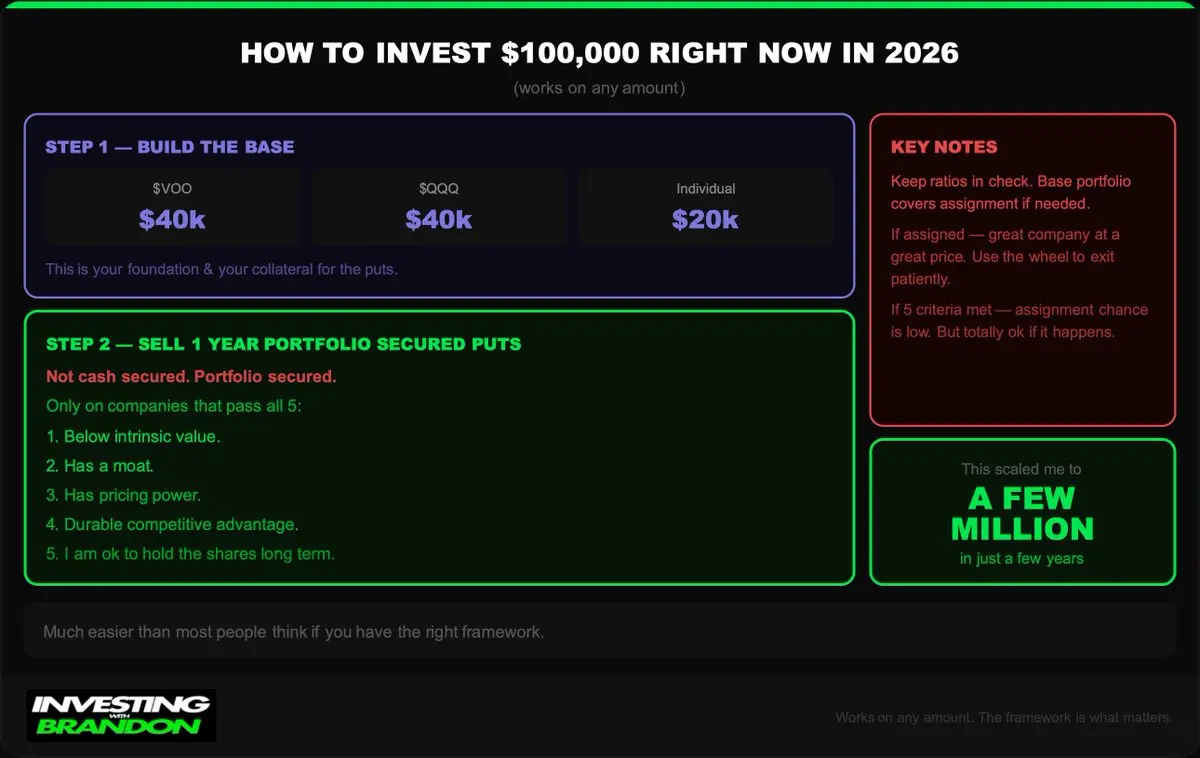
Step 1. Market is cheap. Sell 1 year portfolio secured put. Collect $10k.
Step 2. Take 6k and buy shares of the company you are bullish on.
Step 3. Take $3k of that premium. Buy 1 year calls on the same company.
post-image
  • Reward
  • Comment
  • Repost
  • Share
Elon. Jensen. Tim Cook.
None of them got rich from their salary.
The board told them: make the stock hit $X in 2 years & we give you millions/billions in call options.
So every CEO wakes up every day trying to boost earnings. Boost revenue. Make the share price go up.
That is the tailwind behind every quality stock you hold.
Now ask yourself this.
Can Jensen make Nvidia worth more in 1 month? No.
In 1 year? Absolutely.
So I sell 1+ year portfolio secured puts.
I buy 1+ year calls.
I am aligned with every person at Nvidia whose job is to prove me right.
Why fight the incentive structure?
Align
  • Reward
  • Comment
  • Repost
  • Share
Only invest money you do not need for 5+ years.
Sounds simple.
Most people ignore it & blow up their portfolio.
If you might need it in 2 years... CD or bond.
Not the stock market.
If the market drops 40% right after you invest & you need that money in 2 years you are forced to sell at a loss.
The market does not care when you need the money.
The right way to make your money work:
Every dollar after bills are paid.
Every raise & bonus.
Every dollar of put premium.
Anything you can let compound for 5+ years
Time horizon is risk management when you hold quality companies at good prices.
Non-ne
post-image
  • Reward
  • Comment
  • Repost
  • Share
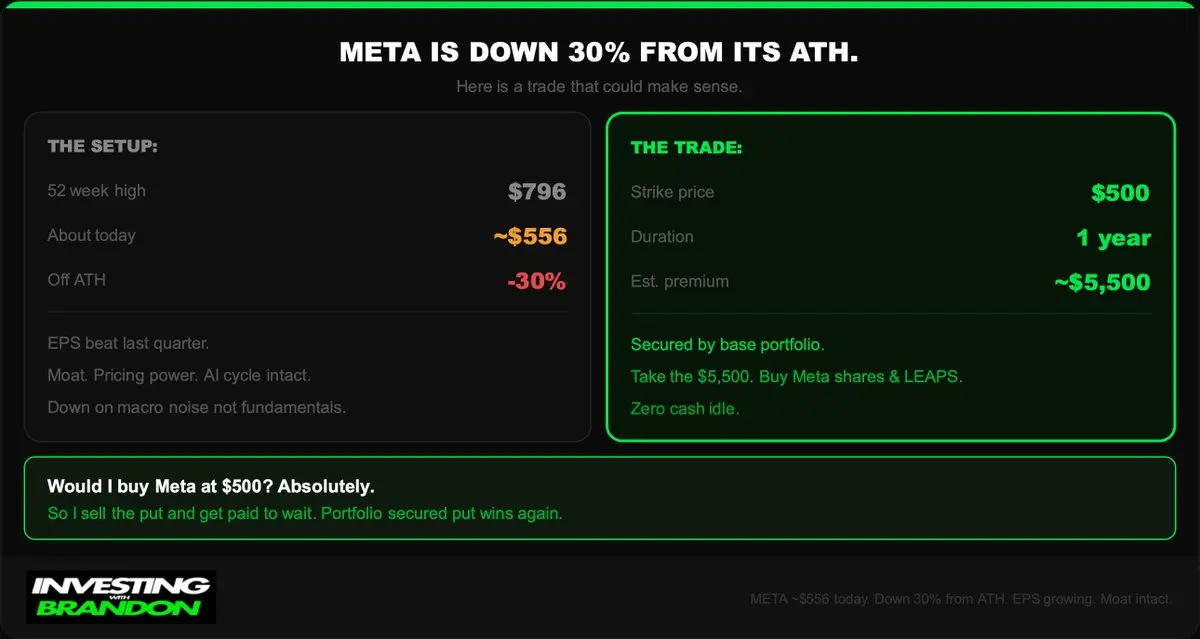
Strike price selection for sold puts.
Most people overthink this completely.
Here is what I do.
I only sell puts on things I already feel are undervalued.
Then I go 10% below the current price.
Q at $600?
I sell the $540 put.
I am already buying something cheap. (assuming this in the example)
Then I am going 10% below that.
The market has to fall 10% from an already undervalued level to put me in assignment range on expiration date.
& guess what, I always have my ratios in check to be able to take assignment no mayor what!
I will be happy to get paid to buy shares cheaper in the future and not
post-image
  • Reward
  • Comment
  • Repost
  • Share
The first $100,000 is the hardest money you will ever make.
Not because the math is hard.
Because the psychology is brutal.
$10k in the bank. You want a vacation.
$50k in the bank. You want a new car.
$99k in the bank. You want to celebrate.
The people who blow it there never get to compound.
The people who hold it there watch the next $100k come way faster.
Then the next one. Then the next one.
The first $100k proves something more important than money.
It proves you have the discipline to not be your own worst enemy.
That is the hardest thing to learn.
COMP1,11%
post-image
  • Reward
  • Comment
  • Repost
  • Share
Rule #1 in investing: do not get wiped out.
Rule #2: do not forget rule #1.
Here is exactly how I keep ratios in check when I sell portfolio secured puts & beat the market at the same time.
Expensive market:
Max sold put assignment = < 50% of portfolio value.
Cheap market:
Max assignment = 65% or more of portfolio value to capitalize on deals but still be fine in volatility.
On a $1M portfolio in a expensive market that means max $500k on the hook for to buy of shares for sold puts.
Even if the portfolio falls 50% to $500k I still cover it.
(I can roll too, but just showing I have the cash if
post-image
  • Reward
  • Comment
  • Repost
  • Share
  • Pin