#USMilitaryMaduroBettingScandal
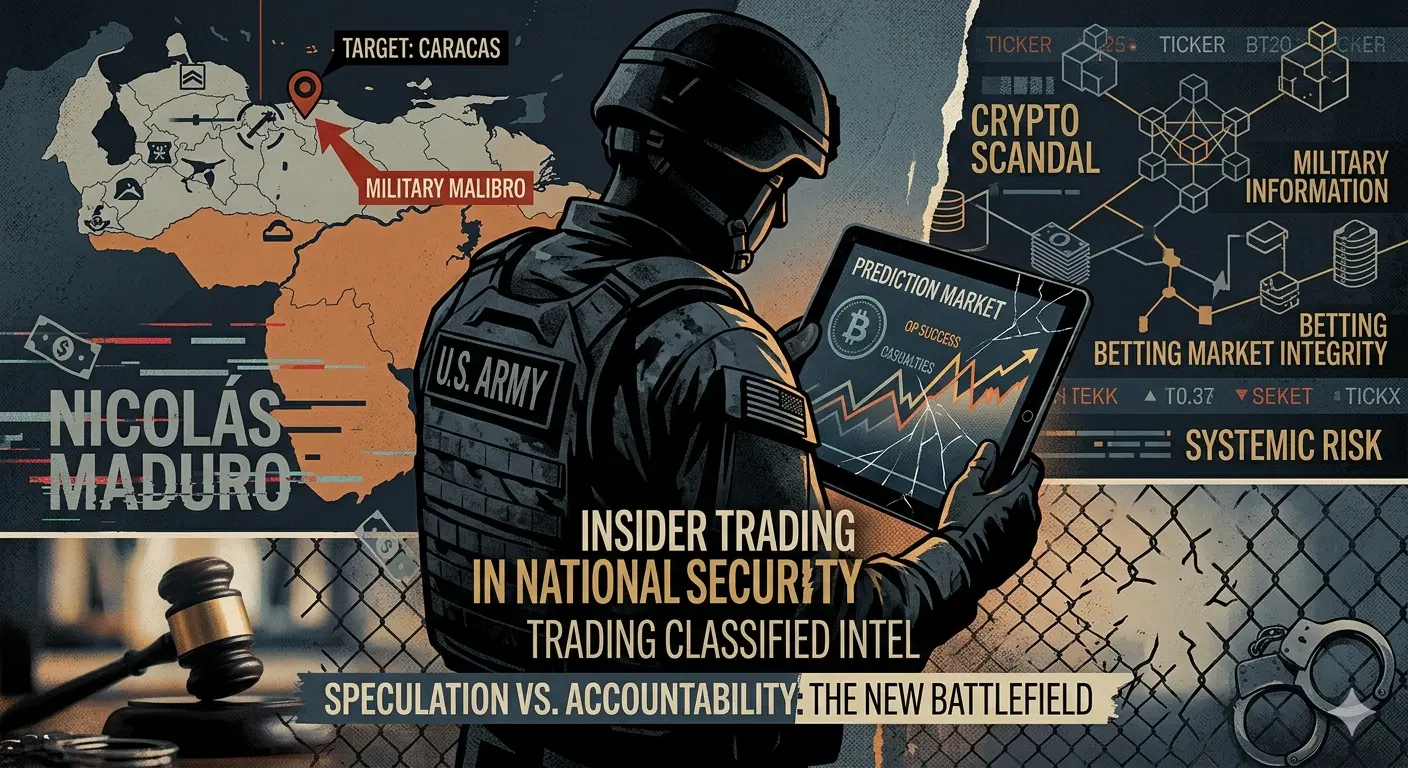
One of the most explosive legal stories of 2026 broke late Thursday evening a sitting US Army Special Forces soldier has been arrested and federally charged for using classified military intelligence about a covert operation to place winning bets on a crypto-powered prediction market. This is not a rumor. This is a Department of Justice indictment, unsealed today in the Southern District of New York, and its implications stretch from military ethics to crypto regulation to prediction market law.
The Scandal Exactly What Happened
US Army Master Sergeant Gannon Ken Van Dyke, 38, stationed at Fort Bragg, North Carolina, was directly involved in the planning and execution of Operation Absolute Resolve the classified predawn military raid in Caracas, Venezuela on January 3, 2026 that resulted in the capture of Venezuelan President Nicolás Maduro and his wife, Cilia Flores. Van Dyke had signed nondisclosure agreements explicitly promising never to reveal or exploit classified or sensitive military information.
Starting December 26, 2025 approximately one week before the operation Van Dyke created a Polymarket account and began placing bets under multiple pseudonymous usernames including "Burdensome-Mix." He placed 13 total bets between December 27, 2025 and the evening of January 26, 2026, spending approximately 33,034 USDT in total. Every single bet took the YES position on outcomes including: US Forces in Venezuela by January 31, Maduro out by January 31, US invades Venezuela by January 31, and Trump invokes War Powers against Venezuela by January 31. He knew with absolute certainty these events were happening. Retail bettors on the other side had no idea.
Hours after Maduro was captured and transported to the USS Iwo Jima, a photograph of Van Dyke in military fatigues carrying a rifle on the ship's deck was taken and uploaded to his personal Google account. Polymarket resolved all Maduro and Venezuela contracts to YES. Van Dyke's 33,034 USDT investment returned 409,881 USDT a 12x return in a matter of days. He then transferred most of the winnings to a foreign cryptocurrency vault before depositing proceeds into a newly created online brokerage account. When media reports of unusual Polymarket trading linked to the Maduro operation began surfacing, Van Dyke attempted to delete his Polymarket account, falsely claiming he had lost access to his email, and changed his cryptocurrency exchange email to an account created under a false name.
Source and Charges Who Filed What
The indictment was unsealed by the US Department of Justice in the Southern District of New York on April 23, 2026. US Attorney Jay Clayton for SDNY announced the charges directly, stating: "The defendant violated the trust placed in him by the United States Government by using classified information about a sensitive military operation to place bets on the timing and outcome of that very operation that is clear insider trading and is illegal under federal law." The Commodity Futures Trading Commission simultaneously filed civil charges against Van Dyke marking the first time in history the CFTC has filed insider trading charges in connection with prediction market event contracts. Van Dyke faces five counts: three violations of the Commodity Exchange Act each carrying up to 10 years, wire fraud carrying up to 20 years, and unlawful monetary transaction carrying up to 10 years. Maximum combined exposure exceeds 60 years in prison.
Official Responses Government, Polymarket, Trump
Polymarket's chief legal officer Neal Kumar stated on X that the company identified the suspicious trading activity internally last month, published enhanced market integrity rules to combat insider trading, and proactively referred the matter to the DOJ before cooperating fully with the investigation. Kumar's direct warning to future bad actors: "It is not anonymous you will be found just like this guy." Polymarket's cooperation with federal investigators was pivotal in building the case. President Trump, when asked about Van Dyke's bets in the Oval Office Thursday, compared him directly to Pete Rose: "That's like Pete Rose betting on his own team." Trump added "the whole world has unfortunately become somewhat of a casino" and said he would look into broader concerns about federal employees placing insider bets on geopolitical events. The Pentagon has not yet issued a formal statement as of publication.
The Broader Pattern This Is Not Isolated
The DOJ indictment contains a critical detail that extends far beyond Van Dyke. Another Polymarket user made approximately 550,000 USDT through a series of bets related to the US striking Iran and the removal of Ayatollah Ali Khamenei a pattern that mirrors the Maduro trades almost exactly. Israeli authorities in February 2026 arrested several individuals and charged two on suspicion of using classified Israeli military intelligence to place bets about military operations in Iran on Polymarket. The pattern across two allied militaries and two separate classified operations suggests a systemic vulnerability: prediction markets, powered by crypto and operating pseudonymously, have become an unintended leak channel for classified national security operations.
Political and Prediction Market Reaction
This case lands as the single most consequential legal development in prediction market history. The CFTC's first-ever insider trading charge on an event contract sets a legal precedent that will reshape how crypto-powered prediction markets are regulated in the United States. Polymarket has been under growing scrutiny from Washington and state regulators calls to rein in prediction markets were already intensifying before this arrest. This case gives regulators the concrete real-world example they needed to push for mandatory KYC, position limits, and real-time surveillance requirements across all prediction market platforms. Congressional hearings on prediction market regulation are now virtually certain in Q2 2026.
Venezuela Oil Market Geopolitical Angle
Maduro's capture on January 3, 2026 already triggered seismic shifts in Venezuelan oil production dynamics. Venezuela holds the world's largest proven oil reserves. Since Operation Absolute Resolve, transitional Venezuelan government negotiations with US energy companies over PDVSA restructuring have been ongoing. The Van Dyke scandal reopens scrutiny of the operation's legitimacy and timeline, creating minor uncertainty around the stability of those negotiations. Brent crude saw a slight uptick in early Asian session trading as the scandal broke markets pricing in a small geopolitical uncertainty premium linked to any potential destabilization of post-Maduro Venezuela energy agreements. The impact is modest but directionally real.
Crypto and Polymarket Reaction
The immediate crypto market reaction is mixed but net negative for prediction market tokens and associated infrastructure. Polymarket operates on Polygon MATIC saw minor selling pressure in early Asian session trading as regulatory risk repricing began. The broader crypto market reaction is more nuanced: Bitcoin and ETH were largely unaffected given the story's narrow focus on prediction market regulation rather than crypto fundamentals. However, the case adds a new regulatory narrative to the crypto ecosystem federal prosecutors and the CFTC now have a high-profile win demonstrating they can pierce pseudonymous crypto account structures to identify and charge bad actors. That is a double-edged signal: bearish for anonymity narratives, mildly bullish for institutional confidence that crypto markets have functional law enforcement oversight.
Social Media Trend Level Extremely High
As of Thursday evening US time, the Van Dyke arrest is trending across X, Reddit, and major financial news feeds simultaneously. The combination of classified military intelligence, a crypto prediction market, Maduro's capture, and a 12x betting return has produced a story with universal appeal across political, military, crypto, and mainstream media audiences. CNN, NBC, ABC, NPR, Washington Post, CNBC, and Axios all published within hours of the DOJ announcement confirming this is a mainstream Tier 1 news cycle, not a crypto-niche story.
Legal Investigation Scope What Comes Next
The Van Dyke case is almost certainly not the end. Three areas of active investigation are now open. First, the unidentified Polymarket user who made 550,000 USDT betting on the Iran strikes DOJ has the template and the CFTC precedent to pursue this case aggressively. Second, any additional military or intelligence community personnel who placed similar insider bets on classified operations the DOJ statement was deliberately broad in language, suggesting active investigation of a wider network. Third, Polymarket itself will face intensified regulatory examination of its KYC procedures, pseudonymous account access, and cross-border fund transfer monitoring.
Risk if Story Grows Bigger Sectors to Watch
If investigation scope expands to additional defendants, three risk areas emerge. Prediction market platforms face potential forced operational changes or temporary shutdowns pending regulatory compliance upgrades. PDVSA and Venezuelan oil transition agreements face renewed scrutiny if Operation Absolute Resolve's legal basis is challenged in international forums. The broader crypto pseudonymity narrative takes a credibility hit as prosecutors demonstrate forensic capability to de-anonymize crypto wallet activity through exchange cooperation.
Opportunity Sectors if Tension Rises
Traditional safe haven flows benefit when institutional trust in alternative markets erodes. Gold held its 4,748 USDT per ounce level. If prediction market regulation expands significantly, regulated alternatives including traditional options and futures markets on CME stand to gain volume migrating away from crypto-based event platforms. Compliance and blockchain analytics firms, including Chainalysis and Elliptic, gain direct commercial validation every time a crypto-based crime case is successfully prosecuted using their forensic frameworks.
Final Outlook and Sentiment April 24, 2026
This scandal is simultaneously a legal milestone, a regulatory accelerant, and a geopolitical footnote. For the prediction market industry, it is the most damaging single news event since Polymarket's CFTC settlement in 2022 but also a proof of concept that the ecosystem can self-police and cooperate with law enforcement. For the US military, it exposes a gap in operational security monitoring that goes beyond Van Dyke. For crypto broadly, it confirms that pseudonymity is not anonymity and that federal prosecutors are now fully capable of operating in this space.
The immediate market sentiment is cautious but not panicked. This story does not threaten Bitcoin, ETH, or the broader crypto bull case. It does permanently change the regulatory environment for prediction markets and raises serious questions about whether classified information has become systematically exploited across multiple operations by multiple actors within the US and allied intelligence communities.
The 33,000 USDT bet that returned 409,000 USDT may cost one soldier 60 years. And it may cost an entire industry its current operating model.
One of the most explosive legal stories of 2026 broke late Thursday evening a sitting US Army Special Forces soldier has been arrested and federally charged for using classified military intelligence about a covert operation to place winning bets on a crypto-powered prediction market. This is not a rumor. This is a Department of Justice indictment, unsealed today in the Southern District of New York, and its implications stretch from military ethics to crypto regulation to prediction market law.
The Scandal Exactly What Happened
US Army Master Sergeant Gannon Ken Van Dyke, 38, stationed at Fort Bragg, North Carolina, was directly involved in the planning and execution of Operation Absolute Resolve the classified predawn military raid in Caracas, Venezuela on January 3, 2026 that resulted in the capture of Venezuelan President Nicolás Maduro and his wife, Cilia Flores. Van Dyke had signed nondisclosure agreements explicitly promising never to reveal or exploit classified or sensitive military information.
Starting December 26, 2025 approximately one week before the operation Van Dyke created a Polymarket account and began placing bets under multiple pseudonymous usernames including "Burdensome-Mix." He placed 13 total bets between December 27, 2025 and the evening of January 26, 2026, spending approximately 33,034 USDT in total. Every single bet took the YES position on outcomes including: US Forces in Venezuela by January 31, Maduro out by January 31, US invades Venezuela by January 31, and Trump invokes War Powers against Venezuela by January 31. He knew with absolute certainty these events were happening. Retail bettors on the other side had no idea.
Hours after Maduro was captured and transported to the USS Iwo Jima, a photograph of Van Dyke in military fatigues carrying a rifle on the ship's deck was taken and uploaded to his personal Google account. Polymarket resolved all Maduro and Venezuela contracts to YES. Van Dyke's 33,034 USDT investment returned 409,881 USDT a 12x return in a matter of days. He then transferred most of the winnings to a foreign cryptocurrency vault before depositing proceeds into a newly created online brokerage account. When media reports of unusual Polymarket trading linked to the Maduro operation began surfacing, Van Dyke attempted to delete his Polymarket account, falsely claiming he had lost access to his email, and changed his cryptocurrency exchange email to an account created under a false name.
Source and Charges Who Filed What
The indictment was unsealed by the US Department of Justice in the Southern District of New York on April 23, 2026. US Attorney Jay Clayton for SDNY announced the charges directly, stating: "The defendant violated the trust placed in him by the United States Government by using classified information about a sensitive military operation to place bets on the timing and outcome of that very operation that is clear insider trading and is illegal under federal law." The Commodity Futures Trading Commission simultaneously filed civil charges against Van Dyke marking the first time in history the CFTC has filed insider trading charges in connection with prediction market event contracts. Van Dyke faces five counts: three violations of the Commodity Exchange Act each carrying up to 10 years, wire fraud carrying up to 20 years, and unlawful monetary transaction carrying up to 10 years. Maximum combined exposure exceeds 60 years in prison.
Official Responses Government, Polymarket, Trump
Polymarket's chief legal officer Neal Kumar stated on X that the company identified the suspicious trading activity internally last month, published enhanced market integrity rules to combat insider trading, and proactively referred the matter to the DOJ before cooperating fully with the investigation. Kumar's direct warning to future bad actors: "It is not anonymous you will be found just like this guy." Polymarket's cooperation with federal investigators was pivotal in building the case. President Trump, when asked about Van Dyke's bets in the Oval Office Thursday, compared him directly to Pete Rose: "That's like Pete Rose betting on his own team." Trump added "the whole world has unfortunately become somewhat of a casino" and said he would look into broader concerns about federal employees placing insider bets on geopolitical events. The Pentagon has not yet issued a formal statement as of publication.
The Broader Pattern This Is Not Isolated
The DOJ indictment contains a critical detail that extends far beyond Van Dyke. Another Polymarket user made approximately 550,000 USDT through a series of bets related to the US striking Iran and the removal of Ayatollah Ali Khamenei a pattern that mirrors the Maduro trades almost exactly. Israeli authorities in February 2026 arrested several individuals and charged two on suspicion of using classified Israeli military intelligence to place bets about military operations in Iran on Polymarket. The pattern across two allied militaries and two separate classified operations suggests a systemic vulnerability: prediction markets, powered by crypto and operating pseudonymously, have become an unintended leak channel for classified national security operations.
Political and Prediction Market Reaction
This case lands as the single most consequential legal development in prediction market history. The CFTC's first-ever insider trading charge on an event contract sets a legal precedent that will reshape how crypto-powered prediction markets are regulated in the United States. Polymarket has been under growing scrutiny from Washington and state regulators calls to rein in prediction markets were already intensifying before this arrest. This case gives regulators the concrete real-world example they needed to push for mandatory KYC, position limits, and real-time surveillance requirements across all prediction market platforms. Congressional hearings on prediction market regulation are now virtually certain in Q2 2026.
Venezuela Oil Market Geopolitical Angle
Maduro's capture on January 3, 2026 already triggered seismic shifts in Venezuelan oil production dynamics. Venezuela holds the world's largest proven oil reserves. Since Operation Absolute Resolve, transitional Venezuelan government negotiations with US energy companies over PDVSA restructuring have been ongoing. The Van Dyke scandal reopens scrutiny of the operation's legitimacy and timeline, creating minor uncertainty around the stability of those negotiations. Brent crude saw a slight uptick in early Asian session trading as the scandal broke markets pricing in a small geopolitical uncertainty premium linked to any potential destabilization of post-Maduro Venezuela energy agreements. The impact is modest but directionally real.
Crypto and Polymarket Reaction
The immediate crypto market reaction is mixed but net negative for prediction market tokens and associated infrastructure. Polymarket operates on Polygon MATIC saw minor selling pressure in early Asian session trading as regulatory risk repricing began. The broader crypto market reaction is more nuanced: Bitcoin and ETH were largely unaffected given the story's narrow focus on prediction market regulation rather than crypto fundamentals. However, the case adds a new regulatory narrative to the crypto ecosystem federal prosecutors and the CFTC now have a high-profile win demonstrating they can pierce pseudonymous crypto account structures to identify and charge bad actors. That is a double-edged signal: bearish for anonymity narratives, mildly bullish for institutional confidence that crypto markets have functional law enforcement oversight.
Social Media Trend Level Extremely High
As of Thursday evening US time, the Van Dyke arrest is trending across X, Reddit, and major financial news feeds simultaneously. The combination of classified military intelligence, a crypto prediction market, Maduro's capture, and a 12x betting return has produced a story with universal appeal across political, military, crypto, and mainstream media audiences. CNN, NBC, ABC, NPR, Washington Post, CNBC, and Axios all published within hours of the DOJ announcement confirming this is a mainstream Tier 1 news cycle, not a crypto-niche story.
Legal Investigation Scope What Comes Next
The Van Dyke case is almost certainly not the end. Three areas of active investigation are now open. First, the unidentified Polymarket user who made 550,000 USDT betting on the Iran strikes DOJ has the template and the CFTC precedent to pursue this case aggressively. Second, any additional military or intelligence community personnel who placed similar insider bets on classified operations the DOJ statement was deliberately broad in language, suggesting active investigation of a wider network. Third, Polymarket itself will face intensified regulatory examination of its KYC procedures, pseudonymous account access, and cross-border fund transfer monitoring.
Risk if Story Grows Bigger Sectors to Watch
If investigation scope expands to additional defendants, three risk areas emerge. Prediction market platforms face potential forced operational changes or temporary shutdowns pending regulatory compliance upgrades. PDVSA and Venezuelan oil transition agreements face renewed scrutiny if Operation Absolute Resolve's legal basis is challenged in international forums. The broader crypto pseudonymity narrative takes a credibility hit as prosecutors demonstrate forensic capability to de-anonymize crypto wallet activity through exchange cooperation.
Opportunity Sectors if Tension Rises
Traditional safe haven flows benefit when institutional trust in alternative markets erodes. Gold held its 4,748 USDT per ounce level. If prediction market regulation expands significantly, regulated alternatives including traditional options and futures markets on CME stand to gain volume migrating away from crypto-based event platforms. Compliance and blockchain analytics firms, including Chainalysis and Elliptic, gain direct commercial validation every time a crypto-based crime case is successfully prosecuted using their forensic frameworks.
Final Outlook and Sentiment April 24, 2026
This scandal is simultaneously a legal milestone, a regulatory accelerant, and a geopolitical footnote. For the prediction market industry, it is the most damaging single news event since Polymarket's CFTC settlement in 2022 but also a proof of concept that the ecosystem can self-police and cooperate with law enforcement. For the US military, it exposes a gap in operational security monitoring that goes beyond Van Dyke. For crypto broadly, it confirms that pseudonymity is not anonymity and that federal prosecutors are now fully capable of operating in this space.
The immediate market sentiment is cautious but not panicked. This story does not threaten Bitcoin, ETH, or the broader crypto bull case. It does permanently change the regulatory environment for prediction markets and raises serious questions about whether classified information has become systematically exploited across multiple operations by multiple actors within the US and allied intelligence communities.
The 33,000 USDT bet that returned 409,000 USDT may cost one soldier 60 years. And it may cost an entire industry its current operating model.