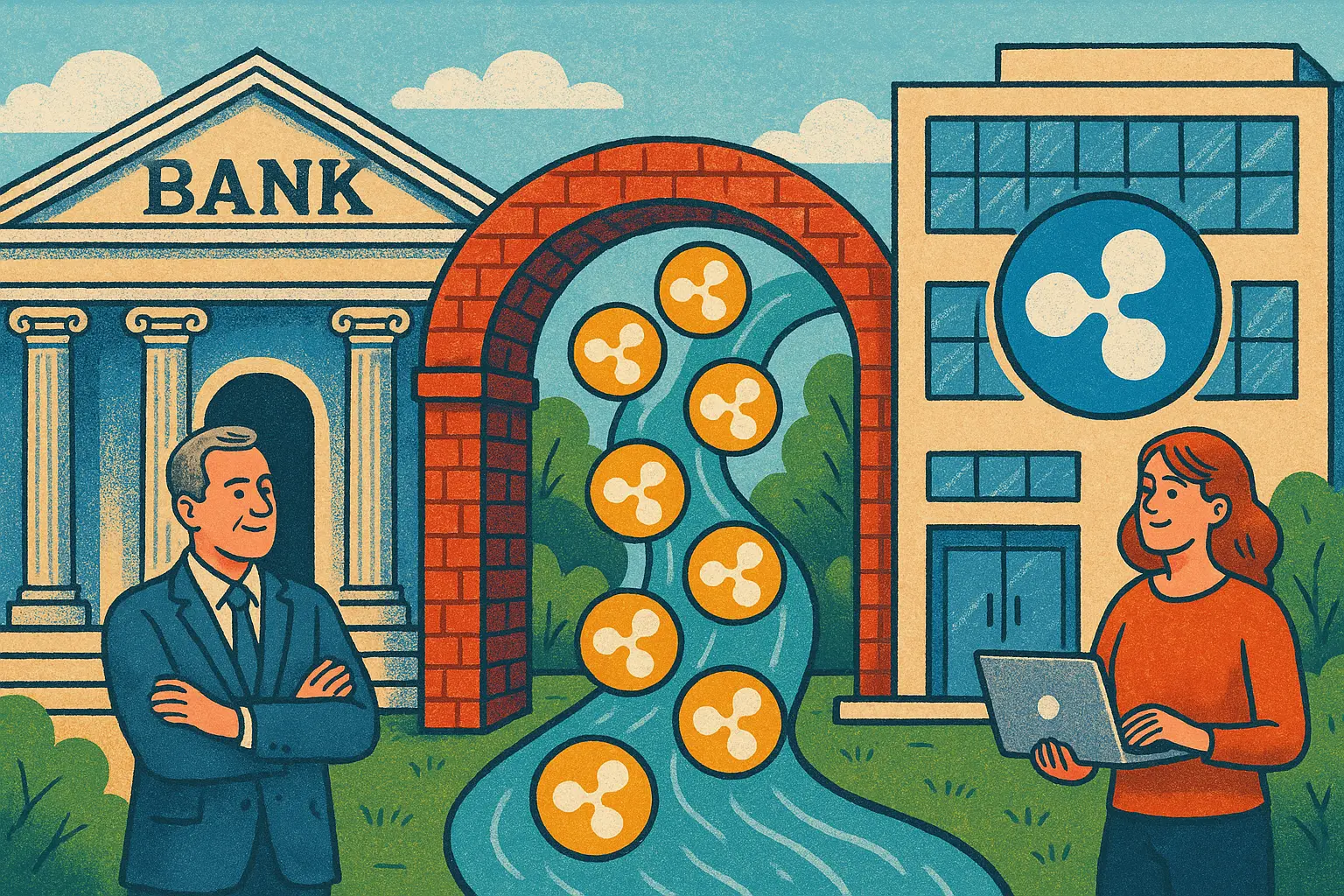
The Office of the Comptroller of the Currency (OCC) announced revisions to regulations related to national bank charters, officially permitting national trust banks to engage in non-trust activities while performing trust duties, thereby eliminating previous industry concerns about the compliance of such activities. For Ripple, Circle, and other companies that have conditionally received national trust bank licenses, this regulation opens a crucial pathway into the U.S. banking system.
OCC Revises Trust Bank Regulations: Key Policy Insights
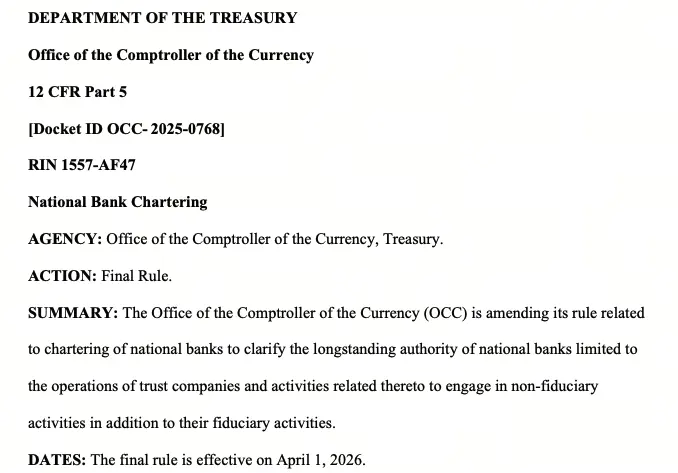 (Source: OCC)
The final OCC regulation confirms that national trust banks can conduct ancillary banking activities beyond solely trust services. Previously, there was industry concern: whether companies holding trust charters had the authority to engage in broader banking operations. The OCC’s final ruling explicitly answers this question — yes, they can.
Major crypto companies with conditional OCC trust bank licenses
Ripple: Expanding crypto asset custody services; recently partnered with Figment to extend custody to staking services on Ethereum and Solana.
Circle: USDC stablecoin issuer; leveraging this to strengthen its business presence within the U.S. banking compliance framework.
Paxos: Deepening its involvement in blockchain settlement; expanding institutional services through bank system integration.
This is a significant policy victory for the cryptocurrency industry, which has actively advocated for the finalization of these rules. Such integration further accelerates the convergence of cryptocurrencies and traditional finance (TradFi).
Federal Reserve’s Simplified Master Account Program: The Next Step for Crypto Access to Payment Systems
In addition to OCC policies, the Federal Reserve is advancing a “Simplified Master Account” plan, which, if implemented, would allow companies like Ripple and Circle limited access to the Fed’s payment system. Fed Governor Chris Waller proposed this plan, with plans to announce related regulations in Q4 of this year.
However, this plan faces clear resistance. The crypto industry and banking sector are at odds; banks believe crypto companies should not have direct access to the Fed’s payment system, and the Colorado Bankers Association has warned that such accounts could facilitate rapid fraud.
Fed Governor Michelle Bowman stated during a Senate Banking Committee hearing that the Fed is working with other banking regulators to develop regulations covering capital and liquidity requirements for stablecoin issuers (including those mandated by the GENIUS Act), clarifying which digital asset activities are permitted, and is open to providing regulatory feedback on new use cases. The regulatory framework for crypto companies entering the U.S. banking system is gradually taking shape, though final rules will take time to implement.
Frequently Asked Questions
Q: What does the OCC new regulation mean for Ripple?
A: The OCC allows national trust banks to engage in non-trust activities (including non-trust custody services), enabling Ripple, which has received conditional approval, to hold and manage customer crypto assets within a compliant framework without traditional fiduciary responsibilities. This provides a clear legal basis for Ripple’s entry into the U.S. banking system and expansion of institutional custody services.
Q: Besides Ripple, which other crypto companies benefit from the OCC new regulation?
A: Circle, Paxos, and Crypto.com have also received conditional approval for OCC national trust bank licenses, benefiting from this regulatory revision alongside Ripple, marking the first tier of crypto firms integrating into the regulated U.S. banking system.
Q: How are the Fed’s Simplified Master Account plan and the OCC regulation related?
A: Both are complementary pathways for crypto companies to access the U.S. financial system. The OCC regulation addresses the scope of trust bank activities; the Fed’s plan further allows these companies to directly connect to the payment system, though it faces greater resistance from the banking industry and is still under development.
Disclaimer: The information on this page may come from third parties and does not represent the views or opinions of Gate. The content displayed on this page is for reference only and does not constitute any financial, investment, or legal advice. Gate does not guarantee the accuracy or completeness of the information and shall not be liable for any losses arising from the use of this information. Virtual asset investments carry high risks and are subject to significant price volatility. You may lose all of your invested principal. Please fully understand the relevant risks and make prudent decisions based on your own financial situation and risk tolerance. For details, please refer to
Disclaimer.
Related Articles
BNB Chain Launches BNBAgent SDK, the First Live Implementation of ERC-8183 for Trustless Onchain AI Agents
[PRESS RELEASE – Dubai, UAE, March 18th, 2026]
BNB Chain today announced the launch of BNBAgent SDK, the first live implementation of ERC-8183 and a complete developer framework enabling trustless onchain AI workflows. The release represents a major step forward in building the infrastructure
CryptoPotato31m ago
Kalshi secures license to offer margin trading to institutional investors
Kalshi has received approval for margin trading, aiming to attract institutional investors. The license enables it to act as a futures commission merchant, pending CFTC approval. This shift could enhance trading potential in prediction markets, facing competition and regulatory challenges.
CoinDesk1h ago
Ondo Gains Momentum as Franklin Templeton Boosts RWA Push
Key Insights:
Ondo gains strength as the Franklin Templeton partnership pushes tokenized ETFs on-chain, lifting total value locked and expanding institutional access significantly.
Futures open interest rises sharply while funding rates remain positive, showing increased trader
CryptoNewsLand2h ago
Pi Network’s First Big Post–Pi Day Announcement Leaves Pioneers Unimpressed
It has been two weeks since the conclusion of the much-anticipated Pi Day (March 14), in which the Core Team behind Pi Network announced some major updates and progress on key infrastructure developments.
One of those garnered the community’s attention, as many of them have been waiting for a
CryptoPotato2h ago
New Ethereum project aims to fix network fragmentation and improve user experience
A new initiative called the Ethereum Economic Zone (EEZ) aims to unify Ethereum's fragmented ecosystem by enabling seamless interactions between layer 2 networks. Developed by Gnosis, Zisk, and the Ethereum Foundation, it seeks to improve user experience and liquidity while maintaining Ethereum's core security.
CoinDesk3h ago
Gnosis and Zisk announce the launch of an “Ethereum Economic Zone” Rollup framework, co-funded by the Ethereum Foundation
Gnosis co-founder and Zisk’s founder announced the Ethereum Economic Zone (EEZ) initiative at the EthCC conference, aiming to provide a framework for Rollups, improve the composability of smart contracts, and address Ethereum’s fragmentation problem. The project received funding from the Ethereum Foundation, and all software will be released as open source to minimize governance and prevent upgrades.
BlockBeatNews3h ago


