Traditional blockchain networks often struggle with slow confirmation speeds, high latency, and subpar application experiences as they scale. MegaETH aims to bridge this gap by enabling real-time responsiveness on blockchain systems, bringing them closer to internet-level performance so that complex applications can run directly on-chain.
MegaETH’s core components include execution architecture, sorting and verification mechanisms, node role specialization, the MEGA token model, application scenarios, and key differences from traditional Layer2 solutions.

What Is MegaETH
MegaETH is a blockchain execution infrastructure purpose-built for high-frequency interaction scenarios, prioritizing transaction speed, efficient state updates, and responsive on-chain application experiences.
Its core innovation lies in deeply optimizing the execution layer, enabling the network to process computations and confirmations with minimal latency—approaching real-time system performance.
Structurally, MegaETH leverages Ethereum’s asset and liquidity foundation while establishing an independent, high-performance execution environment. This delivers both ecosystem compatibility and the capacity to support more complex on-chain applications.
What Ethereum Scaling Challenges Does MegaETH Address
MegaETH tackles the performance and interaction limitations found in Ethereum and certain scaling networks.
Networks built around block cycles often cannot provide immediate feedback. After users submit transactions, they must wait for sorting, execution, and confirmation, constraining the development of high-frequency applications.
MegaETH’s optimization focuses on three areas: reducing transaction latency for faster user results, increasing concurrent processing to maintain network stability under heavy loads, and enhancing application experiences so on-chain products rival traditional internet services.
These improvements mean blockchains can support real-time business logic—not just settlement.
How MegaETH’s Real-Time Execution Architecture Works
MegaETH’s real-time execution architecture is designed to maximize transaction execution efficiency, enabling rapid state updates.
It separates traditional blockchain processes—transaction reception, sorting, execution, data submission, and result verification—into modular components. This collaborative structure reduces bottlenecks from single-node processing.
Here’s how the architecture is structured:
| Architecture Module |
Main Responsibility |
Performance Impact |
| Transaction Entry Layer |
Receives user requests |
Minimizes wait time |
| Sorting Layer |
Arranges transaction order |
Boosts processing efficiency |
| Execution Layer |
Updates on-chain state |
Delivers rapid feedback |
| Data Layer |
Stores transaction records |
Ensures traceability |
| Verification Layer |
Validates execution results |
Increases credibility |
This approach allows users to see balance changes, order updates, or game state shifts almost instantly when interacting on-chain.
MegaETH’s Sorting and Verification Mechanisms
MegaETH utilizes a sorter to manage transaction sequencing and a verification mechanism to ensure execution integrity.
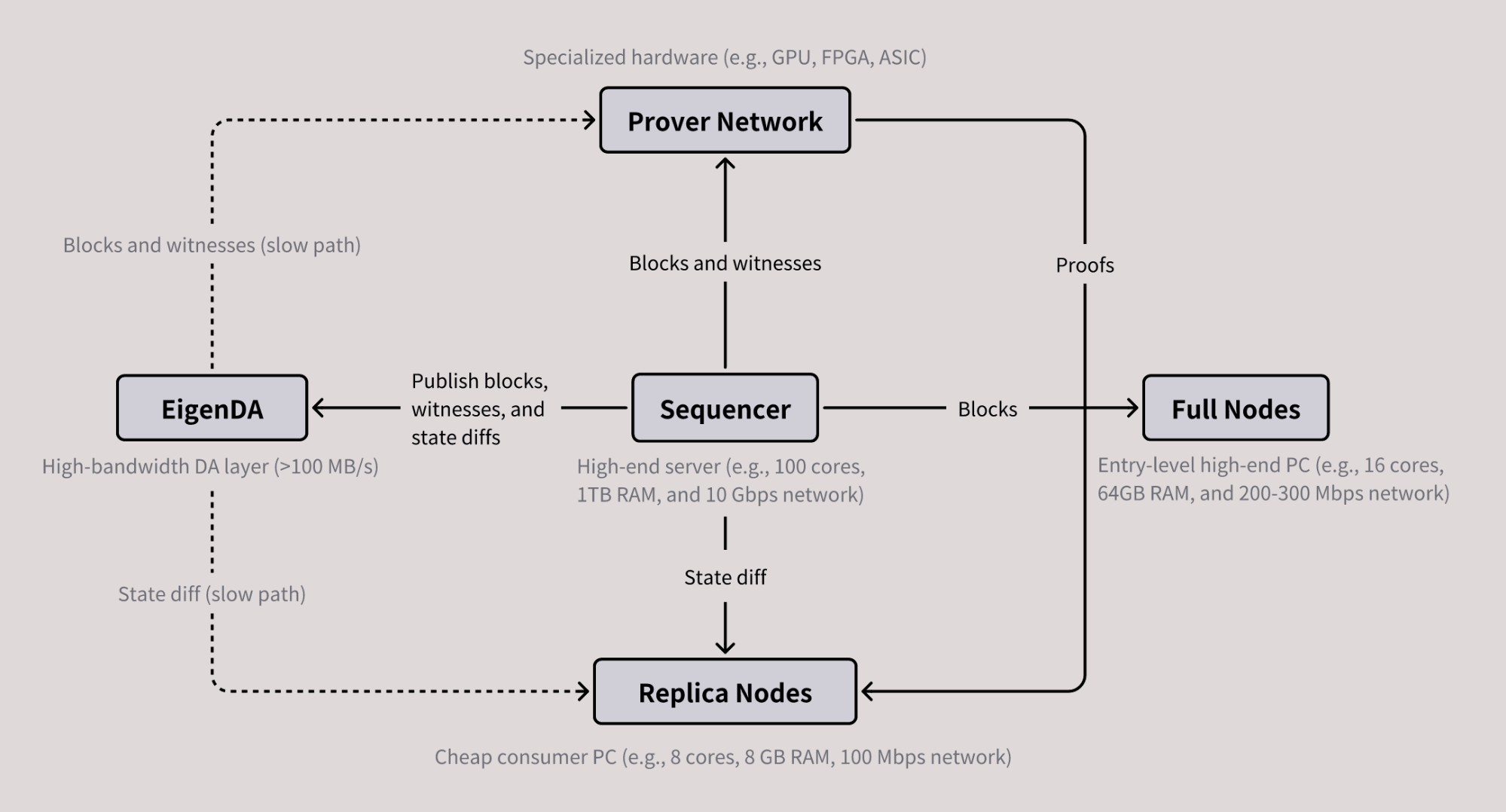
The sorter acts as the system’s scheduling center—receiving transaction requests, determining execution order, and batching transactions for the execution layer. This reduces resource waste from nodes competing for sorting.
The verification mechanism confirms that execution results adhere to protocol rules. Independent verifiers or proof systems validate state updates, ensuring speed does not compromise trust.
By separating execution and security verification, MegaETH achieves both performance and reliability.
Node Roles in MegaETH
MegaETH nodes operate with specialized roles, rather than all performing identical tasks.
Different nodes handle sorting, execution, verification, and data services—boosting efficiency and reducing redundant computation.
Typical roles include: sorting nodes (organize transaction order), execution nodes (run transaction logic and update state), verification nodes (check execution results), data nodes (store historical info), and access nodes (connect Wallets, apps, and developer tools).
This division of labor aligns with modern distributed computing, supporting more complex on-chain business scenarios.
MEGA Tokenomics and Utility
MEGA is MegaETH’s native token, serving as the medium for fee payments, node incentives, and governance.
MEGA is used to pay transaction execution costs and on-chain resource consumption. When users initiate transfers, trades, or application calls, they utilize network computing resources.
The incentive mechanism is central to the token model—node operators, developers, and ecosystem participants earn MEGA for providing services.
Key utilities include:
| Utility |
Description |
| Gas Fees |
Pays transaction execution costs |
| Node Incentives |
Rewards network participants |
| Governance |
Participates in protocol decisions |
| Ecosystem Subsidies |
Supports development and growth |
| Staking |
Enhances network security |
MEGA’s long-term value depends on network activity, application demand, and the token’s supply-demand dynamics.
MegaETH and traditional Ethereum Layer2 solutions share the goal of improving scalability, but their design priorities differ.
Most Layer2 solutions focus on lowering fees and increasing transaction throughput, while MegaETH emphasizes low-latency execution and real-time interaction. This creates distinct application positioning.
| Comparison Dimension |
MegaETH |
Traditional Ethereum Layer2 |
| Core Objective |
Real-time execution experience |
Scalability and lower fees |
| Response Speed |
Prioritizes low latency |
Varies by architecture |
| Application Focus |
High-frequency interactive apps |
General DeFi and transfers |
| Node Structure |
Specialized execution model |
Project-dependent |
| User Experience |
Near real-time system |
Conventional chain experience |
In summary, MegaETH is an execution network for high-performance applications, while traditional Layer2 solutions are infrastructure for transaction scalability.
Key Application Scenarios for MegaETH
MegaETH’s application scenarios are concentrated in on-chain businesses demanding speed, concurrency, and real-time feedback.
High-frequency trading platforms require fast matching and order updates, making low-latency execution essential. Blockchain games need continuous action feedback and instant asset changes, suiting high-performance networks.
On-chain social, prediction markets, real-time payment networks, and data interaction platforms also benefit from MegaETH’s architecture.
The core value: enabling complex, previously centralized business logic to migrate on-chain.
MegaETH: Advantages and Limitations
MegaETH’s key advantage is advancing blockchain from settlement to application layer.
With higher throughput and faster response, MegaETH improves user experience and broadens blockchain’s commercial potential. Developers can build more complex, high-frequency interactive products.
However, high-performance systems require complex coordination, potentially raising node hardware requirements, maintenance costs, or decentralization trade-offs.
The core challenge: achieving lasting balance among performance, security, and openness.
Summary
MegaETH is an Ethereum scaling network engineered for real-time execution. Its focus is not just processing more transactions, but delivering rapid response for on-chain applications. Its structure includes sorter, execution layer, verification mechanism, and specialized node roles, sustained by the MEGA token incentive system. Compared to traditional Layer2, MegaETH prioritizes high-frequency interaction—ideal for trading, gaming, and social use cases.
FAQ
What Is MegaETH
MegaETH is a high-performance blockchain execution network that enhances real-time processing and application experience within the Ethereum ecosystem.
What Is the Function of the MEGA Token
MEGA is used for fee payments, node incentives, staking, and ecosystem governance.
What Is the Difference Between MegaETH and Layer2
Traditional Layer2 solutions focus on scalability and lower fees; MegaETH emphasizes low-latency execution and high-frequency application support.
What Applications Is MegaETH Suitable For
MegaETH is ideal for high-frequency trading, blockchain games, social protocols, real-time data platforms, and other interaction-intensive scenarios.
Does MegaETH Rely on the Ethereum Ecosystem
MegaETH maintains synergy with the Ethereum ecosystem, leveraging its asset liquidity and user base.







