As DeFi, on-chain derivatives, and automated financial systems continue to evolve, blockchains are becoming increasingly dependent on external data. Oracle networks play a critical role by bridging off-chain information with on-chain smart contracts.
In this space, Chainlink and Pyth Network stand out as two of the most prominent solutions, though they differ significantly in design philosophy and technical approach.
Positioning and Core Differences Between Pyth and Chainlink
The primary function of an oracle is to securely deliver off-chain data, such as prices, indices, or interest rates, to blockchain-based smart contracts. Since blockchains cannot directly access external data, oracles are essential infrastructure for DeFi, derivatives, and real-world asset applications.
Chainlink is widely regarded as a general-purpose, industry-standard oracle network that prioritizes security and decentralization. Pyth Network, on the other hand, is purpose-built for financial markets, with a focus on low latency and high-frequency data delivery.
At a high level, Chainlink functions more like a foundational infrastructure layer, while Pyth operates closer to a real-time data layer.
| Comparison Dimension |
Pyth Network |
Chainlink |
| Data Source |
Direct from first-party institutions |
Aggregated by third-party nodes |
| Update Method |
Pull (on-demand) |
Push (continuous updates) |
| Core Strength |
High-frequency, low latency |
Decentralized verification |
| Cost Structure |
Pay-per-use |
Continuous update costs |
| Use Case Focus |
High-frequency DeFi pricing |
General-purpose oracle services |
From a system design perspective, Chainlink can be seen as a decentralized consensus layer for data validation, whereas Pyth focuses on high-speed financial data distribution. Rather than being direct replacements, the two are optimized for different use cases.
Chainlink gathers data from multiple independent nodes, aggregates it, and verifies it before submitting it on-chain. This approach enhances resistance to manipulation and improves reliability. In contrast, Pyth Network connects directly to exchanges and market makers, enabling faster delivery of raw market data with significantly reduced latency.
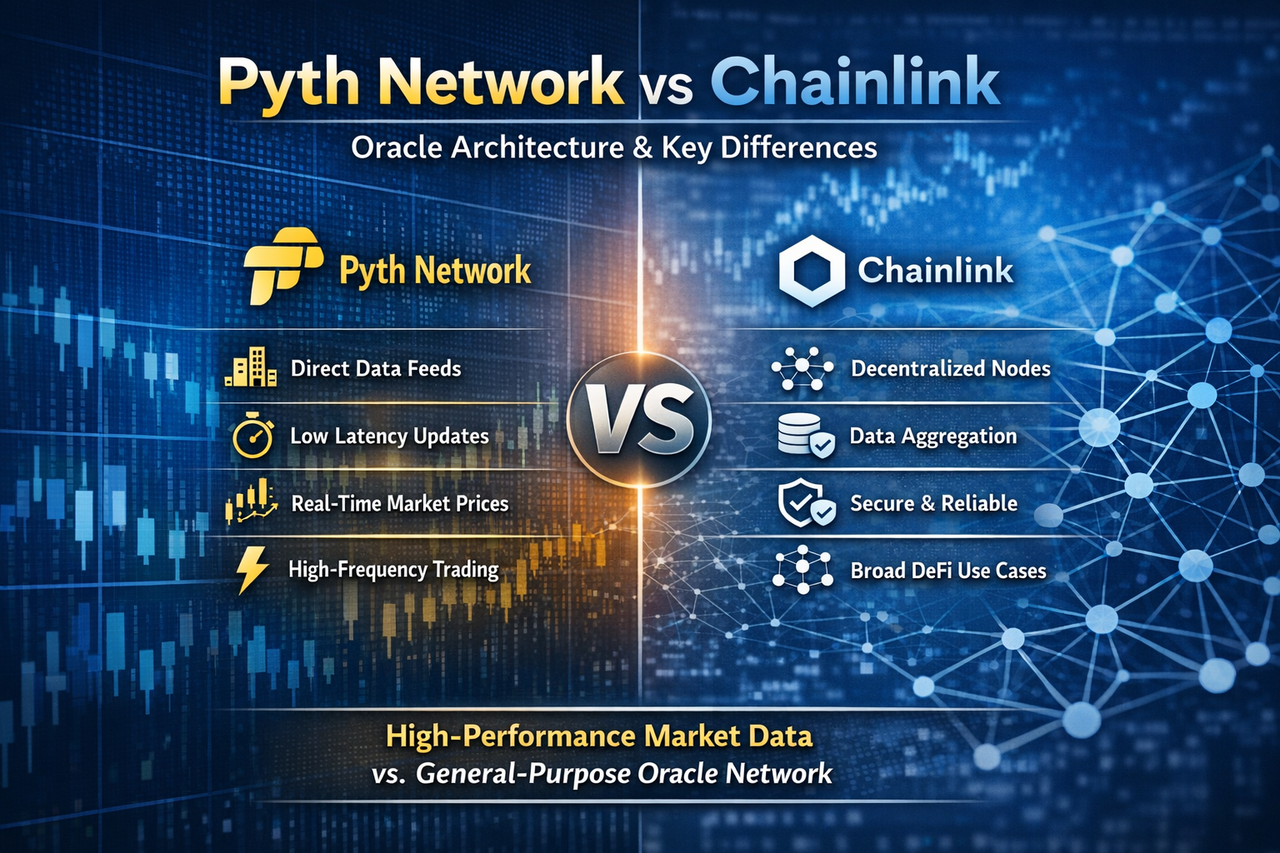
Chainlink vs Pyth Network: Architectural and Data Flow Differences
At the architectural level, Chainlink uses a distributed network of independent nodes, where each node retrieves data separately and participates in aggregation and consensus. This structure provides high redundancy and robustness, though it may introduce additional latency.
Pyth Network adopts a more streamlined architecture, relying directly on exchanges and institutional market makers as data sources. By reducing intermediaries, it achieves faster data transmission, which is particularly advantageous in high-frequency trading environments.
Chainlink vs Pyth Network: Data Sources and Data Integrity Models
In terms of data sourcing, Chainlink emphasizes multi-source validation. Its data is typically collected from APIs, node operators, and external providers, then cross-verified to minimize the risk of inaccurate inputs.
Pyth Network, in contrast, uses real-time data from market participants themselves, including exchanges and market makers. This approach produces prices that closely reflect live market conditions, though it depends more heavily on the quality and reliability of its data providers.
Chainlink vs Pyth Network: Price Update Mechanisms
Chainlink typically updates prices either at fixed intervals or when certain conditions are met. This makes it well-suited for applications where ultra-low latency is not critical, such as lending protocols or stablecoins.
Pyth Network supports high-frequency, near real-time updates, making it better suited for derivatives trading and quantitative strategies where timing precision is crucial.
Chainlink vs Pyth Network: Target Use Cases
At the application level, Chainlink is designed for a wide range of blockchain use cases, including DeFi lending, cross-chain communication, and integration of traditional financial data. Its strength lies in stability and compatibility across ecosystems.
Pyth Network is more specialized, focusing on high-performance financial use cases such as futures, options, and perpetual contracts. It is particularly prominent in high-throughput ecosystems like Solana.
Chainlink vs Pyth Network: Cost Structure
From a cost perspective, Chainlink’s reliance on multiple nodes and complex aggregation processes leads to higher operational costs, but this trade-off enhances security and decentralization guarantees.
Pyth Network reduces intermediary layers and optimizes its data pipeline, resulting in greater cost efficiency, especially in high-frequency environments.
Conclusion
Chainlink and Pyth Network are not direct competitors but complementary oracle solutions operating at different layers of the ecosystem. Chainlink serves as a general-purpose infrastructure focused on security and broad applicability, while Pyth specializes in high-performance financial data with an emphasis on low latency and high-frequency updates.
Looking ahead, the oracle ecosystem is likely to evolve into a multi-layered architecture where different solutions coexist, each optimized for specific use cases rather than a single protocol dominating the market.
FAQs
Will Pyth Network replace Chainlink?
No. They serve different roles, one as a general infrastructure layer and the other as a high-performance financial data layer, making long-term coexistence more likely.
Can Pyth and Chainlink be used together?
Yes. Many DeFi protocols integrate both to improve data reliability and redundancy.
Which oracle is more secure?
Chainlink has a longer track record in node-based verification and security, while Pyth offers more direct data sourcing from market participants. Their security models differ rather than one being strictly superior.
Why does Pyth have lower latency?
Because it sources data directly from exchanges and institutional providers, reducing the need for intermediate aggregation and verification steps.