When selecting or evaluating a metaverse platform, users often face a key question: how do different platforms fundamentally operate, and how do their sources of value and participation models differ? These distinctions—especially around virtual assets, NFTs, and user engagement—directly affect the user experience and ecosystem structure.
This question typically centers on five aspects: platform architecture, operational mechanisms, incentive structures, asset control, and application scenarios. These dimensions form the core framework for comparison.
What is Highstreet?
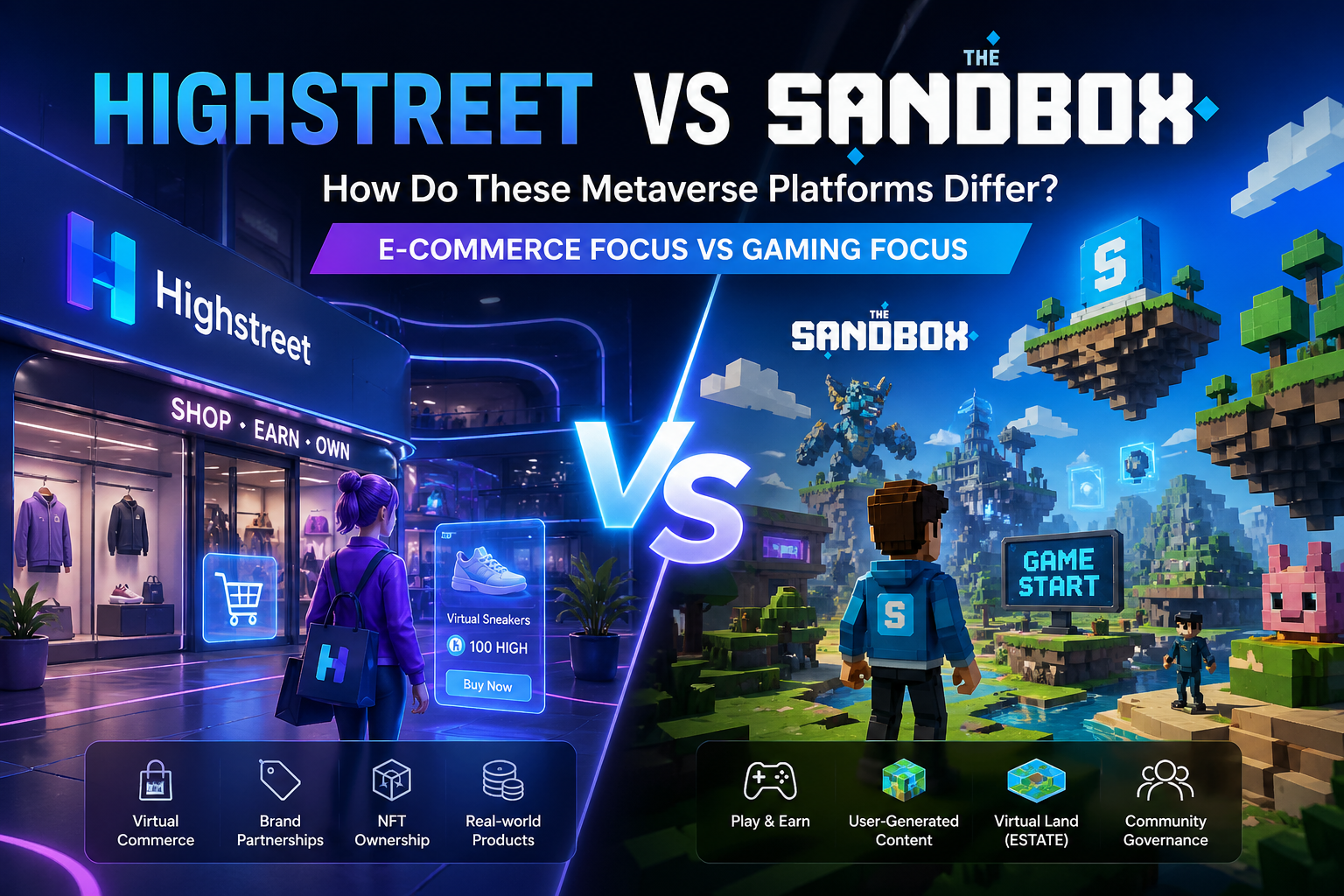
Highstreet is a metaverse platform built around virtual commerce, with its core value proposition being the integration of real-world products and NFT assets.
Structurally, Highstreet leverages a virtual reality environment to showcase products and utilizes blockchain to record asset ownership. Purchases on the platform grant users not only virtual assets but, in some cases, rights to corresponding physical goods.
This model is fundamentally “product-driven.” Users are drawn to the platform primarily for shopping and interaction, and products themselves form the foundation of the ecosystem’s value. Highstreet, therefore, operates as a digital consumption platform blending e-commerce with immersive virtual experiences.
What is Sandbox?
Sandbox is a user-generated content-focused metaverse gaming platform designed to build an open virtual world and content ecosystem.
Sandbox creates its gaming environment using virtual land and NFT assets. Users can create content, design games, and interact with other players. Asset value on the platform is driven primarily by in-game use and engagement.
This model is “content-driven.” As creators and players participate, the platform continuously generates new gaming experiences, driving ecosystem growth. As a result, Sandbox functions as a virtual world platform centered on creativity and interaction.
Structural Differences Between Highstreet and Sandbox
Highstreet and Sandbox have distinct architectural priorities.
Highstreet’s structure centers around its product system, including virtual shops, product NFTs, and real-world product mapping. Sandbox’s architecture is built around its virtual world, with core modules like a land system, asset tools, and a game engine.
| Dimension |
Highstreet |
Sandbox |
| Core Module |
Product System |
Virtual Land System |
| Asset Type |
Product NFTs |
Game Asset NFTs |
| Platform Foundation |
E-commerce Structure |
Game World Structure |
| User Entry Point |
Shopping Experience |
Gaming Experience |
| Content Source |
Brands & Products |
User-Generated Content |
Highstreet emphasizes product logic, while Sandbox is defined by spatial and content logic. These differences shape users’ entry points and interaction paths on each platform.
Operational Differences
Highstreet and Sandbox are driven by different user behaviors: consumption on Highstreet and interaction on Sandbox.
On Highstreet, users drive the ecosystem by browsing products, making purchases, and participating in virtual experiences. Transactions are central to the platform, with product sales directly impacting user engagement.
On Sandbox, users fuel ecosystem growth by creating content, playing games, and interacting with others. The platform’s value comes from ongoing user participation rather than discrete transactions.
As a result, Highstreet relies more on product supply and consumer demand, while Sandbox depends on content creation and player engagement.
Incentive Mechanisms and User Behavior
Each platform’s incentive structure directly shapes how users participate.
Highstreet’s incentive system is built around consumption and engagement. Users earn rewards by purchasing products or joining activities, creating a cycle driven by consumption.
Sandbox’s incentives center on creation and interaction. Users earn revenue by designing assets or games, making participation itself a source of value.
As a result, user roles diverge: on Highstreet, users mostly act as consumers; on Sandbox, they are both creators and players.
Asset Ownership and Control
Both Highstreet and Sandbox implement asset ownership through NFTs, but their control models differ.
On Highstreet, assets are generally linked to real-world products, so value comes from both their virtual use and associated physical rights. Owning an NFT equates to holding the corresponding product or entitlement.
On Sandbox, assets exist entirely in the virtual world, and their value is derived from in-game use and interaction. Users control assets via their wallets and deploy them across various contexts.
In essence, Highstreet’s assets are “digitized products,” while those on Sandbox are “virtual resources.”
Application Scenarios and Ecosystem Focus
Highstreet and Sandbox diverge significantly in their primary use cases.
Highstreet is focused on virtual shopping, brand showcases, and product transactions, with an ecosystem expanding around e-commerce. Sandbox is oriented toward gaming, content creation, and social interaction, with its ecosystem built on engagement and entertainment.
From a long-term perspective, Highstreet aligns more with virtual consumption platforms, while Sandbox represents an open virtual world. This distinction leads to different target audiences and use cases.
Summary
Highstreet and Sandbox reflect two distinct metaverse models: one driven by e-commerce, the other by content. Highstreet builds a consumption ecosystem by linking products with NFTs; Sandbox constructs a virtual world fueled by user-generated content. Their differences in structure, operation, incentives, and asset types fundamentally shape their ecosystem development and user participation.
FAQ
What is the main difference between Highstreet and Sandbox?
Highstreet is focused on virtual commerce, while Sandbox centers on gaming and user-generated content. Their core value drivers are fundamentally different.
Is Highstreet more like an e-commerce platform or a game?
Highstreet is more comparable to an e-commerce platform, though it integrates virtual experiences and NFT assets.
Why does Sandbox emphasize user creation?
Sandbox relies on user-generated content to continually expand its gaming experiences and sustain ecosystem growth.
How do assets differ between the two platforms?
Highstreet’s assets are typically tied to real-world products, while Sandbox’s assets are primarily for use within the virtual world.
Which platform is better for the average user?
Highstreet is best for those interested in shopping and consumption; Sandbox is ideal for users who want to create and engage in gaming experiences.