What is SOL: A Comprehensive Guide to the Solana Blockchain Network and Its Native Cryptocurrency

Solana's Positioning and Significance
In 2017, former engineers from Qualcomm, Intel, and Dropbox launched Solana (SOL), aiming to address scalability issues in blockchain technology without compromising decentralization or security.
As a high-performance blockchain protocol, Solana plays a crucial role in DeFi, NFTs, and decentralized applications.
As of 2025, Solana has become one of the top 10 cryptocurrencies by market capitalization, boasting over 1.8 million holders and an active developer community. This article will delve into its technical architecture, market performance, and future potential.
Origin and Development History
Birth Background
Solana was created by former engineers from Qualcomm, Intel, and Dropbox at the end of 2017, aiming to solve scalability issues in blockchain technology. It was born during the blockchain technology boom, with the goal of providing a high-performance, low-cost blockchain infrastructure to change the status quo. Solana's launch brought new possibilities for decentralized applications and blockchain scalability.
Important Milestones
- 2020: Mainnet launch, achieving high throughput and low transaction costs.
- 2021: Major ecosystem growth, with the number of DeFi protocols and NFT platforms surging.
- 2022: Adoption by various institutions, pushing the price to all-time highs.
- 2023-2025: Continued ecosystem expansion and technological improvements.
With support from the Solana Foundation and community, Solana continues to optimize its technology, security, and real-world applications.
How Does Solana Work?
No Central Control
Solana operates on a decentralized network of computers (nodes) spread across the globe, free from control by banks or governments. These nodes collaborate to validate transactions, ensuring system transparency and attack resistance, granting users greater autonomy and enhancing network resilience.
Blockchain Core
Solana's blockchain is a public, immutable digital ledger that records every transaction. Transactions are grouped into blocks and linked through cryptographic hashes to form a secure chain. Anyone can view the records, establishing trust without intermediaries. Solana's unique Proof of History (PoH) technology further enhances performance and scalability.
Ensuring Fairness
Solana uses a Proof of Stake (PoS) consensus mechanism with Proof of History to validate transactions and prevent fraudulent behaviors like double-spending. Validators maintain network security by staking SOL tokens and running nodes, and are rewarded with SOL. Its innovations include high throughput of up to 65,000 transactions per second and sub-second finality.
Secure Transactions
Solana uses public-private key encryption to protect transactions:
- Private keys (like secret passwords) are used to sign transactions
- Public keys (like account numbers) are used to verify ownership
This mechanism ensures fund security, keeping transactions pseudonymous. Solana also implements additional security features such as on-chain programs (smart contracts) and composability.
Solana's Market Performance
Circulation Overview
As of December 15, 2025, Solana's circulating supply is 562,049,960.0572038 tokens, with a total supply of 616,174,714.2034392. The maximum supply is infinite, indicating an inflationary model.
Price Fluctuations
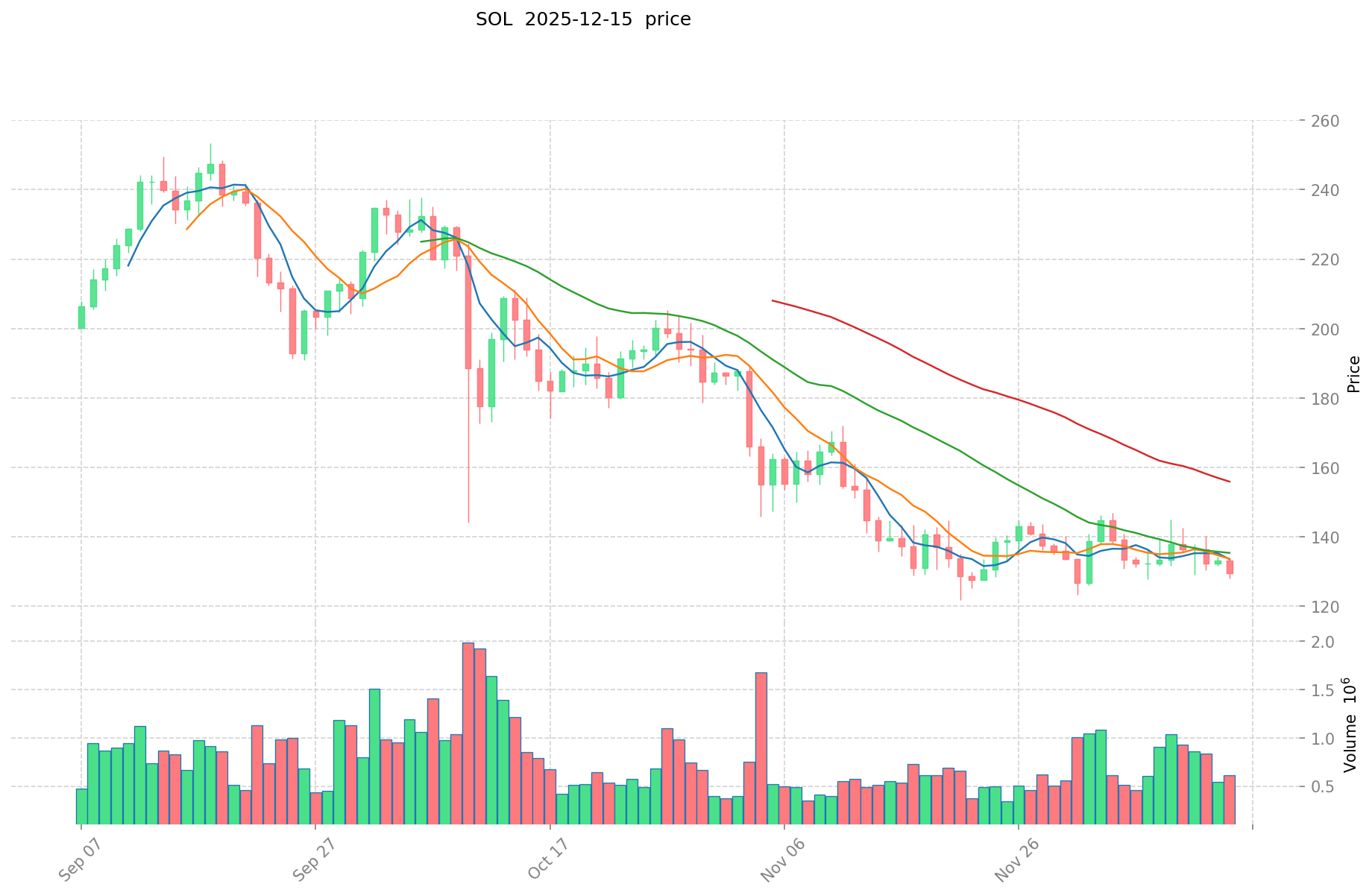
Solana reached its all-time high of $293.31 on January 19, 2025, driven by broader market bullishness and increased institutional adoption.
Its lowest price was $0.500801, recorded on May 12, 2020, likely due to early-stage market uncertainty and limited adoption.
These fluctuations reflect market sentiment, adoption trends, and external factors influencing the cryptocurrency space.
Click to view the current SOL market price
On-Chain Metrics
- Daily Transaction Volume: Data not available (indicates network activity)
- Active Addresses: Data not available (reflects user engagement)
- Staking Rate: Data not available (if applicable, shows community commitment to network security)
Solana Ecosystem Applications and Partnerships
Core Use Cases
Solana's ecosystem supports various applications:
- DeFi: Projects like Serum, providing decentralized trading.
- NFT and GameFi: Platforms like Solanart, driving digital collectibles and blockchain gaming.
Strategic Collaborations
Solana has established partnerships with Chainlink and Brave, enhancing its technical capabilities and market influence. These partnerships provide a solid foundation for Solana's ecosystem expansion.
Controversies and Challenges
Solana faces the following challenges:
- Technical Issues: Network outages and transaction delays
- Regulatory Risks: Potential SEC scrutiny
- Competitive Pressure: Rise of other blockchains like Ethereum
These issues have sparked discussions within the community and market, driving Solana's continuous innovation.
Solana Community and Social Media Atmosphere
Fan Enthusiasm
Solana's community is vibrant, with daily transaction volumes reaching millions.
On X, related posts and hashtags like #Solana frequently trend, with monthly post volumes in the millions.
Price surges and new feature releases ignite community enthusiasm.
Social Media Sentiment
Sentiment on X is polarized:
- Supporters praise Solana's high performance and scalability, viewing it as the "future of finance".
- Critics focus on network stability issues and centralization concerns.
Recent trends show generally bullish sentiment during market uptrends.
Hot Topics
X users actively discuss Solana's scalability solutions, network upgrades, and DeFi ecosystem growth, highlighting both its transformative potential and challenges in mainstream adoption.
More Information Sources on Solana
- Official Website: Visit Solana's official website for features, use cases, and latest updates.
- Whitepaper: Solana's whitepaper details its technical architecture, goals, and vision.
- X Updates: On X, Solana uses @solana, with over 2 million followers as of December 2025, covering technical upgrades, community events, and partnership news, generating thousands of likes and retweets.
Solana Future Roadmap
- 2026: Launch improved sharding solutions, enhancing TPS and network stability
- Ecosystem Goal: Support 10,000 DApps and attract 100 million users
- Long-term Vision: Become the global standard for high-performance blockchain infrastructure
How to Participate in Solana?
- Purchase Channels: Buy Solana on Gate.com
- Storage Solutions: Use Solana-compatible wallets for secure storage
- Governance Participation: Engage in community decisions through Solana's governance platform
- Ecosystem Building: Visit Solana's developer documentation to develop DApps or contribute code
Summary
Solana redefines digital currency through blockchain technology, offering high performance, scalability, and efficient transactions. Its active community, rich resources, and strong market performance make it stand out in the cryptocurrency space. Despite facing network stability challenges, Solana's innovative spirit and clear roadmap secure its important position in the future of decentralized technology. Whether you're a newcomer or an experienced player, Solana is worth watching and participating in.
FAQ
What is sol in crypto?
SOL is the native cryptocurrency of the Solana blockchain, known for its high-speed transactions and smart contract capabilities.
What is a sol in chemistry?
A sol in chemistry is a stable colloidal solution with solid particles dispersed in a liquid medium. It doesn't settle over time.
What does sol stand for in money?
SOL in money refers to Solana, a high-performance blockchain cryptocurrency. It's not an acronym, but the name of the digital asset.
What is the meaning of sol in medical terms?
SOL stands for Space-occupying Lesion, referring to a mass that takes up space within the body, often indicating abnormal growth or pathology.
Share
Content
Solana's Positioning and Significance
Origin and Development History
How Does Solana Work?
Solana's Market Performance
Solana Ecosystem Applications and Partnerships
Controversies and Challenges
Solana Community and Social Media Atmosphere
More Information Sources on Solana
Solana Future Roadmap
How to Participate in Solana?
Summary
FAQ
How to Buy Cryptocurrency


Trending Cryptocurrencies



XZXX: A Comprehensive Guide to the BRC-20 Meme Token in 2025

Bitcoin Fear and Greed Index: Market Sentiment Analysis for 2025

Top Crypto ETFs to Watch in 2025: Navigating the Digital Asset Boom

5 ways to get Bitcoin for free in 2025: Newbie Guide
Bitcoin Market Cap in 2025: Analysis and Trends for Investors

2025 Bitcoin Price Prediction: Trump's Tariffs' Impact on BTC

What Are the Major Cryptocurrency Security Risks and Smart Contract Vulnerabilities in 2024-2025?
What is BNB market cap and trading volume in 2025: complete market overview

What is BNB's whitepaper core logic and how does it drive the BNB Chain ecosystem?
What is NUC Price Volatility: Understanding the 3.33% Fluctuation and 52-Week Trading Range?

What Is RLS Community Activity and Why Does DApp Ecosystem Growth Matter in 2025?