What is ADA: A Comprehensive Guide to the Americans with Disabilities Act and Its Impact on Modern Society
Cardano's Positioning and Significance
In 2017, Charles Hoskinson launched Cardano (ADA), aiming to address scalability, sustainability, and interoperability issues in blockchain technology.
As a third-generation blockchain platform, Cardano plays a crucial role in DeFi, smart contracts, and sustainable blockchain solutions.
As of 2025, Cardano has become one of the top 15 cryptocurrencies by market capitalization, with a market cap of $14.83 billion and an active developer community. This article will delve into its technical architecture, market performance, and future potential.
Origin and Development History
Birth Background
Cardano was created by Charles Hoskinson in 2017, aiming to solve scalability and sustainability issues in blockchain technology.
It was born during the blockchain technology boom, with the goal of providing a more efficient, sustainable, and scientifically-driven blockchain platform.
Cardano's launch brought new possibilities for blockchain developers and businesses seeking a more sustainable and scalable platform.
Important Milestones
- 2017: Mainnet launched, implementing proof-of-stake consensus mechanism.
- 2020: Shelley upgrade introduced decentralized block production.
- 2021: Alonzo upgrade brought smart contract functionality, pushing the price to an all-time high of $3.09.
- 2022: Vasil hard fork enhanced scalability and smart contract capability.
With support from the Cardano Foundation and IOHK, Cardano continues to optimize its technology, security, and real-world applications.
How Does Cardano Work?
No Central Control
Cardano runs on a decentralized network of computers (nodes) spread globally, free from bank or government control. These nodes collaborate to validate transactions, ensuring system transparency and attack resistance, empowering users with greater autonomy and enhancing network resilience.
Blockchain Core
Cardano's blockchain is a public, immutable digital ledger that records every transaction. Transactions are grouped into blocks and linked through cryptographic hashes to form a secure chain. Anyone can view the records, establishing trust without intermediaries. Cardano's unique Ouroboros proof-of-stake protocol further enhances performance and energy efficiency.
Ensuring Fairness
Cardano uses a Proof-of-Stake (PoS) consensus mechanism to validate transactions and prevent fraudulent activities like double-spending. Stake pool operators maintain network security by running nodes and staking ADA, and receive ADA rewards in return. Its innovation includes higher energy efficiency and improved scalability compared to traditional PoW systems.
Secure Transactions
Cardano uses public-private key encryption to protect transactions:
- Private keys (like secret passwords) are used to sign transactions
- Public keys (like account numbers) are used to verify ownership
This mechanism ensures fund security, keeping transactions pseudonymous. Additional security features include multi-signature wallets and quantum-resistant encryption techniques.
Cardano's Market Performance
Circulation Overview
As of December 15, 2025, Cardano's circulating supply is 36,642,122,600.96213 ADA, with a total supply of 45,000,000,000 ADA. This indicates a fixed supply model.
Price Fluctuations
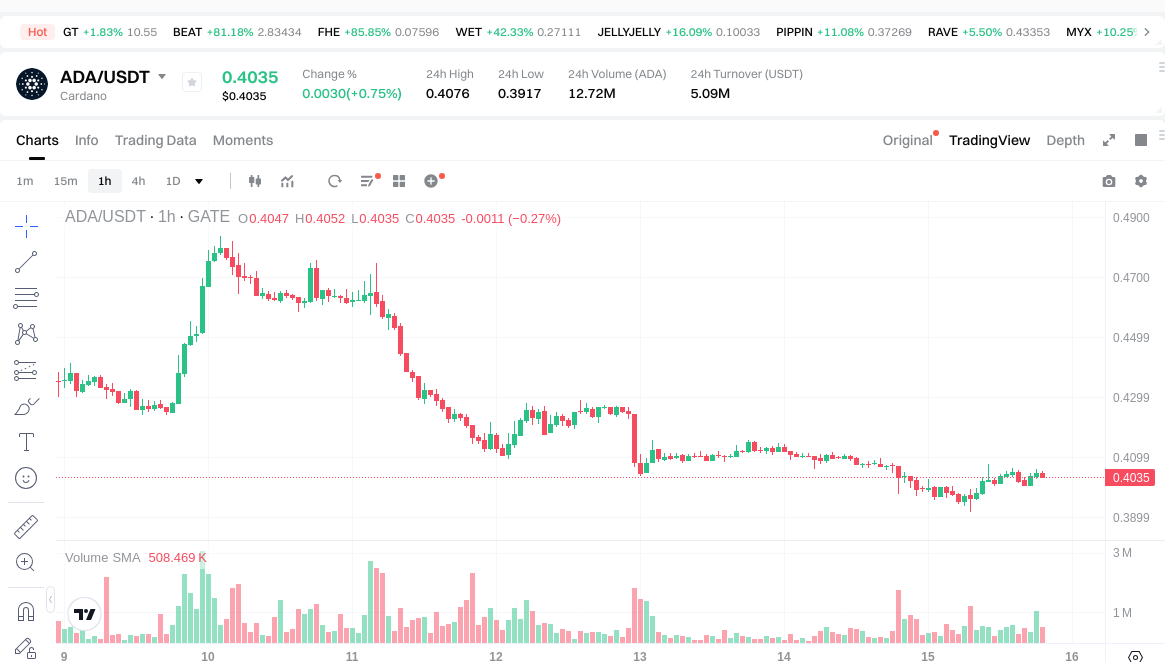
Cardano reached its all-time high of $3.09 on September 2, 2021, driven by overall market bullishness and increased adoption.
Its lowest price was $0.01925275, occurring on March 13, 2020, likely due to the global market crash associated with the COVID-19 pandemic.
These fluctuations reflect market sentiment, adoption trends, and external factors.
Click to view the current ADA market price
On-Chain Metrics
- Daily Transaction Volume: Data not available
- Active Addresses: Data not available
- Staking Rate: Data not available
Cardano Ecosystem Applications and Partnerships
Core Use Cases
Cardano's ecosystem supports various applications:
- DeFi: Projects like SundaeSwap, providing decentralized trading.
- NFT: Platforms such as CNFT.IO, driving digital collectibles innovation.
Strategic Collaborations
Cardano has established partnerships with IOHK, Emurgo, and the Cardano Foundation, enhancing its technical capabilities and market influence. These partnerships provide a solid foundation for Cardano's ecosystem expansion.
Controversies and Challenges
Cardano faces the following challenges:
- Technical Issues: Scalability concerns and network congestion
- Regulatory Risks: Potential scrutiny from financial regulators
- Competitive Pressure: The rise of other blockchain platforms
These issues have sparked discussions within the community and market, driving Cardano's continuous innovation.
Cardano Community and Social Media Atmosphere
Fan Enthusiasm
Cardano's community is vibrant, with over 3 million wallet addresses.
On X, related posts and hashtags like #Cardano frequently trend, with monthly post volumes reaching millions.
Network upgrades and new feature releases ignite community enthusiasm.
Social Media Sentiment
Sentiment on X shows polarization:
- Supporters praise Cardano's peer-reviewed approach and sustainability, viewing it as the "future of blockchain".
- Critics focus on development delays and market performance.
Recent trends indicate cautious optimism amidst market volatility.
Hot Topics
X users actively discuss Cardano's smart contract capabilities, energy efficiency, and potential real-world applications, highlighting both its transformative potential and the challenges in mainstream adoption.
More Information Sources on Cardano
- Official Website: Visit Cardano's official website for features, use cases, and latest updates.
- White Paper: Cardano's white paper details its technical architecture, goals, and vision.
- X Updates: On X, Cardano uses @Cardano, with over 1.2 million followers as of December 15, 2025, Posts cover technical updates, community events, and partnership news, generating significant engagement.
Cardano's Future Roadmap
- 2026: Launch Hydra scaling solution, enhancing transaction throughput and scalability
- Ecosystem Goal: Support thousands of DApps and attract millions of users
- Long-term Vision: Become a global financial and social operating system
How to Participate in Cardano?
- Purchase Channels: Buy ADA on Gate.com
- Storage Solutions: Use Daedalus or Yoroi wallets for secure storage
- Governance Participation: Engage in community decisions through Project Catalyst
- Ecosystem Building: Visit Cardano Developers Portal to develop DApps or contribute code
Summary
Cardano redefines digital currency through blockchain technology, offering transparency, security, and efficient transactions. Its active community, rich resources, and strong market performance make it stand out in the cryptocurrency space. Despite facing regulatory and technical challenges, Cardano's innovative spirit and clear roadmap secure its important position in the future of decentralized technology. Whether you're a beginner or an experienced player, Cardano is worth watching and participating in.
FAQ
What exactly does ADA do?
ADA powers Cardano's blockchain, enabling smart contracts, decentralized apps, and fast, secure transactions. It's used for staking, governance, and as a digital currency in the Cardano ecosystem.
What is considered a violation of ADA?
An ADA violation occurs when an employer discriminates against disabled employees by demoting, terminating, harassing, or failing to provide reasonable accommodations. This is illegal under the Americans with Disabilities Act.
What does ADA stand for in medical terms?
ADA stands for American Dental Association or Adenosine deaminase, an enzyme.
What does ADA mean in court?
ADA in court refers to the Americans with Disabilities Act, a federal law ensuring equal access and prohibiting discrimination against individuals with disabilities in all court activities and services.
Share
Content
Cardano's Positioning and Significance
Origin and Development History
How Does Cardano Work?
Cardano's Market Performance
Cardano Ecosystem Applications and Partnerships
Controversies and Challenges
Cardano Community and Social Media Atmosphere
More Information Sources on Cardano
Cardano's Future Roadmap
How to Participate in Cardano?
Summary
FAQ
How to Buy Cryptocurrency


Trending Cryptocurrencies



XZXX: A Comprehensive Guide to the BRC-20 Meme Token in 2025

Bitcoin Fear and Greed Index: Market Sentiment Analysis for 2025

Top Crypto ETFs to Watch in 2025: Navigating the Digital Asset Boom

5 ways to get Bitcoin for free in 2025: Newbie Guide

Bitcoin Market Cap in 2025: Analysis and Trends for Investors

2025 Bitcoin Price Prediction: Trump's Tariffs' Impact on BTC
Gate Ventures Weekly Crypto Recap (December 15, 2025)
What is CC: A Comprehensive Guide to Creative Commons and Its Impact on Digital Content Sharing
What is TAO: Understanding the Ancient Chinese Philosophy of the Way and Its Modern Applications
How Japan's Interest Rate Hike Affects Bitcoin and the Crypto Market
Bitcoin Four-Year Cycle: Why Market Cycles Are No Longer Anchored to Halving Events