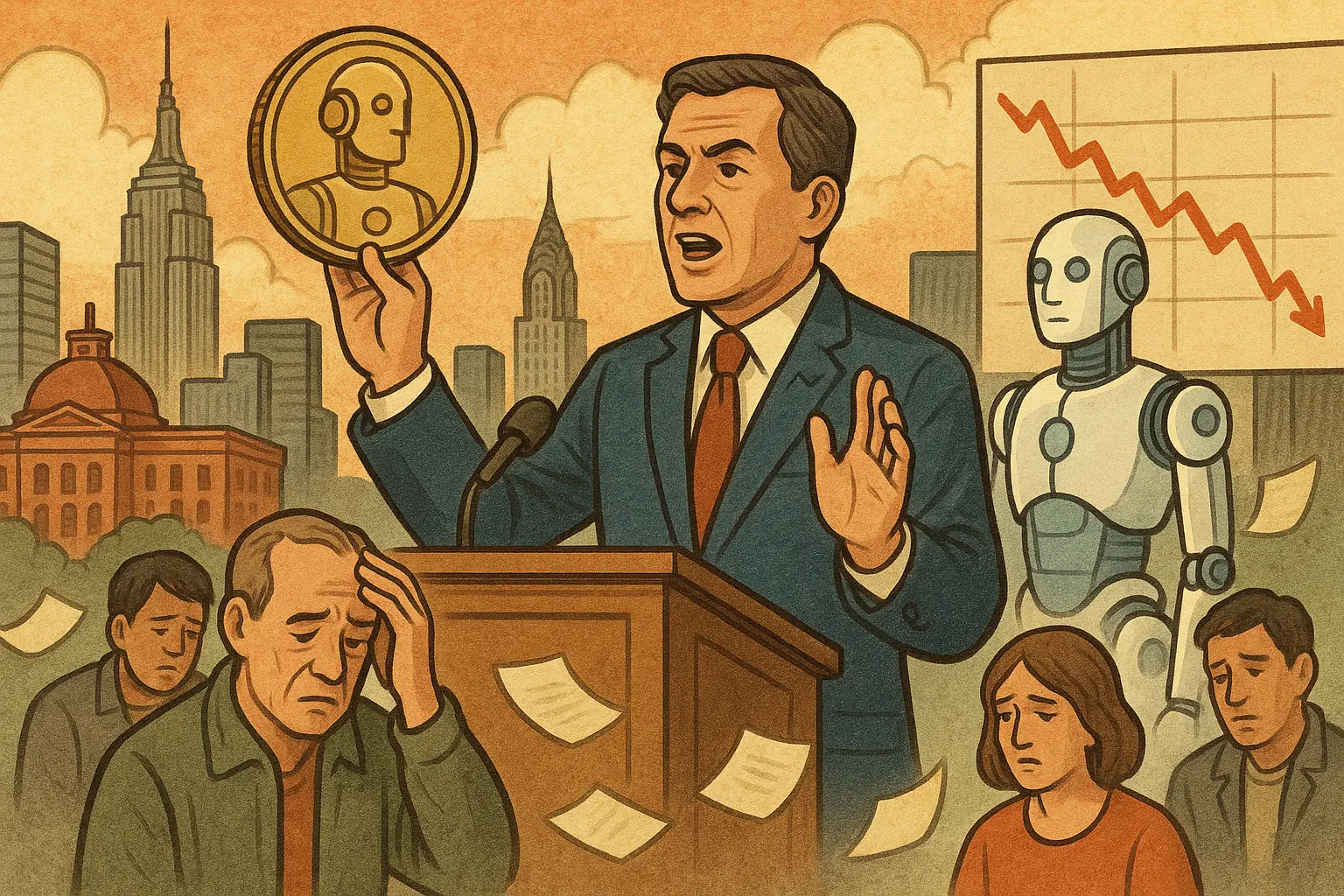
New York state legislator and congressional candidate Alex Bores announced on Sunday an “AI dividend” plan, aiming to make direct payments to U.S. citizens when artificial intelligence significantly replaces American workers. The announcement comes after a Goldman report found that AI adoption has already led to the loss of about 16k jobs per month in the United States; tech giants including Amazon, Meta, Intel, and Microsoft have all announced large-scale layoffs in succession.
Design mechanisms of the AI dividend plan: trigger conditions and how the funds are used
(Source: Alex Bores)
The AI dividend plan is not a fixed universal basic income (UBI). Instead, it sets trigger conditions—only when AI “significantly replaces American workers” will it be activated. In addition to making direct dividend payments to U.S. citizens, the funds will be used in three directions: investing in “workforce transition, training, and education”; building AI oversight and safety infrastructure; and incentivizing employers to choose hiring humans rather than AI.
The funding-raising mechanism includes: taxing the use of AI, holding equity in leading AI companies, and reforming the tax treatment of labor and capital. Bores is currently positioning this policy as a key platform for his congressional campaign, and whether it can be implemented depends on whether his campaign is successful.
Divergence between the two institutions: how severe is the AI unemployment impact, really?
A Goldman report shows that AI adoption has led to the loss of about 16k jobs per month in the United States, and the large-scale layoffs by Amazon, Meta, Intel, and Microsoft are considered to be directly related to AI efficiency-driven substitution.
However, a more cautious assessment was provided in a report published by Morgan Stanley on April 14: so far, AI’s impact on the labor market is “relatively mild,” and there is no sufficient evidence indicating that widespread unemployment is already occurring. Morgan Stanley cites historical patterns showing that waves of new technology long-term have typically also promoted job growth—while at the same time acknowledging that artificial intelligence may break this historical rule.
Policy backdrop: political responses amid the tech giants’ layoff wave
The proposal of the AI dividend plan reflects the U.S. political establishment’s growing attention to how AI is affecting the job market. How to allocate the productivity gains brought by AI is becoming a campaign issue for more and more political figures. From conception to implementation, the plan still faces several major challenges, including quantifying the trigger conditions, the legality of an AI usage tax, the enforcement mechanisms for holding equity in AI companies, and how to avoid negative impacts on AI innovation.
Frequently asked questions
What are the trigger conditions of the AI dividend plan, and does it amount to universal basic income?
The AI dividend is not a universal basic income (UBI). Its key difference lies in the setting of trigger conditions—only when AI “significantly replaces American workers” will it be activated. The plan is positioned as an “insurance mechanism,” not a fixed baseline income. The specific quantitative trigger criteria (such as an unemployment-rate threshold) have not been explained in detail in public statements.
Why do Goldman and Morgan Stanley assess the AI unemployment impact differently?
Goldman focuses on presenting substitution effects that have already occurred (16k job losses per month), while Morgan Stanley evaluates from a longer historical perspective, concluding that the impact is “mild” for now, and citing historical precedents that after technological substitution, job growth typically follows. At the same time, it also acknowledges that AI’s disruptive potential may differ from past technology revolutions.
Is this plan legislatively feasible?
The plan is currently still at the campaign-proposal stage. The premise for implementation is that Bores successfully wins a seat in Congress and secures sufficient political support in Congress. The AI usage tax and mandatory shareholding mechanisms involved in the plan may face strong resistance from the tech industry and capital markets.
Disclaimer: The information on this page may come from third parties and does not represent the views or opinions of Gate. The content displayed on this page is for reference only and does not constitute any financial, investment, or legal advice. Gate does not guarantee the accuracy or completeness of the information and shall not be liable for any losses arising from the use of this information. Virtual asset investments carry high risks and are subject to significant price volatility. You may lose all of your invested principal. Please fully understand the relevant risks and make prudent decisions based on your own financial situation and risk tolerance. For details, please refer to
Disclaimer.
Related Articles
Alipay Launches AI Agent Payments in Hangzhou, Reaches 100M Users
Gate News message, April 21 — Alipay has launched an AI agent payment service in Hangzhou that enables OpenClaw-type AI agents to make purchases and process payments on a user's behalf. The feature requires users to enable it, verify their identity, and approve each transaction, with risk controls a
GateNews24m ago
Moonshot AI Launches Kimi K2.6 With 300-Agent Swarm Capability, Advancing Autonomous AI Systems
Moonshot AI's Kimi K2.6 expands parallel sub-agents to 300, boosts multi-domain task speed to 4,000 steps, and adds a Skills tool for converting documents into reusable templates.
Abstract: Moonshot AI releases Kimi K2.6, an open-source model that scales agent orchestration to 300 parallel sub-agents and 4,000 coordinated steps. It improves long-horizon coding across Rust, Go, and Python, enhances front-end, DevOps, and performance optimization, and introduces a Skills mechanism that converts PDFs, spreadsheets, and Word files into reusable task templates for autonomous multi-step workflows and persistent monitoring.
GateNews54m ago
Qualcomm CEO Meets Samsung, SK Hynix, LG on Memory Supply and AI Partnerships
Gate News message, April 21 — Qualcomm CEO Cristiano Amon recently met with executives from Samsung Electronics, SK Hynix, and LG Electronics to discuss memory supply, chip manufacturing, and AI partnerships. The talks centered on addressing Qualcomm's tight LPDDR memory supply as demand for AI
GateNews1h ago
Bundesbank Warns Anthropic's Mythos Model Could Expose Weak Spots in European Banking Systems
Gate News message, April 21 — Germany's Bundesbank President Joachim Nagel warned on Tuesday that Anthropic's Mythos AI model poses significant cybersecurity risks to European financial institutions and called for broader access to the technology. Nagel, also a member of the European Central Bank
GateNews2h ago
South Korea's Semiconductor Exports Surge 182.5% in Early April on AI Chip Demand
AI demand boosted Korea's semiconductor exports and profits for Samsung and SK hynix; shipments to China and the US rose. Yet policy risks from U.S. tariffs loom despite a record 2025 level.
Abstract: The article reports that South Korea's semiconductor exports surged in early April, driven by AI-related demand that increased memory-chip shipments and profits for Samsung Electronics and SK hynix. Exports rose to US$18.3 billion in April 1–20, with total exports up 49.4% to US$50.4 billion and a US$10.4 billion trade surplus. China and the United States were primary growth markets, and 2025 semiconductor exports reached a record US$173.4 billion, up over 20% year over year. However, policy uncertainties persist: a 25% U.S. tariff on certain advanced computing chips could affect sentiment, memory-chip exports being excluded, and tensions in the Middle East and broader tariff policies could weigh on the outlook.
GateNews2h ago
Economists point out job opportunities after an AI-driven job displacement wave: the value of scarcity shifts toward “emotional services”
Imas points out that AI will not completely replace human labor, but will shift scarcity toward an economy centered on emotion and relationships. The Starbucks experiment reveals the blind spots of automation: customer retention depends on how they’re treated and the atmosphere. Historical structural transformations and the Baumol effect show that AI reduces the prices of standardized goods, so scarcity shifts toward high-perceived value that requires interpersonal interaction. In the future, the focus will be on emotional services and areas like handmade crafts, but issues of global distribution and basic income still need to be addressed.
ChainNewsAbmedia2h ago


