Kelp DAO released a statement on April 21, rebutting LayerZero’s criticism of its 1/1 DVN configuration, and pointing to LayerZero infrastructure as the root cause of the $292 million vulnerability. Aave released an event impact assessment report: under a loss evenly distributed scenario, the loss is about $124 million; under a scenario where losses are concentrated on L2, it is as high as $230 million.
Kelp DAO’s Rebuttal: DVN Default Settings and the Attack Target Are LayerZero Infrastructure
LayerZero previously criticized Kelp DAO for adopting a 1/1 DVN configuration that creates a single point of failure in its event report, and said it had already provided best-practice recommendations to Kelp DAO regarding distributed verification. Kelp DAO responded directly: “The 1/1 DVN configuration is the default configuration recorded in LayerZero documentation and applies to all new OFT deployments. Since January 2024, Kelp has been running on LayerZero infrastructure, and this configuration has been explicitly confirmed as appropriate during the L2 expansion period.”
Kelp DAO also noted that its mitigation measures effectively prevented further losses—pausing all relevant contracts, adding the attacker-associated wallets to a blacklist, and contacting SEAL-911. These measures successfully prevented the attacker from attempting to steal an additional 40,000 rsETH (about $95 million) by forging data packets.
Aave Bad Debt Analysis: Two Scenarios, Up to $230 Million
(Source: Aave)
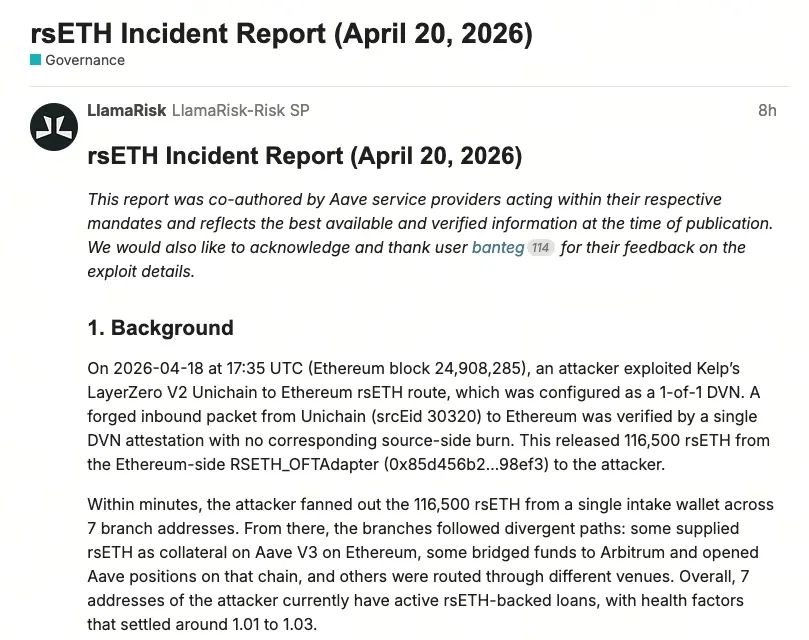
The attacker provided 89,567 rsETH (about $221 million) as collateral for Aave V3, borrowing 82,650 WETH and 821 wstETH, resulting in extremely low health factors for the related positions. Aave evaluated two hypothetical scenarios:
Scenario One (Even Distribution): About 112,204 rsETH losses are evenly distributed across all chains; rsETH de-pegs by 15.12%; Aave’s total bad debt is about $123.7 million. The Ethereum core market has the largest absolute loss ($91.8 million), but WETH reserves are sufficient, leaving a gap of only 1.54%; the Mantle market has the highest gap ratio, at 9.54%.
Scenario Two (Loss Concentration on L2): Losses are concentrated in L2 rsETH; the L2 collateral is reduced by 73.54%; bad debt in the L2 markets (Mantle, Arbitrum, Base) reaches $230.1 million, while Ethereum mainnet rsETH is fully supported.
Aave stated: “Which case occurs depends on Kelp’s accounting treatment of rsETH and how the LRTOracle exchange rate is updated—these are decisions Aave cannot control.”
Aave’s Capital Buffer and Next Steps
In scenario one, the $54 million WETH Umbrella fund held by Aave can serve as initial collateral; in scenario two, the fund would not be triggered. Aave DAO currently holds $181 million in assets and has already received multiple commitments from ecosystem participants to provide support in the event of bad debt. Kelp DAO said it is working with Aave, LayerZero, and all major stakeholders to jointly assess the next steps for restoring operations of the protocol and potential mitigation solutions.
Frequently Asked Questions
What is at the core of the responsibility dispute between Kelp DAO and LayerZero?
The dispute centers on the 1/1 DVN configuration. LayerZero believes that Kelp DAO’s adoption of a configuration with only one DVN creates a single point of failure, and that security recommendations were provided earlier. Kelp DAO rebuts that 1/1 DVN is the default set by LayerZero for all new deployments and has been confirmed by LayerZero as appropriate during the L2 expansion period; the real security vulnerability lies in LayerZero’s own RPC nodes being compromised.
How are Aave’s two bad debt scenarios calculated?
Scenario one assumes losses of about 112,204 rsETH are evenly allocated to all chains; rsETH de-pegs by 15.12%, corresponding to Aave bad debt of about $123.7 million. Scenario two assumes losses are concentrated on L2; the L2 rsETH collateral is reduced by 73.54%, and bad debt in the L2 markets reaches $230.1 million. The key difference between the two scenarios is how Kelp ultimately allocates responsibility for the losses.
What capital resources does Aave have to address potential bad debt?
Aave has a $54 million WETH Umbrella fund (available in scenario one), $181 million in Aave DAO assets, and multiple support commitments from ecosystem participants. If the bad debt exceeds the above buffer, according to Aave’s security module design, stkAAVE holders’ staked tokens may provide protection for the remaining gap through a Slashing mechanism.
Disclaimer: The information on this page may come from third parties and does not represent the views or opinions of Gate. The content displayed on this page is for reference only and does not constitute any financial, investment, or legal advice. Gate does not guarantee the accuracy or completeness of the information and shall not be liable for any losses arising from the use of this information. Virtual asset investments carry high risks and are subject to significant price volatility. You may lose all of your invested principal. Please fully understand the relevant risks and make prudent decisions based on your own financial situation and risk tolerance. For details, please refer to
Disclaimer.
Related Articles
DefiLlama Founder: Arbitrum Prioritizing Seized Funds for Aave Market Could Cut Bad Debt by 80%
Gate News message, April 21 — According to DefiLlama founder 0xngmi, if Arbitrum prioritizes using seized funds for the Aave market on Arbitrum, bad debt could be significantly reduced. Under a "loss socialization" scenario, Arbitrum would face no bad debt at all; if rsETH on the L2 faces a
GateNews1h ago
Singapore's MetaComp Launches AI Agent Framework for Financial Compliance and Payments
MetaComp debuts StableX Know Your Agent for regulated AI in payments, combining multi-vendor analytics to slash false clean rates, with AgentX Skills supporting Claude; aims for auditable cross-border finance via downloadable AI Skills.
Abstract: MetaComp introduces the StableX Know Your Agent framework to govern AI agents in regulated payments and wealth management, covering identity, permissions, monitoring, auditing, and agent-to-agent interactions. It reduces false positives by parallel analytics from multiple vendors and enables auditable cross-border finance through downloadable AI Skills (AgentX), starting with Claude support and expansion across regions.
GateNews1h ago
Qivalis Consortium of 12 European Banks Advances Euro Stablecoin Launch for H2 2026
Qivalis, a 12-bank European consortium including BBVA and BNP Paribas, is advancing a euro-stablecoin with a planned H2 2026 launch, backed by Fireblocks for issuance and distribution and Dutch central bank oversight under MiCAR.
Abstract: The Qivalis euro-stablecoin project, backed by 12 European banks and Fireblocks, targets a H2 2026 launch with Dutch central bank oversight under MiCAR, aiming to expand euro-denominated stablecoin use in institutional markets.
GateNews2h ago
OCBC Launches GOLDX Tokenized Gold Fund on Ethereum and Solana
OCBC launches GOLDX, a tokenized physical gold fund on Ethereum and Solana with Lion Global Investors and DigiFT, targeting institutions and Web3 participants; tokenized RWAs reach $29B on chains.
OCBC, with Lion Global Investors and DigiFT, introduced GOLDX, a tokenized version of the LionGlobal Singapore Physical Gold Fund on Ethereum and Solana. The product targets institutional investors and high‑net‑worth individuals, allowing purchases with stablecoins or fiat and delivery to blockchain wallets, providing on‑chain exposure to about $525 million in gold assets. OCBC views GOLDX as a milestone linking traditional finance with the decentralized finance ecosystem to attract Web3 participants. The broader context shows rapid growth in tokenized real‑world assets, with RWAs on public blockchains exceeding $29 billion by mid‑April 2026, while gold prices traded in a tight range around $4,775–$4,831 per ounce.
GateNews2h ago
Aave rsETH Event Update: Core V3 WETH Unfrozen, Five Major Markets Reserves Still Frozen
Aave announced on X on April 21 that the WETH reserves in the Ethereum Core V3 market have been unfrozen, and users can supply WETH to Ethereum Core V3 again; the WETH loan-to-value ratio (LTV) remains at 0. WETH reserves on Ethereum Prime, Arbitrum, Base, Mantle, and Linea remain frozen.
MarketWhisper3h ago
Ice Open Network suffers a data leak by an insider, and after the ION token plunged, it reorganized to survive
Ice Open Network posted on X on April 20, confirming that a data breach occurred last week. The cause was that after four business partners terminated their business relationship with a third-party service provider, they still accessed external servers, leaking users’ email addresses, 2FA phone numbers, and identity-linked data. The background of this incident is that the ION token had already crashed by 93% two weeks ago, and the project team is in a period of large-scale emergency restructuring.
MarketWhisper3h ago


