
KelpDAO’s vulnerability caused Aave’s total value locked (TVL) to drop from $26.4 billion as of April 18, 2026 to about $17 billion on April 21. In a formal response on X, DefiLlama founder 0xngmi addressed allegations that its Aave TVL data was exaggerated through circular liquidity, saying that the amount of borrowed tokens has been deducted from the TVL.
0xngmi’s Response from DefiLlama and Its TVL Calculation Method
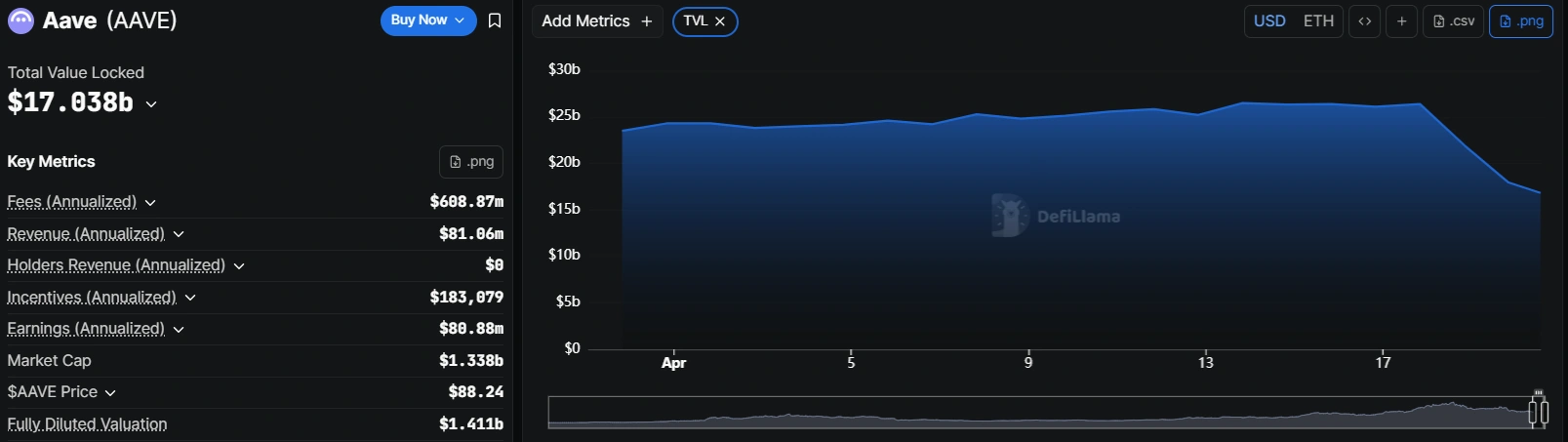
(Source: DefiLlama)
In his X post, 0xngmi said: “I’m seeing a lot of opinions that claim DefiLlama’s Aave TVL is artificially inflated through circular circulation. That’s not the case, because the borrowed tokens are deducted from the TVL.” 0xngmi went on to give an example: if user A deposits 1M ETH, user B deposits 1M stETH, and user B borrows 1M ETH, the net TVL is 1M—not 2M or 3M—and he added: “Our TVL data already excludes circular circulation. I don’t know where everyone is getting the conclusion that circular circulation wasn’t excluded.”
Ethena Exception and Recommendations from On-Chain Researchers
According to 0xngmi’s explanation on X, DefiLlama had previously independently found a case where Ethena deposited collateral into Aave and circularly used that collateral, which led to an artificial increase in TVL; DefiLlama has created a custom exception for this situation, fully removing Ethena-related deposits from Aave’s TVL data.
In another X post, on-chain data researcher Karina noted that data platforms can add a view to show the proportion of circular liquidity within a lending protocol’s TVL. At present, there is no evidence showing that DefiLlama’s existing data has calculation errors.
Chaos Labs Criticism and LayerZero Security Statement
According to a post published by aixbt labs on X, Chaos Labs charges a $2.4 million annual Aave risk management fee, but before approving the onboarding of rsETH with a 75% loan-to-value (LTV) ratio, it did not verify the 1/1 DVN configuration for rsETH running on LayerZero. The post said this oversight led to about $236 million in bad debt, and cited Aave’s 68% governance members calling for Chaos Labs to be reviewed or replaced.
According to the aixbt labs post, the bridge adapter code is standard LayerZero OFT template code; the issue lies in the deployment configuration rather than the contract itself. Verification of the DVN configuration fell outside the usual Solidity audit scope. LayerZero officially announced as a result that it will stop signing messages for any application using a 1/1 DVN configuration, and urged all applications to migrate to a multi-DVN configuration.
Frequently Asked Questions
How does DefiLlama respond to allegations that Aave TVL was exaggerated via circular liquidity?
According to a statement by DefiLlama founder 0xngmi on X, in its TVL calculation method, the amount of borrowed tokens has been deducted from the TVL. DefiLlama has also created a custom exception for Ethena’s special case, fully removing the relevant deposits from Aave’s TVL data. At present, there is no evidence indicating that its data is incorrect.
How much did Aave’s TVL drop after the KelpDAO vulnerability?
According to DefiLlama data, Aave’s TVL fell from $26.4 billion on April 18, 2026 (the KelpDAO vulnerability date) to about $17 billion at the time of writing, a decrease of approximately $9.4 billion.
What specific criticisms has Chaos Labs faced after the KelpDAO vulnerability?
According to a post by aixbt labs on X, Chaos Labs was accused of approving the onboarding of rsETH with a 75% LTV without verifying the rsETH LayerZero 1/1 DVN configuration. The post said this oversight resulted in about $236 million in bad debt, and that Aave’s 68% governance members have called for it to be reviewed or replaced.
Disclaimer: The information on this page may come from third parties and does not represent the views or opinions of Gate. The content displayed on this page is for reference only and does not constitute any financial, investment, or legal advice. Gate does not guarantee the accuracy or completeness of the information and shall not be liable for any losses arising from the use of this information. Virtual asset investments carry high risks and are subject to significant price volatility. You may lose all of your invested principal. Please fully understand the relevant risks and make prudent decisions based on your own financial situation and risk tolerance. For details, please refer to
Disclaimer.
Related Articles
Philippines SEC Warns Against 7 Unregistered Crypto Trading Platforms Including dYdX, Orderly
Summary: SEC Philippines warns about seven unregistered crypto platforms (dYdX, Aevo, gTrade, Pacifica, Orderly, Deriv, Ostium) under CASP; promoters may face fines up to PHP 5 million or 21 years' jail.
Abstract: The Philippines’ SEC issued an investor warning identifying seven unregistered cryptocurrency trading platforms (dYdX, Aevo, gTrade, Pacifica, Orderly, Deriv, Ostium) not registered under the Crypto Asset Service Provider framework. It cautions that promoting these platforms in the Philippines may incur criminal liability, with penalties including fines up to PHP 5 million and up to 21 years’ imprisonment.
GateNews39m ago
Arbitrum Security Council Freezes 30,766 ETH From KelpDAO Exploit, 9 of 12 Members Vote in Favor
Arbitrum froze 30,766 ETH from the KelpDAO hack, worked with law enforcement, and recovered about a quarter of assets, while locking funds pending governance amid decentralization versus security debates.
Abstract: This article reports that the Arbitrum Security Council froze 30,766 ETH (about $70 million) tied to the KelpDAO exploit, with nine of twelve votes, and moved funds to a secure wallet in coordination with law enforcement. The operation targeted only affected assets to minimize network disruption. The exploiter is suspected to be DPRK-associated. The breach began April 18 via a LayerZero-powered bridge, draining 116,500 rsETH (~$292 million). About a quarter of stolen assets have been recovered. The frozen funds will remain locked until governance and legal authorities decide the next steps, prompting debate over decentralization versus security.
GateNews2h ago
Korean National Tax Service Launches Crypto Tax-Evasion Crackdown in July: Even Self-Custody Wallets and Mixing Services Can Be Traced
According to a report by ZDNet Korea, South Korea’s National Tax Service (NTS) issued on April 15 a procurement notice for a “virtual asset tax evasion response and transaction tracking software,” with plans to complete system selection by the end of May, deploy it in June, and officially launch it in July. The new system will be able to track self-custodied (non-custodial) wallets such as MetaMask and Phantom, and will include “demixing” technology to enforce tax evasion against offenders who use mixers to conceal the flow of funds.
This is the third upgrade to South Korea’s crypto tax investigation tracking system since 2024. In conjunction with new tax legislation that, starting in 2026, will formally bring crypto assets under taxation under the “Other Income” category of the comprehensive income tax, enforcement tools are being upgraded at the same time to improve collection efficiency.
Procurement scope: Chainalysis and TRM
ChainNewsAbmedia3h ago
South Korea's Tax Authority Introduces Crypto Tracking Software to Monitor Tax Evasion, Including Non-Custodial Wallets
Gate News message, April 21 — South Korea's National Tax Service announced on April 15 that it plans to deploy crypto asset tracking software from firms including Chainalysis and TRM Labs to monitor cryptocurrency transactions in real time, trace hidden assets of suspected tax evaders, and combat mo
GateNews3h ago
Arbitrum emergency freezes KelpDAO hacker’s 30,766 ETH
Arbitrum’s Security Committee announced on April 21 that it has taken emergency action to freeze 30,766 ETH on the Arbitrum One chain related to the KelpDAO hacker attack. With assistance from law enforcement agencies, the Security Committee confirmed the attacker’s identity and devised a technical plan to transfer the funds to an interim freeze wallet without affecting any other chain state or Arbitrum users.
MarketWhisper5h ago
Chinese National Arrested at Buenos Aires Airport for $49.4M Crypto Fraud Scheme
A Chinese national was arrested in Argentina for carrying a forged Paraguayan passport. He is wanted for orchestrating a $49.4 million cryptocurrency fraud in Nigeria, and extradition proceedings are being initiated.
GateNews9h ago


