
Layer 1 blockchain Pharos announced its native token PROS tokenomics framework on April 21. The total supply of PROS is 1 billion tokens, including a 6% airdrop. Both the core team and investors are subject to a lock-up of 12 months plus linear release over 36 months. The staking inflation policy is divided into two phases: for the first six months before the mainnet launch it is 0%, from the seventh month onward it is 5% per year, after which the foundation adjusts it dynamically based on network operations.
PROS Genesis Supply Allocation Overview
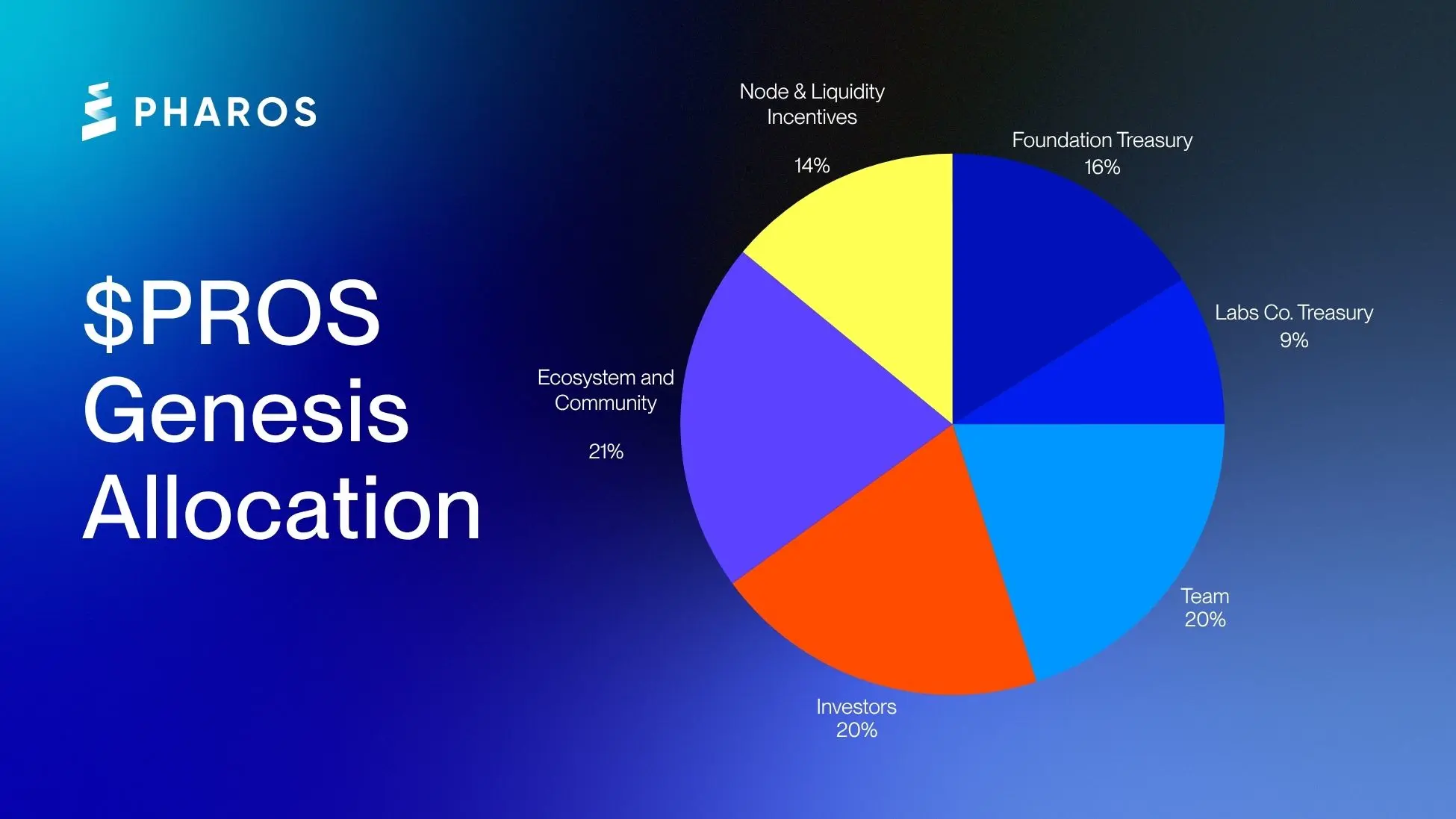
Pharos uses a structured token issuance framework, aiming to reduce short-term supply pressure and promote long-term development:
Foundation Treasury: 16%, with the lock-up period extended to as long as 48-60 months
Lab Co. Treasury: 9%, adopting an extended vesting period
Core Team: 20%, 12 months locked + 36 months linear release
Investors (Private Placement): 20%, 12 months locked + 36 months linear release
Ecosystem and Community: 21%, including a 6% airdrop (1% unlocked at TGE, 5% reserved for future community growth)
Node and Liquidity Incentives: 14%
During the TGE period, only part of the genesis tokens are expected to enter circulation, while the rest will be unlocked gradually according to the published issuance plan.
PROS Token Utility: From Transaction Fees to RWA-Specific Applications
PROS serves multiple functions within the Pharos network. At the base network level, it acts as the payment medium for transaction fees and on-chain execution costs, and as adoption increases, it may perform partial token burn to create deflationary pressure. In terms of security and governance, PROS protects network security through PoS staking, and as a governance token it allows holders to propose and vote on network upgrades and ecosystem initiatives.
At the RWA application layer, potential specific uses for PROS include stablecoin collateral, prioritized access to financial primitives, and using staked RWA for network security (subject to future governance decisions). This design differentiates Pharos from most general-purpose Layer 1 blockchains by making institutional-grade financial applications its core objective.
Staking Inflation Policy: The Logic of a Phased Design
Pharos adopts a phased staking issuance policy. For the first six months after the mainnet goes live, the staking inflation rate is 0%, aiming to maintain early supply discipline and avoid unnecessary dilution pressure during the price discovery phase. Starting from the seventh month, the annual inflation rate is set at 5% to introduce a sustainable security budget for validator incentives and long-term ecosystem expansion. After that, the foundation may dynamically adjust the inflation rate based on staking participation levels, the need for validator incentives, and the state of overall ecosystem development.
Frequently Asked Questions
What is Pharos, and how does it differ in positioning from other Layer 1s?
Pharos is a high-performance Layer 1 public blockchain that uses a PoS consensus mechanism, focused on real-world financial applications (RWA), stablecoin infrastructure, and a payment-grade on-chain experience. Its clear design orientation toward RWA differentiates it from most general-purpose Layer 1 blockchains. The mainnet officially launched on December 12, 2025.
How exactly will the 6% PROS airdrop be released?
The 6% community airdrop is a subset of the 21% ecosystem and community allocation. Of this, 1% will be unlocked immediately at TGE (token generation event), and 5% will be reserved for future community growth plans and airdrop incentives. The specific release schedule will be announced based on subsequent community planning.
Why adopt a zero-inflation transition to a phased design that reaches 5% annualized?
Pharos believes that token issuance should reflect the network’s development stages: the initial 0% inflation maintains supply discipline, reduces dilution impact on early holders, and provides sufficient room for price discovery in the market. The 5% annual inflation introduced after the seventh month provides a sustainable source of funds to support validator incentives and the network’s long-term security; the balance between the two is the core logic of the entire framework design.
Disclaimer: The information on this page may come from third parties and does not represent the views or opinions of Gate. The content displayed on this page is for reference only and does not constitute any financial, investment, or legal advice. Gate does not guarantee the accuracy or completeness of the information and shall not be liable for any losses arising from the use of this information. Virtual asset investments carry high risks and are subject to significant price volatility. You may lose all of your invested principal. Please fully understand the relevant risks and make prudent decisions based on your own financial situation and risk tolerance. For details, please refer to
Disclaimer.
Related Articles
Story (IP) launches re-staking and kicks off a 200 million KRW incentive campaign
Gate News message, April 21——A certain CEX has launched a Story (IP) re-staking product, adding it to the list of existing staking assets such as 15 assets including ETH, SOL, TRX, and more. The incentive campaign will run from April 21 to 27, with a total prize pool of 200 million KRW.
$IP is the native token of the Story protocol. Story positions itself as an AI-focused on-chain IP infrastructure, supporting IP registration for datasets, models, and AI-generated content, programmable licensing, and automated revenue distribution.
GateNews1h ago
Ice Open Network suffers a data leak by an insider, and after the ION token plunged, it reorganized to survive
Ice Open Network posted on X on April 20, confirming that a data breach occurred last week. The cause was that after four business partners terminated their business relationship with a third-party service provider, they still accessed external servers, leaking users’ email addresses, 2FA phone numbers, and identity-linked data. The background of this incident is that the ION token had already crashed by 93% two weeks ago, and the project team is in a period of large-scale emergency restructuring.
MarketWhisper2h ago
Tencent QClaw Overseas Version Starts Beta Testing, Japan Offers $700 Token for Early Access
Tencent Computer Manager’s AI agent product QClaw, under the company’s team, announced on April 20 that its overseas version has officially started internal testing. The first batch covers the United States, Canada, Singapore, and South Korea, supporting multiple languages including Chinese, English, French, Spanish, and Korean. During the internal testing period, 40 million Tokens are given away each day, and the first batch of 20,000 slots for “Founding Claw” is also opened on a first-come, first-served basis.
MarketWhisper3h ago
SEALCOIN early access campaign “Spacedrop,” building an on-chain ecosystem experience for satellite infrastructure foundations
SEALCOIN officially launches an early-access campaign called “Spacedrop.” This is a user onboarding program that allows users to participate before fully going live across the ecosystem. The event emphasizes an interactive experience, helping users understand how it works through completing tasks and earning points, among other methods. The project combines satellite communications and blockchain technology, focusing on secure interaction of infrastructure, and aims to drive market expansion. The campaign is now open for participation.
ChainNewsAbmedia3h ago
Pharos Releases PROS Tokenomics: 1 Billion Total Supply With 6% Community Allocation
Pharos has announced the tokenomics for its PROS token, with a total supply of 1 billion. Allocations include 16% for the Foundation Treasury, 9% for Lab Co. Treasury, and a 12-month lock-up for team and investors. The token will be used for various applications, with a phased inflation policy starting at 5% after six months.
GateNews7h ago
Pokémon card tokenization weekly revenue nearing 5.4 million, Courtyard validates the viability of RWA collectibles
For the week ending April 6, the tokenized Pokémon Trading Card Game market’s weekly revenue grew to $5.38 million, slightly below the all-time high recorded in September 2025. The approach toward a near-new peak is structurally different this time: the September 2025 peak was concentrated in a single week from the Collector Crypt TGE, while the current high point comes from organically accumulating for six consecutive weeks, with the Courtyard platform as the primary contributor.
MarketWhisper7h ago


