

Trade
Basic
Futures
Futures
Hundreds of contracts settled in USDT or BTC
TradFi
Gold
Trade global traditional assets with USDT in one place
Options
Hot
Trade European-style vanilla options
Unified Account
Maximize your capital efficiency
Demo Trading
Futures Kickoff
Get prepared for your futures trading
Futures Events
Participate in events to win generous rewards
Demo Trading
Use virtual funds to experience risk-free trading
Earn
Launch
CandyDrop
Collect candies to earn airdrops
Launchpool
Quick staking, earn potential new tokens
HODLer Airdrop
Hold GT and get massive airdrops for free
Launchpad
Be early to the next big token project
Alpha Points
Trade on-chain assets and enjoy airdrop rewards!
Futures Points
Earn futures points and claim airdrop rewards
Investment
Simple Earn
Earn interests with idle tokens
Auto-Invest
Auto-invest on a regular basis
Dual Investment
Buy low and sell high to take profits from price fluctuations
Soft Staking
Earn rewards with flexible staking
Crypto Loan
0 Fees
Pledge one crypto to borrow another
Lending Center
One-stop lending hub
VIP Wealth Hub
Customized wealth management empowers your assets growth
Private Wealth Management
Customized asset management to grow your digital assets
Quant Fund
Top asset management team helps you profit without hassle
Staking
Stake cryptos to earn in PoS products
Smart Leverage
New
No forced liquidation before maturity, worry-free leveraged gains
GUSD Minting
Use USDT/USDC to mint GUSD for treasury-level yields

More





Martin Gale's Husband in Trading: Risk Management for Profit
The Martingale system originated as a mathematical strategy in the 18th century but has gained popularity among cryptocurrency traders in recent years. If you consider this Martingale system as a trading method, it’s important to understand not only its potential but also the serious risks it entails.
How the Martingale System Works in Markets
The main idea of the Martingale system is to consecutively double the position size after each losing trade. The logic is simple: sooner or later, a successful trade will occur that not only recovers all previous losses but also yields a profit.
In practice, it looks like this: you enter a trade with a certain volume. If the trade results in a loss, you close it and repeat with double the size. This process continues until the first successful trade. Theoretically, when this successful trade occurs, the profit will offset all previous losses.
Traders who use the Martingale system typically set clear parameters in advance: maximum number of attempts, take-profit and stop-loss levels, and risk-to-reward ratio.
Advantages of the Strategy: Quick Recovery and Simplicity
The first appeal of the Martingale system is its simplicity. Unlike complex technical indicators or deep fundamental analysis, you only need discipline to follow the algorithm.
The second advantage is the potential for rapid recovery after a series of losses. When one successful trade closes several unsuccessful ones, capital can quickly return to the initial level. Under certain market conditions, especially on short timeframes with a clear trend, this strategy can generate consistent small profits.
The third point is accessibility for beginners. Someone without deep financial market knowledge can start using the Martingale system relatively quickly, making it popular among traders seeking an alternative to complex strategies.
Critical Risks to Understand
However, the Martingale system hides significant dangers that beginners often underestimate.
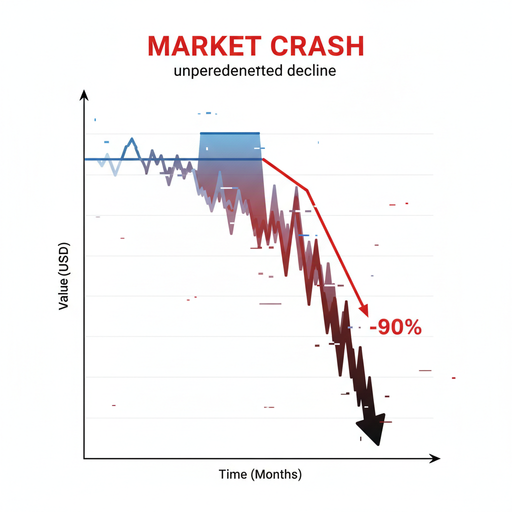
Exponential Loss Growth. Doubling position sizes means each new failure exponentially increases your market exposure. If you enter a prolonged trend against you, losses can become catastrophic. Five consecutive losses require capital 32 times larger than the initial volume — with no guarantee that a successful trade will eventually happen.
Capital Limitations and Margin Calls. Applying the Martingale system requires a substantial reserve of funds. Many traders underestimate the capital requirements and find themselves unable to double their position simply because they lack sufficient funds. Additionally, if you trade with leverage, your broker may forcibly close your position earlier than expected.
Dependence on Predictions. The Martingale system assumes that the market will eventually turn in the predicted direction. In reality, unpredictable price movements, sudden news, or sentiment shifts can invalidate this assumption. On volatile cryptocurrency markets, this risk is especially acute.
Psychological Pressure. When you have already invested significant amounts of money and continue to lose, psychological stress increases exponentially. Logic often gives way to panic, leading to mistakes — such as closing a position at a loss instead of sticking to the plan, or, conversely, becoming more aggressive after a series of failures.
When the Martingale System Can Be Effective
The Martingale system is not inherently bad — everything depends on the context and discipline.
It shows the greatest potential in sideways markets (range-bound), where prices fluctuate between support and resistance levels. The probability of a reversal from extremes is much higher there. The strategy can also work on very short timeframes (minutes, hours) with a clear trend.
A key condition is well-defined boundary parameters. An unrestricted system is a path to bankruptcy. The trader must decide in advance: how many consecutive losses am I willing to endure, what is the maximum acceptable position size, and what portion of capital am I risking.
Key Rules for Capital and Risk Management
If you decide to experiment with the Martingale system, follow these essential rules:
Limit the number of iterations. Set a maximum number of doubles (e.g., 4-5) before closing the position with a potential loss.
Calculate capital correctly. Ensure you have enough funds to withstand the worst-case scenario without a margin call.
Start with micro positions. If you’re a beginner, test the Martingale system with minimal volumes until you understand its dynamics.
Set a total stop-loss on your account. Don’t let a losing streak wipe out a significant part of your capital.
Combine with technical analysis. Try to enter positions near key support or resistance levels to increase the likelihood of success.
Conclusion: Realism Before Optimism
The Martingale system is not a holy grail of trading, as it is sometimes portrayed. It’s a tool with clear advantages and serious drawbacks. It can work, but only with strict risk management, sufficient capital, and discipline.
Before applying this strategy with real money, you must deeply understand both its mechanics and market realities. The Martingale system does not replace fundamental market understanding and risk management — it is only an auxiliary tool for those who know its limitations.
It is recommended to consult with experienced professionals before deploying any trading strategies with real capital.