


Futures
Hundreds of contracts settled in USDT or BTC
TradFi
Gold
Trade global traditional assets with USDT in one place
Options
Hot
Trade European-style vanilla options
Unified Account
Maximize your capital efficiency
Demo Trading
Futures Kickoff
Get prepared for your futures trading
Futures Events
Participate in events to win generous rewards
Demo Trading
Use virtual funds to experience risk-free trading
Launch
CandyDrop
Collect candies to earn airdrops
Launchpool
Quick staking, earn potential new tokens
HODLer Airdrop
Hold GT and get massive airdrops for free
Launchpad
Be early to the next big token project
Alpha Points
Trade on-chain assets and enjoy airdrop rewards!
Futures Points
Earn futures points and claim airdrop rewards
Investment
Simple Earn
Earn interests with idle tokens
Auto-Invest
Auto-invest on a regular basis
Dual Investment
Buy low and sell high to take profits from price fluctuations
Soft Staking
Earn rewards with flexible staking
Crypto Loan
0 Fees
Pledge one crypto to borrow another
Lending Center
One-stop lending hub
VIP Wealth Hub
Customized wealth management empowers your assets growth
Private Wealth Management
Customized asset management to grow your digital assets
Quant Fund
Top asset management team helps you profit without hassle
Staking
Stake cryptos to earn in PoS products
Smart Leverage
New
No forced liquidation before maturity, worry-free leveraged gains
GUSD Minting
Use USDT/USDC to mint GUSD for treasury-level yields







How to break through BTC and Ether
First, you should know that the software allows you to set conditional orders. I am only screenshotting the web version here, but the mobile version is the same.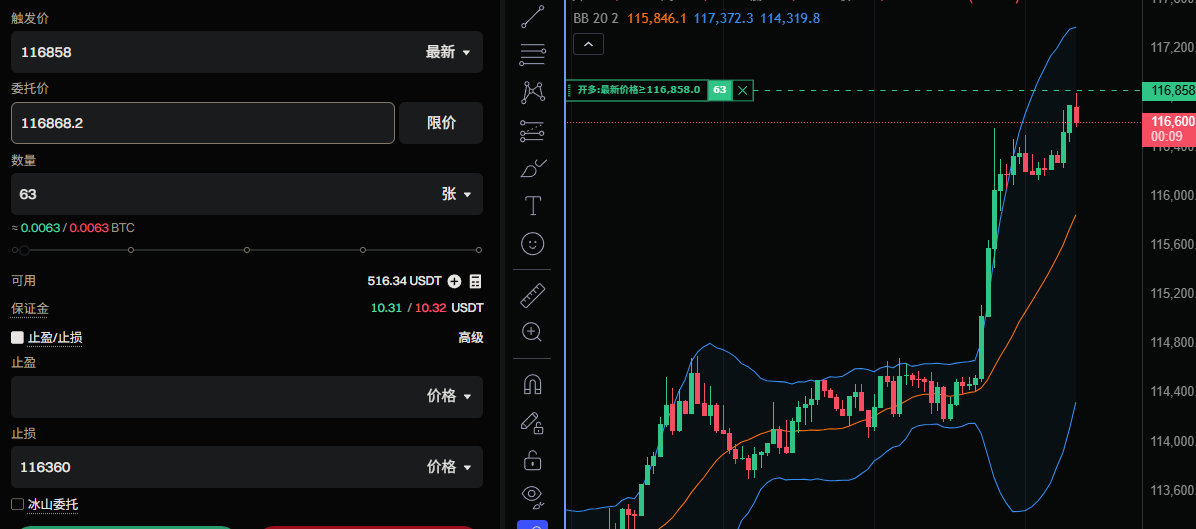
There are three options in the conditional order that must be filled out.
Trigger price, after reaching this price, the system will immediately submit the order.
The order price is the price at which you immediately place an order after the trigger price is reached. Limit orders are suitable for small coins and altcoins, those with thin order books and poor liquidity, while market orders are suitable for mainstream coins like BTC, ETH, and SOL, which have good liquidity.
Next is taking profits and cutting losses. When chasing breakouts, be sure to set stop-loss orders to avoid being heavily injured by false breakouts.
According to the meaning set in the above figure, when the price reaches 116858, trigger the order, and then immediately place a buy order at 116868, with a stop loss at 116360.
In other words, as soon as this K-line hits a new high, I will immediately place a long position slightly above the new high. Then set a stop-loss of 500 points. I suggest that when placing a limit order for Bitcoin, if the price is triggered, chase it up by about 50-80 points, which is perfectly fine. For Ethereum, the suggestion is to go up by an additional 7-10 points after the price is triggered.
When the market is big and moves quickly, if Bitcoin doesn't hang around 50-80 points, it is very likely that you won't be able to catch it. In a normal market, even if you hang on a bit more, you can only chase an additional 10-20 points at most.
Here are a few common trends after Ethereum's breakout. It is recommended to look for breakouts on a 4-hour chart or higher for Ethereum, as there are many false breakouts with long wicks on the upper and lower sides. Avoid using smaller timeframes.
There is still a lot more, you can go back and review it yourself. The breakout on Ethereum's 4-hour chart is very suitable for Bitcoin and Ethereum. Especially for Ethereum, just remember, once a direction comes out in the 4-hour chart, it moves within a small K-line fluctuation range. Once it breaks upwards, it is a big K-line breakout that soars. Direction, fluctuation, big breakout! This method is very suitable for those of you who don't have time to watch the market.