


define drawdown
What Is Drawdown?
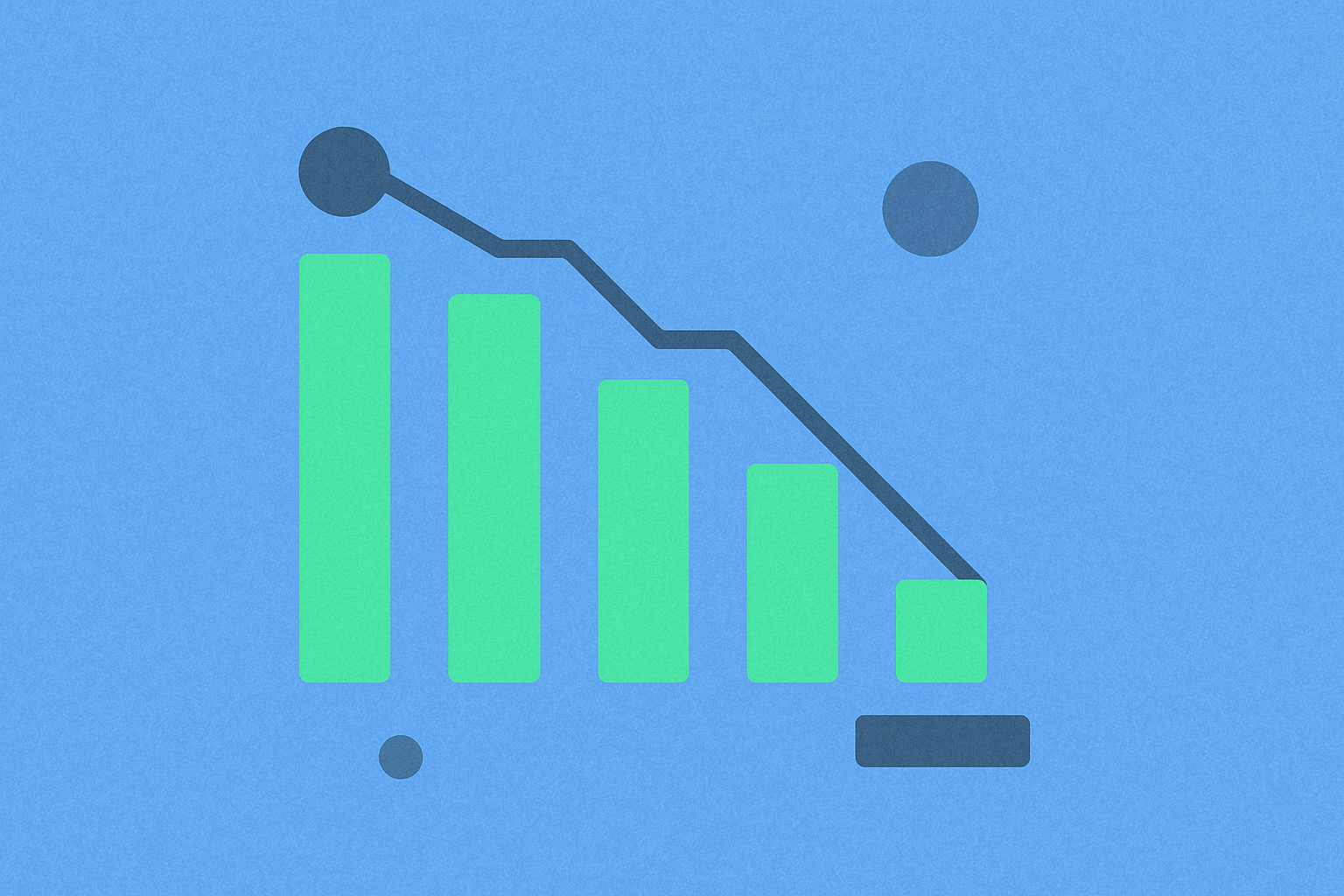
Drawdown refers to the decline in asset price or account equity from a historical peak to a subsequent trough, typically expressed as a percentage. In essence, it answers: how much has the value dropped after reaching a high point?
For example, if your account equity rises from 10,000 to 12,000 and then falls to a low of 9,000, the drawdown rate for this period is (12,000−9,000)÷12,000=25%. Here, "equity" refers to the total value of all assets in your account, marked to market, often visualized as an "equity curve."
How Is Drawdown Calculated?
You can calculate drawdown using these steps:
Step 1: Identify the "highest equity" up to the current point in your time series—this is the peak or high watermark.
Step 2: From this peak, look forward to find the lowest subsequent equity value—this is the trough.
Step 3: Calculate drawdown rate as (peak−trough)÷peak to get a percentage. For absolute drawdown in terms of amount, simply use peak−trough.
Step 4: Slide this calculation across the entire time series to determine the drawdown for each period, then select the deepest one—this is referred to as "maximum drawdown," which will be discussed later.
Two key points: First, if there are deposits or withdrawals during the period, you must adjust the equity curve to avoid mistaking capital inflows/outflows for gains or losses. Second, results will differ depending on the calculation interval, so always compare strategies or accounts over the same period.
What Does Maximum Drawdown Mean?
Maximum drawdown refers to the largest single drop among all drawdown periods within the observation window. It answers: during the worst case, how much did capital fall from its peak to its lowest point?
Its main purpose is to quantify "worst-case risk." If Strategy A has a maximum drawdown of −15%, while Strategy B's is −45%, even if B has higher annualized returns, many investors find it psychologically and financially difficult to stick with it. In practice, many set a "system stop-loss": when account equity drops beyond a preset threshold (such as 10% or 20%) from its high watermark, they reduce positions or pause trading to allow for review and recovery.
Drawdown vs. Pullback: What’s the Difference?
Drawdown measures "the decline in account or asset value from its historical peak," serving as a risk indicator on the equity curve level. Pullback typically refers to "a short-term price drop within an uptrend" and is used more in trading contexts. The two are related but not equivalent.
It's also important to distinguish between "drawdown" and "loss." Drawdown can include unrealized losses (paper declines) as well as realized losses (locked in after selling). In contrast, "volatility" reflects the magnitude and frequency of price swings but does not directly indicate how far an asset has fallen from its peak. Thus, drawdown provides a more intuitive measure of capital safety boundaries.
Why Is Drawdown Important in Crypto Investing?
Crypto markets are highly volatile and trade around the clock, making deep daily drawdowns common. The use of leverage and derivatives amplifies price swings into even greater equity fluctuations—magnifying drawdowns. For activities like market making or liquidity provision, price deviations can also result in additional paper losses, further impacting your equity curve.
Therefore, assessing strategy stability and setting account-level risk thresholds with drawdown is often more decisive for long-term success than focusing solely on returns. When drawdown hits your risk tolerance, timely adjustments to position size and trading frequency can significantly reduce destructive emotional reactions.
How to Implement Drawdown Risk Controls?
Risk controls can be applied at the account, position, and execution levels:
Step 1: Set an account-level drawdown threshold. For example, set a maximum acceptable drawdown from the high watermark at 10% or 15% (for illustration only—not financial advice). If triggered, reduce leverage, cut positions, or pause trading for review.
Step 2: Set per-trade risk limits. Cap the "worst-case loss" on each trade at a small percentage of total equity (e.g., under 1%), and enforce this with stop-loss orders. This keeps cumulative drawdowns from multiple consecutive losses manageable.
Step 3: Use position sizing and diversification. Enter markets in multiple tranches or spread risk across less correlated assets to avoid deep drawdowns caused by single events.
Step 4: Employ trailing stop-losses. A trailing stop-loss is a protective stop-loss that moves up as prices rise, helping you lock in gains during trends and control drawdowns when reversals occur.
Step 5: Establish a review mechanism. After hitting your drawdown threshold, pause active trading, review logs and risk assumptions, and if necessary lower your return targets with a focus on restoring stability.
How to View and Manage Drawdown on Gate?
You can manage drawdown on Gate using platform tools and data exports:
Step 1: Track changes in account equity. On the assets page, monitor how your account equity evolves over time—this is your "equity curve." Some pages allow you to view subaccounts or split by spot and futures accounts for more granular analysis.
Step 2: Export transaction and fund records. Export CSV files of funding or trade history and use spreadsheet software to calculate drawdown and maximum drawdown—remember to exclude deposits/withdrawals from calculations.
Step 3: Set stop-loss/take-profit orders and risk limits. Pre-set stop-loss triggers when placing orders or use conditional orders to avoid uncontrolled losses. For derivatives trading, choose isolated or cross margin according to your risk tolerance and adjust leverage/risk limits accordingly.
Step 4: Create account-level alerts. Set up alerts for equity drawdowns that trigger contingency plans such as reducing position sizes, lowering leverage, or halting trading altogether.
Trading and leverage involve risks; always set risk management parameters prudently according to your own circumstances and avoid overtrading.
How to Balance Drawdown vs. Returns?
A practical approach is to set your "drawdown budget" first before setting return goals. If your account-level drawdown budget is 10%, you should select strategies that historically deliver acceptable returns while keeping drawdowns around that level—not just those with the highest returns.
You can also use simple risk-adjusted metrics such as the ratio of "annualized return ÷ maximum drawdown" to gauge efficiency—i.e., how much return you get per unit of drawdown risk. For example: Strategy A has a 20% annualized return with a −10% max drawdown (ratio = 2); Strategy B has a 35% return but −30% max drawdown (ratio ≈ 1.17). Higher ratios typically indicate more stable strategies. (This is for illustration only; it does not constitute endorsement.)
Common Drawdown Mistakes
Mistake #1: Focusing only on returns while ignoring drawdowns. High returns accompanied by deep drawdowns are often unsustainable over the long term.
Mistake #2: Treating historical maximum drawdown as a hard limit. Future market conditions may result in even deeper drawdowns; past extremes do not guarantee future limits.
Mistake #3: Using too short a sample period. Evaluating drawdowns with only weeks or months of data underestimates risk—sampling should span different market cycles.
Mistake #4: Not accounting for capital inflows/outflows. Treating deposits as profit or withdrawals as loss distorts true drawdown measurement.
Mistake #5: Equating account drawdown with price pullback. Account drawdowns may be amplified by leverage, slippage, and fees—these are not always proportional to underlying price pullbacks.
Key Takeaways on Drawdown and Next Steps
Drawdown is a core metric for assessing equity curve stress; maximum drawdown captures "worst-case" risk scenarios. Start by learning to calculate drawdowns consistently across strategies, then set account-level thresholds and per-trade risk caps. Use stop-losses, position layering, and alert mechanisms for enforcement. When thresholds are breached, prioritize protecting capital and stabilizing your curve before resuming pursuit of returns. Treat drawdown management like routine health checks—essential for resilience in highly volatile markets.
FAQ
What’s the difference between drawdown and pullback?
Both terms describe price declines but differ in meaning. Drawdown refers to the drop from a historical peak to the current trough—an absolute measure of loss; pullback means a short-term dip within an uptrend, often seen as a buying opportunity. In short: drawdown shows the worst-case scenario; pullback reflects trend correction.
Why do I have good returns but high maximum drawdown?
This highlights the balance between risk and reward. High returns often come with high volatility—even if you end up profitable, you may experience significant interim losses. For example, a strategy with 50% annualized return but 30% max drawdown is aggressive; one with 15% return and only 5% max drawdown is more stable. Choose your preferred risk/drawdown level based on your own tolerance.
How can I control drawdowns in practice?
Common methods include: setting stop-losses (e.g., closing out when a trade loses more than 5%), diversifying (not concentrating funds in one asset), and periodically taking profits (selling part when targets are reached). On Gate, you can use stop-loss or trailing stop orders so the system enforces your risk boundaries automatically and prevents emotional decisions.
What mistakes do beginners make regarding drawdowns?
Typical errors include: overreacting to short-term drawdowns with frequent stop-outs (which often leads to more losses), ignoring drawdowns while chasing gains blindly, or judging strategies as "dead" based solely on maximum drawdown (when returns must also be considered). The right approach is to treat drawdown as a long-term risk metric rather than a short-term trading signal—helping you develop rational investing habits.
What level of drawdown is normal in crypto markets?
Crypto volatility far exceeds that of traditional markets. Bitcoin has historically experienced single-event drawdowns of 20%-50%, with some coins swinging even more wildly. Generally speaking, if you’re bullish long-term, keeping single-event drawdowns within 15%-30% is relatively moderate; exceeding 50% calls for caution. Define your acceptable range based on holding period and risk profile—and use Gate’s risk management tools for strict discipline.
Related Articles

Exploring 8 Major DEX Aggregators: Engines Driving Efficiency and Liquidity in the Crypto Market

What Is Copy Trading And How To Use It?
