Bitcoin is the pioneer of the cryptocurrency market and remains the digital asset with the highest market capitalization and greatest influence. As the first blockchain network to successfully enable decentralized value transfer, Bitcoin established the foundational rules for digital assets and is widely regarded as “digital gold.” As Bitcoin has evolved, numerous projects have sought to build upon its foundation, with Litecoin emerging as a significant example.
Litecoin, launched in 2011, was designed as a “Lite” version of Bitcoin. Its goal is to enhance the utility of digital currency for payments by offering faster block generation and lower transaction costs. Over time, BTC and LTC have developed distinct market roles: Bitcoin is primarily a store of value, while Litecoin focuses on payment efficiency.
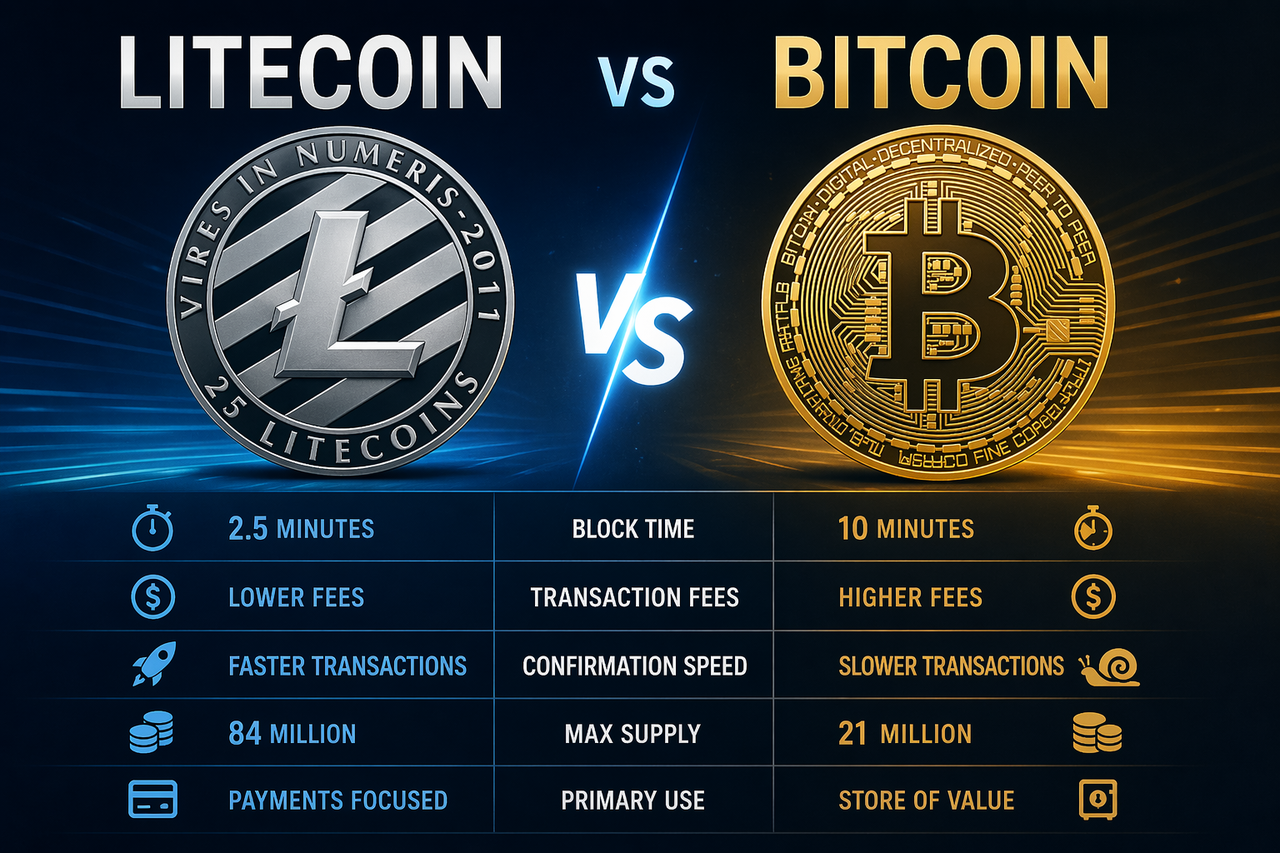
What are the core differences between Litecoin and Bitcoin?
While both Litecoin and Bitcoin use the PoW consensus mechanism and share core blockchain features—such as decentralization and public verifiability—they differ markedly in their network parameters and economic models.
Bitcoin prioritizes security and scarcity, whereas Litecoin is optimized for payment efficiency, offering faster transactions and lower transfer costs. These design distinctions make BTC and LTC suited for different use cases.
| Comparison Dimension |
Bitcoin (BTC) |
Litecoin (LTC) |
| Launch Date |
2009 |
2011 |
| Founder |
Satoshi Nakamoto |
Charlie Lee |
| Consensus Mechanism |
PoW |
PoW |
| Mining Algorithm |
SHA-256 |
Scrypt |
| Block Generation Time |
10 min |
2.5 min |
| Maximum Supply |
21 million |
84 million |
| Trading Fee |
Higher |
Lower |
| Transaction Confirmation Speed |
Slower |
Faster |
| Primary Positioning |
Digital Gold (store of value) |
Digital Silver (payment and transfer) |
| Market Consensus |
Extremely high |
High |
| Institutional Recognition |
High |
Medium |
| Investment Attribute |
Long-term store of value asset |
Payment-oriented auxiliary asset |
From a market perspective, Bitcoin has become the principal store of value asset in the crypto space, while Litecoin operates as a high-efficiency payment network. Rather than direct competitors, each serves a distinct function within the digital asset ecosystem.
How do LTC and BTC differ in transaction speed?
Bitcoin’s average block generation time is about 10 minutes, while Litecoin’s is approximately 2.5 minutes—resulting in faster transaction confirmations for LTC. For users, shorter block times mean quicker settlement, enhancing the payment and transfer experience.
This speed advantage makes Litecoin better suited for everyday payments, while Bitcoin’s longer confirmation times are preferable for large-value transfers and long-term asset storage. LTC’s efficiency is especially notable in scenarios requiring rapid settlement.
How do Litecoin and Bitcoin differ in trading fees?
The Bitcoin network’s larger user base often leads to higher trading fees during periods of on-chain congestion, especially in active markets when transaction costs can spike. In contrast, Litecoin’s network typically offers lower fees due to faster block confirmations and less congestion, making it ideal for smaller transfers.
Lower fees give Litecoin a competitive edge in payment scenarios, particularly for cross-border and frequent transactions, effectively reducing usage costs. Bitcoin’s higher fees further reinforce its role as a store of value rather than a payment instrument.
How do LTC and BTC supply mechanisms differ?
Bitcoin’s maximum supply is 21 million, while Litecoin’s maximum supply is 84 million—four times greater. Both feature a fixed supply cap and halving mechanism, but the difference in total supply shapes market perceptions of scarcity.
Bitcoin’s smaller supply makes it more scarce, strengthening its reputation as a long-term store of value. While Litecoin also has a fixed cap, its higher supply results in a less compelling scarcity narrative, contributing to LTC’s lower market capitalization compared to BTC.
How do LTC and BTC mining mechanisms differ?
Bitcoin uses the SHA-256 mining algorithm, while Litecoin employs Scrypt, which requires more memory resources. In Litecoin’s early days, this lowered the entry barrier for ordinary users, broadening network participation.
However, with the advent of professional mining machines, both networks are now dominated by ASIC hardware. Despite different algorithms, LTC and BTC rely on miners to secure their networks, and their core security principles are fundamentally aligned.
How do Bitcoin and Litecoin differ in market positioning?
Bitcoin is positioned as “digital gold” in today’s market, valued for its scarcity, security, and role as a long-term store of value. Institutional investors increasingly view BTC as a digital store of value for hedging inflation and long-term allocation.
Litecoin, meanwhile, is seen as “digital silver,” emphasizing transaction efficiency and payment functionality. While LTC possesses asset attributes, the market typically regards it as a payment-focused digital currency. As a result, BTC is favored for store of value, while LTC is chosen for payment convenience.
Which is better for investment: LTC or BTC?
For long-term store of value, Bitcoin is generally considered superior. BTC enjoys stronger market consensus, higher institutional recognition, and greater scarcity, making it the preferred choice for long-term allocation. Its price movements often lead the broader crypto market.
Litecoin’s investment thesis centers on payment utility and liquidity. While LTC maintains a stable market position, its growth potential and narrative are less compelling than Bitcoin’s. For risk-averse, long-term investors, BTC is typically the core asset, with LTC serving as an auxiliary holding.
Summary
Despite similar technical architectures, Bitcoin and Litecoin differ significantly in design goals and market positioning. Bitcoin emphasizes scarcity and value retention, earning the label “digital gold,” while Litecoin leverages faster transactions and lower fees to enhance its payment function, known as “digital silver.”
For users, Litecoin is preferable for payment efficiency, while Bitcoin is more attractive for long-term value storage. Understanding these differences helps users make informed choices between payment use and investment allocation.
FAQs
Is Litecoin faster than Bitcoin?
Yes. Litecoin’s block generation time is around 2.5 minutes, compared to Bitcoin’s 10 minutes, so LTC’s transaction confirmation is typically faster.
Are Litecoin’s trading fees lower than Bitcoin’s?
Generally yes. Litecoin’s network experiences less congestion and faster block times, resulting in lower trading fees than Bitcoin.
Why is Bitcoin’s market capitalization much higher than Litecoin’s?
Bitcoin commands stronger market consensus, greater scarcity, and broader institutional recognition, leading to a much higher market capitalization than Litecoin.
Which is better for payments: Litecoin or Bitcoin?
Litecoin is more suitable for payments due to faster transaction confirmations and lower fees.
Which is better for long-term investment: Litecoin or Bitcoin?
For long-term value storage, Bitcoin is usually the preferred investment asset, while Litecoin is better suited as a supplementary holding.







