As Web3 applications continue to expand, on-chain data processing has become a core part of infrastructure. Whether for monitoring DeFi protocol operations, analyzing user behavior, or issuing risk alerts, all of these use cases rely on efficient data indexing mechanisms. Traditional data query tools can provide access to on-chain data, but they usually involve some delay in response time, which limits their usefulness in real-time monitoring scenarios.
Sentio offers a data indexing mechanism built around real-time performance. By continuously monitoring blockchain events and processing data quickly, Sentio allows developers to receive feedback as soon as on-chain data changes. This capability gives it significant value in scenarios such as real-time monitoring and automated alerts.
What Is Real-Time On-Chain Data Indexing?
Real-time on-chain data indexing refers to the process of capturing, parsing, and processing relevant data immediately after a blockchain event occurs, then quickly delivering it to the application layer for use. Its goal is to reduce the time gap between when on-chain data is generated and when it becomes usable, making instant monitoring and rapid response possible.
In traditional on-chain data architectures, data usually has to be synchronized, organized, and stored before it can be queried. That workflow is better suited to historical data analysis, but it struggles to meet the needs of real-time monitoring. A real-time indexing mechanism, by contrast, emphasizes event-driven processing. As soon as a transaction or state change occurs on-chain, the system begins processing the relevant data immediately.
For protocols that need to respond quickly to on-chain changes, real-time data indexing affects not only data visibility, but also risk control and operational efficiency.
How Does Sentio Monitor On-Chain Events?
Sentio’s real-time indexing flow begins with monitoring on-chain events. Smart contracts on the blockchain continuously generate event logs during operation, including information such as transaction execution, state updates, and fund transfers. Sentio continuously listens for these events and immediately triggers the next stage of processing when a new event is detected.
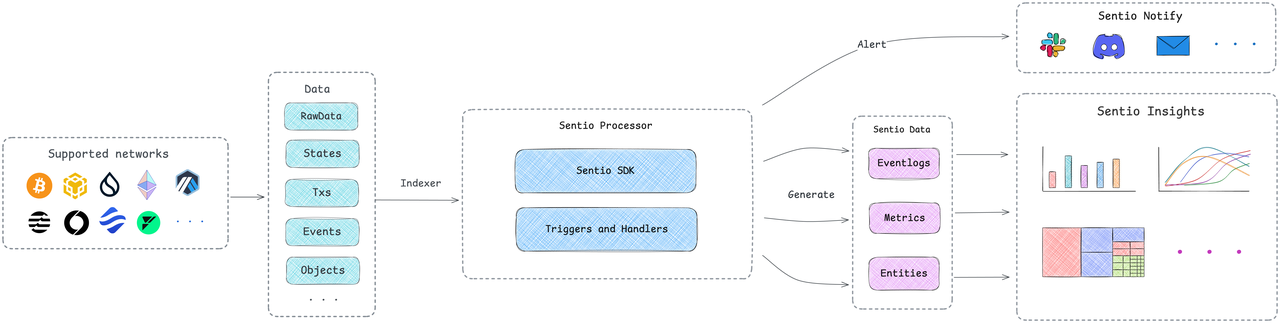
This monitoring mechanism can be understood as a continuously running data capture layer. It is responsible for connecting to the blockchain network and tracking event changes in target contracts. When a specified event occurs, the system quickly retrieves the relevant log data and moves it into the parsing stage.
Through this continuous monitoring mechanism, Sentio can obtain raw data as soon as the on-chain state changes, providing the foundation for subsequent real-time analysis.
How Is On-Chain Data Parsed and Processed?
Once an on-chain event has been detected, Sentio parses the raw log data and converts it into a structured form. Blockchain event logs are typically stored in low-level encoded formats, which are not suitable for direct analysis, so they must be transformed into readable data formats.
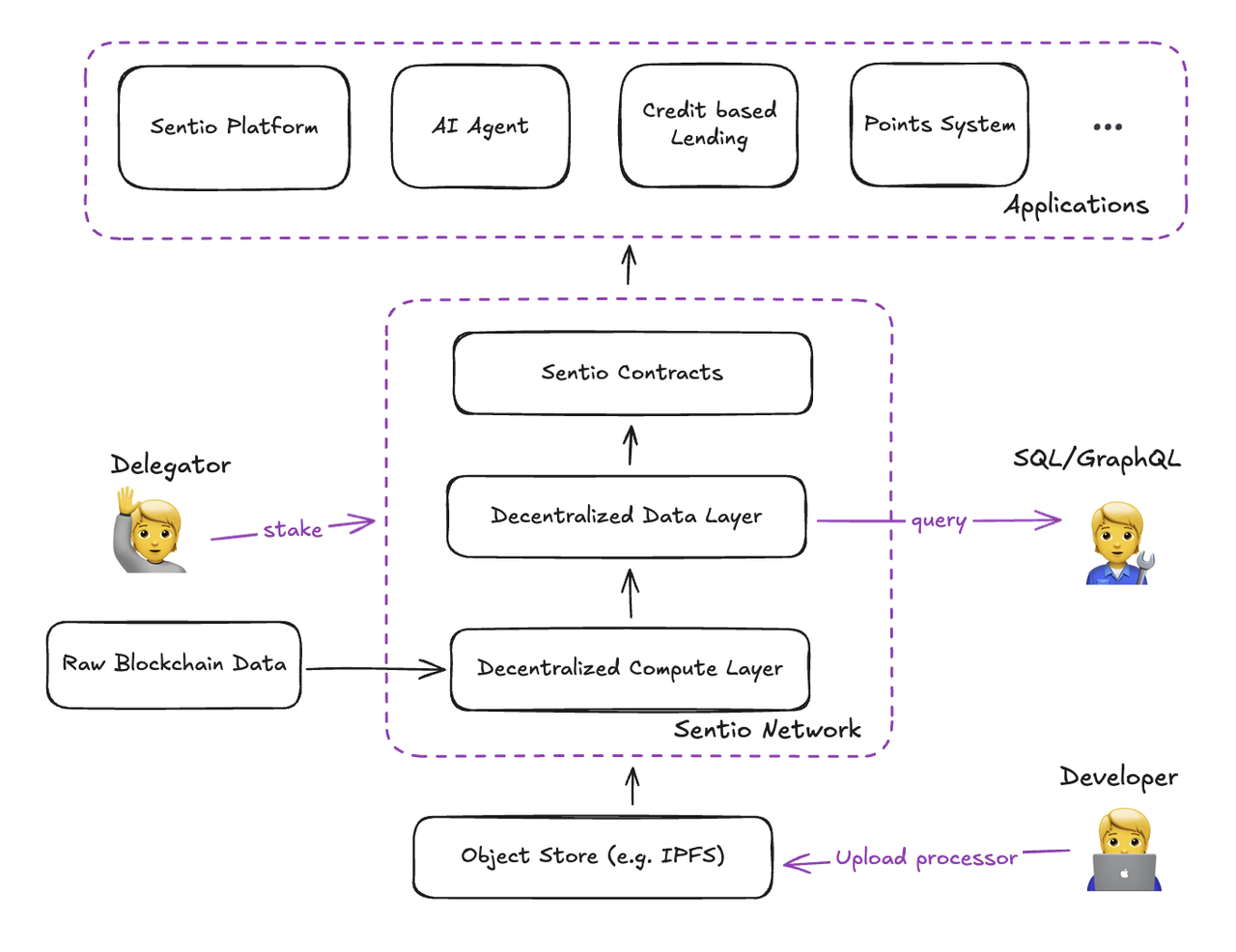
Sentio Network architecture, image source: Sentio
At this stage, the system identifies the event type and extracts key fields such as address information, transaction amounts, and state parameters. The data is then standardized so it can be used for metric calculation and visual display.
The significance of this process lies in turning complex on-chain logs into structured data, allowing developers to obtain analyzable results without dealing directly with raw on-chain data. This not only improves data usability, but also reduces development complexity.
How Does Sentio Deliver Real-Time Data Output?
After data parsing is complete, Sentio outputs the processed results in real time to visualization panels or alert systems, allowing developers to view on-chain changes immediately.
Real-time output generally appears in two forms. One is the real-time updating of data metrics, such as changes in transaction volume or address activity. The other is automated alert notifications, where the system triggers warnings automatically when monitored metrics reach predefined thresholds.
This real-time output capability means on-chain data is no longer just a passive query result, but becomes an information stream that can actively respond to business needs. For applications that require immediate decision-making, this mechanism significantly improves data response efficiency.
Why Is Real-Time Indexing Better Suited to Web3 Applications Than Traditional Indexing?
Traditional indexing mechanisms are mainly designed for data query needs, with the core goal of organizing on-chain data into accessible data interfaces. This approach works well for historical data analysis, but because it involves synchronization and update delays, it is not suitable for scenarios that require rapid response.
A real-time indexing mechanism, by contrast, is built on event-triggered processing. It begins processing data immediately after an on-chain event occurs, significantly reducing data latency. This low latency capability is especially important in scenarios such as DeFi protocol monitoring, security alerts, and real-time operational analysis.
As Web3 applications increasingly demand instant responsiveness, real-time indexing is becoming an important direction for on-chain data infrastructure. It not only improves data timeliness, but also strengthens protocol monitoring capabilities on-chain.
What Scenarios Is Sentio’s Real-Time Indexing Mechanism Suitable For?
Sentio’s real-time data indexing mechanism is mainly suited to scenarios that are sensitive to on-chain changes.
In DeFi protocols, real-time indexing can help development teams track fund flows, trading activity, and liquidity changes, allowing them to stay on top of protocol operating conditions in a timely manner. When abnormal trading behavior appears, the system can quickly capture the anomaly and trigger an alert.
In security monitoring scenarios, real-time indexing can help identify unusual fund transfers or changes in contract behavior, improving the efficiency of risk response.
In addition, in on-chain operations analysis, real-time indexing can be used to monitor user activity, transaction trends, and key business metrics, providing immediate data support for protocol optimization.
All of these scenarios depend on the ability to process on-chain data quickly, and that is exactly where Sentio’s real-time indexing mechanism delivers its core value.
What Value Does Sentio’s Real-Time Data Indexing Mechanism Provide?
Sentio’s real-time indexing mechanism improves the responsiveness of on-chain data, enabling developers to receive data feedback quickly after events occur. This capability not only enhances the experience of using on-chain data, but also provides the technical foundation for real-time monitoring and automated alerts.
Compared with traditional data indexing models, real-time indexing reduces latency, improves monitoring efficiency, and allows on-chain data to serve business decision-making more quickly. This is highly significant for Web3 applications that need real-time awareness of changes in on-chain state.
As on-chain applications become more complex, real-time data processing capability is becoming an important competitive advantage in Web3 data infrastructure, and Sentio’s real-time indexing mechanism is a representative example of this trend.
Conclusion
Sentio’s real-time data indexing mechanism achieves low latency data processing by continuously monitoring on-chain events and completing data parsing, structured processing, and real-time output. This mechanism helps developers quickly transform complex on-chain events into actionable information, and it is widely used in scenarios such as protocol monitoring, security alerts, and operations analysis.
As Web3 applications continue to demand more real-time data, real-time indexing has become an important part of on-chain data infrastructure. By improving the visibility and response speed of on-chain data, Sentio provides a more efficient solution for real-time data monitoring.
FAQs
What Is Sentio’s Real-Time Data Indexing Mechanism?
Sentio’s real-time data indexing mechanism refers to listening for, parsing, and outputting data immediately after an on-chain event occurs, enabling low latency data monitoring.
How Does Sentio Obtain On-Chain Data?
Sentio captures on-chain data by continuously monitoring smart contract event logs, then parsing and processing that data.
What Is the Difference Between Real-Time Indexing and Traditional Indexing?
Traditional indexing is better suited to data queries, while real-time indexing emphasizes immediate processing after events occur, making it more suitable for real-time monitoring scenarios.
What Scenarios Is Sentio’s Real-Time Indexing Suitable For?
It is mainly suitable for scenarios that require fast responses to changes in on-chain data, such as DeFi protocol monitoring, security alerts, and on-chain operations analysis.







