As demand for zero-knowledge proofs (ZK) and AI computation continues to grow rapidly, compute power is shifting from a “basic resource” to a “core asset.” In scenarios such as ZK Rollups and verifiable AI, computation must not only be high-performance but also verifiable. This makes it difficult for traditional cloud computing models to fully meet emerging needs.
Against this backdrop, Cysic introduces the ComputeFi framework, which transforms compute power into verifiable, tradable on-chain assets. Through its token mechanism, it enables efficient resource allocation and value distribution. Within this system, CYS serves as the central hub, driving network operations while playing a key role in value capture and incentive design.
Overview of Cysic
Cysic is a decentralized compute network focused on providing services such as ZK proof generation and AI inference. Its core objective is to convert computational resources into verifiable on-chain assets, allowing compute power to be used, allocated, and priced like financial assets.
Within this system, users submit computation tasks, compute providers execute them, and the network coordinates scheduling, incentives, and governance through token mechanisms. This model transforms compute resources from something passively consumed into an active value-generating economic system.
Overview of Cysic’s Dual-Token Model
Cysic adopts a dual-token structure consisting of CYS and CGT. CYS is the base token of the network, responsible for payments, incentives, and value capture. CGT (Cysic Governance Token), on the other hand, is generated by staking CYS and is primarily used for governance.
This design separates “usage rights” from “governance rights,” allowing the system to balance operational efficiency with long-term governance. CYS powers the compute market, while CGT enables the community to participate in protocol evolution and key decisions, creating a more stable economic structure.
CYS Token Distribution and Supply
Cysic has a total supply of 1 billion CYS tokens, distributed across ecosystem incentives, investors, contributors, the foundation, and the community.
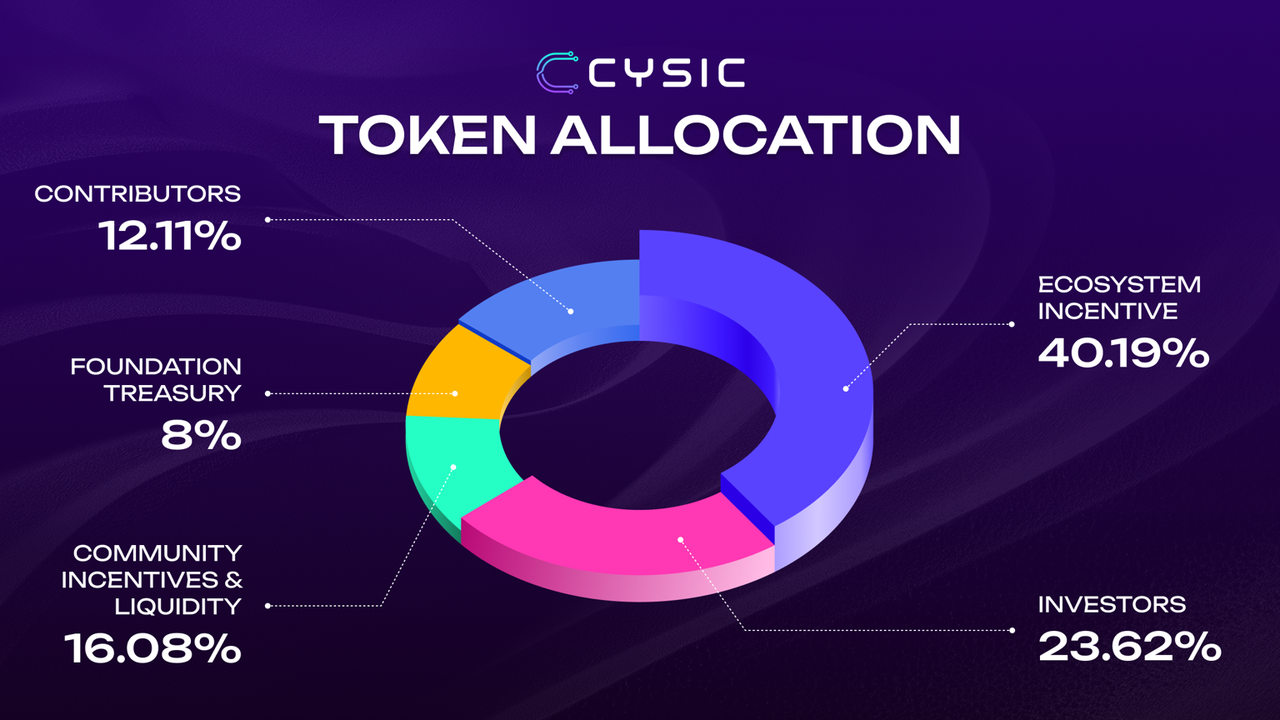
The largest share, approximately 40.19%, is allocated to ecosystem incentives, including mining rewards, staking incentives, and developer support. This reflects Cysic’s focus on expanding compute supply and ecosystem growth.
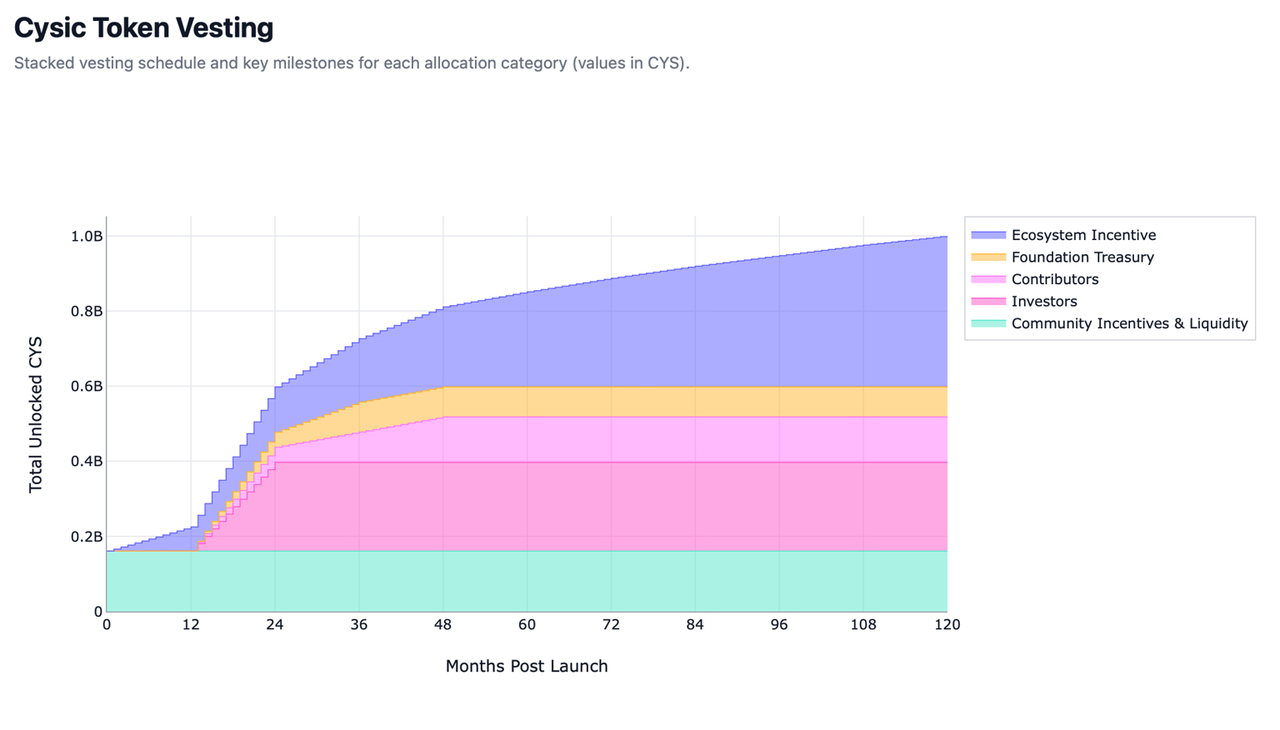
Investors hold around 23.62%, subject to a one-year lock-up followed by one year of linear vesting, balancing early funding support with market stability. Contributors and team members receive about 12.11%, with longer vesting periods of up to 36 months, reinforcing a long-term commitment to development.
The foundation and community allocations are used for protocol development and early user incentives, including testnet participation, community campaigns, and liquidity support. This distribution structure helps maintain network vitality and stability across different stages.
The Utility of CYS in the ZK Compute Market
Within the Cysic network, CYS is far more than just a payment token. It serves as a foundational asset representing three core rights.
First is governance. Users can stake CYS to obtain CGT, enabling them to participate in protocol upgrades, parameter adjustments, and node elections. As the network grows, governance participation becomes increasingly important.
Second is compute access. Compute providers must lock or reserve CYS to run provers, AI nodes, or other computational tasks. In this sense, CYS acts as an access credential for compute resources, with its demand directly tied to computational activity.
Third is financial reward rights. Whether they are compute providers, stakers, or ecosystem contributors, participants can earn CYS rewards through network participation. This makes the token the core medium for value distribution across the compute economy.
How CYS Captures Value
Cysic’s value capture mechanism is grounded in real computational demand rather than purely circular token flows. As the number of tasks on the network increases, including ZK proofs, AI inference, and batch computation jobs, demand for CYS rises accordingly.
On one hand, compute providers must lock CYS to participate in task execution, reducing circulating supply. On the other hand, task fees are settled in CYS, creating a continuous source of demand.
Additionally, task priority and node rewards are linked to the amount of CYS staked and performance metrics. This strengthens the connection between the token and actual compute usage. As the network scales, a positive feedback loop emerges: growing compute demand increases token demand, which in turn attracts more compute supply.
The Role of CGT in Governance and Incentives
CGT is a governance token generated by staking CYS. Its primary function is to grant holders the right to participate in network governance. Through CGT, users can vote on protocol upgrades, economic model adjustments, and resource allocation strategies.
This mechanism separates governance power from transactional utility, reducing the impact of short-term speculation on network decisions. CGT can also be used to incentivize long-term participation, rewarding users for governance involvement and ecosystem contributions.
Risks and Sustainability Analysis of Cysic token
Although Cysic’s token model is built around real compute demand, its long-term performance depends on several factors. First, whether demand for ZK and AI computation continues to grow will directly influence the expansion of token utility.
Second, competition in the compute market could affect its market share. If other platforms offer lower costs or higher efficiency, Cysic’s attractiveness may decline. In addition, the balance between token release schedules and market liquidity plays a critical role in price stability.
From a sustainability perspective, Cysic’s strength lies in its value capture mechanism being tied to real computational demand. If the network continues to attract meaningful workloads, its token model will have strong long-term support.
Conclusion
Cysic’s tokenomics revolve around the ComputeFi framework. Through its dual-token design of CYS and CGT, it aligns compute resources, governance rights, and reward distribution into a unified system.
As the core asset, CYS not only connects compute supply and demand but also captures real value through staking and task execution mechanisms.
FAQs
What is the primary use of the CYS token?
It is used to pay for ZK proof generation and to incentivize prover nodes to supply compute power.
Why does Cysic use a dual-token model?
To separate payment functionality from governance, improving flexibility and system stability.
What is the difference between CGT and CYS?
CYS is a utility token used for payments, staking, and rewards. CGT is a governance token obtained by locking CYS, used for voting and additional incentives.
What drives the value of CYS?
Its value primarily comes from real demand for proof generation in ZK applications.
Is this token model sustainable?
Its sustainability depends on continued growth in ZK compute demand and the network’s ability to maintain a balance between supply and demand.