


Futures
Access hundreds of perpetual contracts
TradFi
Gold
One platform for global traditional assets
Options
Hot
Trade European-style vanilla options
Unified Account
Maximize your capital efficiency
Demo Trading
Futures Kickoff
Get prepared for your futures trading
Futures Events
Join events to earn rewards
Demo Trading
Use virtual funds to experience risk-free trading
Launch
CandyDrop
Collect candies to earn airdrops
Launchpool
Quick staking, earn potential new tokens
HODLer Airdrop
Hold GT and get massive airdrops for free
Launchpad
Be early to the next big token project
Alpha Points
Trade on-chain assets and earn airdrops
Futures Points
Earn futures points and claim airdrop rewards





Aave token price has dropped over 82% from its peak; ecosystem contributors publish a lengthy article revealing the current operational status
Author: ACI (Aave Chan Initiative)
Edited by: Jiahua, ChainCatcher
ACI is a team of 8 people. Since March 2023, the DAO has paid us $4.625 million. We started working unpaid four months prior. Below are the deliverables.
The DAO is currently discussing a single funding request that exceeds the total paid to all other service providers. Before token holders vote on any service provider’s budget, they have the right to know what each dollar spent yields in return. Every service provider should publish a report like this. ACI leads by example and publishes first.
All data here comes from TokenLogic’s public dashboard, DefiLlama, Aave governance forum, or on-chain data. Nothing here requires blind trust. Please verify for yourself.
Core Achievements
Every dollar paid to ACI has generated $29 in protocol revenue growth. We don’t claim all the credit—BGD maintains the codebase, Chaos Labs manages risk, TokenLogic handles treasury, data analysis, and leads BD and institutional trading, and market conditions are equally important. But someone has to turn infrastructure into revenue. That’s our job.
In 2025, $101 million in incentive funds were deployed, with $80 million from external partners who chose Aave because of ACI’s infrastructure and network relationships. GHO grew 15x, reaching $527 million. The AAVE buyback program is now live. Without a dedicated growth team, similar protocols closest to us generate only a small fraction of Aave’s revenue.
Revenue: From $5.2M to $142M
Source: TokenLogic Revenue Dashboard.¹ TokenLogic built and maintains the data infrastructure enabling this transparency.
Rolling 365-day revenue: $142.9 million (as of Feb 13, 2026)
We started as unpaid contributors in November 2022, began receiving paid compensation in March 2023. Since then, the protocol’s annual revenue has grown from $5.2 million to $141.8 million.
V3 launched in January 2023. During this period, BGD continuously delivered protocol upgrades, but the core lending architecture remained unchanged. The 27x revenue increase isn’t because the protocol was rebuilt—V3 was already live. The real change was in what was built on top: which assets went live, which chains were deployed, which partners brought in funds, which incentives were optimized, and which governance proposals passed. That’s what we do.
It runs on the Aave V3 and eMode architecture built and maintained by BGD. Over 75 governance proposals designed and executed by us have driven more than 48% of the revenue.
LRT / eMode Engine
In February 2024, Gauntlet reported WETH borrowing of $1.1 billion, generating $3.87M annual reserve factor income, with loans mainly collateralized by WETH LSTs. We saw this opportunity and built a yield machine around it.
We introduced weETH (Feb 2024), rsETH (May 2024), and ezETH (Aug 2024) into Aave, then configured eMode with 93% LTV for ETH-related trading pairs to enable capital-efficient cycle borrowing: deposit LRT, borrow wETH, swap for LRT, repeat. Each cycle generates interest for the DAO.
This is a simplified version. The actual design involves more layers. LRT holders lend out wstETH. wstETH holders lend out wETH. Demand is built across the tech stack, not all LRTs competing for the same wETH pool. LRT borrowing increases wstETH utilization, raising its deposit rate. Higher deposit rates attract more wstETH deposits. More deposits deepen the wETH borrowing pool. Each layer feeds into the next, allowing users and the DAO to earn more at every step.
On-chain data shows: currently, $247.8 million of wstETH is borrowed in Core and Lido markets. wstETH holders owe $1.27 billion WETH (22.5% of all WETH loans), while LRT / LST collateral drives 97.6% of WETH borrowing demand.
We increased the reserve factor for LRT to capture more income at each step. We controlled access: EtherFi gained eMode access to wETH to maintain high capital utilization. Lido received a dedicated instance (TEMP CHECK: Deploy a Lido Aave V3 Instance, approved by 7.027 billion votes via AIP 133), with its own market and growth trajectory. This maintained good relations with Lido and generated millions in independent income. WETH utilization on this instance often exceeds 90%.
Morpho cannot replicate this. On Aave, collateral in lending pools earns deposit interest—LRT depositors get staking rewards plus lending pool APY. On Morpho, collateral is idle—no deposit income, no compounding. This cycle structure yields higher profits on Aave. We identified this early, built around it, capturing over 85% of this asset class, turning it into over $37 million in annual WETH income.
Key parameter decision: we raised the reserve factor for weETH from 15% to 45% (ARFC: Updating weETH Risk Parameters), doubling the income captured on Aave’s fastest-growing collateral assets.
WETH is Aave’s largest single revenue asset, generating $37 million in 2025 (28% of protocol revenue). WeETH is the second-largest asset by deposit volume on Aave Ethereum market ($4.47B). ETH-related assets account for 43.6% of all Ethereum V3 deposits.
In ETH terms, this engine is still growing. Borrowed ETH increased from about 2.55 million to 2.86 million (+12%). The dollar value decline reflects ETH price drop from $3,800 to $2,051, not a strategy failure.
On-chain scan (as of Feb 16, 2026, 2,704 WETH borrowers) confirms the cycle logic at the wallet level. WETH loans from just weETH holders account for 57.9% of all WETH loans: $3.27 billion debt, generating $18.9 million annual reserve income. If expanded to all LRTs introduced by ACI (weETH, rsETH, ezETH, osETH, ETHx, tETH), this ratio rises to 75.1% of total WETH debt ($24.4M/year). Including wstETH, the ratio reaches 97.6%. Nearly all WETH borrowing demand on Aave traces back to our LRT / LST tech stack. These LRT holders also lend out $707 million stablecoins, generating an additional $3.9 million RF annually.
ACI drafted over 35 governance proposals involving LRT deployment on Ethereum, Arbitrum, Base, Scroll, Sonic, and Avalanche, as well as eMode configuration and parameter optimization.
Ethena / Pendle Flywheel
Ethena / USDe was a core growth narrative for Morpho. We reversed that, turning it into Aave’s yield engine.
Starting March 2024, we launched sUSDe, then USDe, eUSDe, and Pendle principal tokens (PT) covering multiple maturities. The strategy: use PT as collateral (via eMode with 91-94% LTV) to borrow stablecoins, swap for USDe, re-stake, and repeat.
When USDe launched, we set its reserve factor at 25% (ARFC: Onboard USDe to Aave V3 on Ethereum). This rate is high enough to capture significant income from billions in loans, yet low enough to keep borrowing rates competitive compared to Morpho.
The launch of Pendle PT (TEMP CHECK: Onboard Pendle PT Tokens to Aave V3 Core Instance) was a game-changer. It passed during TEMP CHECK with 69% approval, then after debate, was approved at 99.99% during ARFC. We pushed a initially controversial strategy that became one of Aave’s largest revenue sources.
Assets related to Ethena (USDe, sUSDe, eUSDe, Pendle PT tokens) generated $12.7 million in direct revenue in 2025. Collateral holders also lent out $1.58 billion USDC and USDT using their positions, earning an additional $5.8 million in reserve income annually. At peak, over 50% of USDe assets in DeFi were stored on Aave.
Aave commands 85% of Ethena / Pendle’s lending market. Morpho accounts for 13%, but earns zero protocol revenue. We designed competitive eMode parameters, better liquidity depth, and reserve factors to capture value for the DAO.
Holder attribution analysis (as of Feb 16, 2026, 2,672 Ethena / Pendle holders) confirms $1.58 billion in stablecoin loans (USDT $1.02B, USDC $0.55B, GHO $6.5M), generating $5.68M annual RF income, within 2% of the estimated $5.8M. sUSDe, eUSDe, and Pendle PT tokens are only used as collateral (no direct borrowing income); their value lies in creating borrowing demand. USDe on Ethereum ($3.8M) and Plasma ($2.8M) networks’ direct borrowing scan value totals $6.6M annually.
Overall Impact
On-chain verification (as of Feb 16, 2026; V3 pool reads + attribution across 16 chains, 22 markets, 254 assets):
All four are confirmed on-chain. The difference between full-year TokenLogic data and on-chain snapshot reflects changes in interest rates (mid-2025 ETH price ~$3,800, now ~$2,051) rather than business volume decline. 97.6% of WETH loans come from LRT / LST holders. Ethena stablecoin loans: 896 borrowers, $1.58B debt, within 2% error. GHO supply hit record highs across 9 chains ($527M). By all standards, strategies designed by ACI drove over 48% of protocol revenue.
Beyond these strategies, at current rates, assets introduced by ACI generate about $9.3 million annually in direct protocol revenue ($1.6M RLUSD, $400K USDG, $300K USDtb, $250K EURC, $100K cbBTC, etc.). The total revenue from the chains deployed by ACI (Plasma, Ink, Sonic) is $6.8 million per year.
Ethena collateral holders (sUSDe, USDe, eUSDe, Pendle PT depositors) lent out $1.58 billion in stablecoins: $555 million USDC and $1.02 billion USDT. This accounts for 20.6% of all USDC loans and 28.8% of all USDT loans on Aave V3 Ethereum. The reserve income from these loans ($5.8M/year) is directly attributable to Ethena strategies: without our collateral onboarding and eMode setup, this demand wouldn’t exist on Aave. The LRT cycle also boosts stablecoin borrowing demand outside this 48% lower bound, increasing actual figures.
Per-chain revenue
Plasma’s accelerating growth trajectory is detailed below.
Asset Revenue (2025)
On-chain verification: V3 pool scans confirm that at current rates, WETH annual income is $33 million (difference from $37 million = ETH price decline, not activity drop; borrowing volume in ETH increased 12%).
The Plasma story
Plasma is the clearest single case. We drove deployment via Skywards, managed a $7.7M incentive program (WXPL + USDT0 + ETHFI), resulting in $2.3B TVL and $3M income in six months. Annualized at current 30-day rate: $6.5M. On-chain scan (Feb 16, 2026) independently confirms $5.9M annual income, 7.5% of total V3 protocol revenue. The DAO’s Plasma airdrop was also coordinated through us.
Nothing is eternal
As market conditions shift and PT maturities expire, Ethena’s assets shrank from $6.8B to $2.35B. The LRT engine will eventually mature. The revenue engine’s decline outpaces protocol upgrade delivery. When building the next engine, someone must keep the current one running.
Since Ethena peaked, we’ve launched or are actively guiding the next generation of revenue assets: Syrup (syrupUSDT, syrupUSDC), USDG, Strata srUSDe PT, frxUSD, USDai / sUSDai, stAVAX. This cycle is continuous: find opportunities, build solutions, optimize parameters, then seek the next.
Operations & Infrastructure
Revenue strategies are only half the work. The other half is keeping the machine running—governance, incentives, partnerships, infrastructure. Every major initiative requires coordination across the entire SP (service provider) ecosystem: drafting proposals, coordinating risk with Chaos Labs and LlamaRisk, implementing with BGD, and guiding proposals through TEMP CHECK, ARFC, AIP, and on-chain execution. The final outcome depends on every team in this chain.
Governance
In the same period, the second-largest entity receiving DAO funds submitted 28 proposals, nearly half about their own budget or products.
Governance is a collective effort. BGD contributes technical upgrade proposals, Chaos Labs updates risk parameters, and community members increasingly participate via Skywards. Our core focuses are strategy, asset onboarding, chain deployment, incentives, and structural reforms.
Dolce Vita aims to reduce the average first reply time on governance forum topics from 300 hours to 48 hours—a 6x speed increase. When managing $27 billion TVL, waiting a day for parameter updates can cost real money.
Orbit maintained over 80% participation throughout 2025. Respect to every delegate who attended and voted: thank you. Without active participation, proposals can’t reach quorum, and governance stalls.
Incentive Deployment
In 2025, we managed a total of $101 million in incentives: $21.2M from DAO treasury, $80M from external partners. Both were deployed via on-chain liquidity mining and our Merit system.
Deposit activities (2025):
Total DAO-funded deposits: $6.5M budget, with a net TVL increase of $339M.
Borrowing activities (2025):
Total borrowing: $2.7M budget, with a net TVL increase of $168M (growth rate 109%).
The sGHO program (budget $12M) increased staked GHO from $122M to $265M (+117%), supporting GHO’s peg stability and adoption.
On the partner side, Merit-as-a-Service (MASIv) attracted $80M in external funding, peaking at $5.55B TVL. The largest was Ripple’s $8.5M RLUSD deposit, which increased TVL from $4.9M to $382.8M (+7,707%). These initiatives are funded by external partners (Ripple, Ethena, Plasma, Stader, etc.), not DAO treasury. They rely on our infrastructure, network relationships, and combined efforts with TokenLogic’s data analysis and BD.
Not every activity met targets. USDS TVL declined. Sonic USDC dropped 17%. We cut these and reallocated to more unit-economics-friendly activities, avoiding losses. When partners underperform, DAO bears no financial downside—that’s the purpose of MASIv.
We show these failures because we have the confidence to do so. USDS underperformed, so we cut spending and reallocated. Sonic USDC declined, so we withdrew the budget rather than chase losses. When past performance is strong, showing failures better proves success.
Asset Onboarding & Business Development
Skywards helps protocols navigate Aave governance for asset onboarding. In 2025, it facilitated over 15 major proposals, including chain deployments (Sonic, Ink, Plasma, MegaETH), asset onboarding (RLUSD, EURC, USDtb, ggAVAX, ETHx, cbBTC), Chainlink SVR integration, HyperLend fork approval, SP compensation reform, and AAVE buyback. Every asset launched via Skywards generates ongoing income for the DAO. Just RLUSD’s launch alone created revenue in a market with over $600M TVL.
All can be verified via on-chain data or governance records.
The Ethereum Foundation deposited 30,800 ETH (~$82M at the time) into Aave as part of its $50K ETH DeFi strategy. On-chain info (address 0x9fC3dc011b461664c835F2527fffb1169b3C213e, Feb 16, 2026): 31,405 ETH supplied in Core ($42M) and Lido ($20M), with $2.07M GHO borrowed. This position deepens Aave’s WETH liquidity to $62M, supporting the LRT / eMode cycle engine. Throughout, we maintained direct business relations with the Ethereum Foundation. Such institutional funds are not accidental—they’re enabled by Aave’s risk framework and our network relationships.
Strategic Leadership
Aavenomics (Aave Economics). We drafted and executed comprehensive reforms: a $50M annual AAVE buyback (now live), activation of protocol revenue sharing via fee switch, and coordination of the Umbrella security module redesign. The buyback is the largest structural change in Aave’s tokenomics since the migration from LEND.
GHO: From $35M to $527M. GHO’s growth is the result of joint efforts with TokenLogic. We designed the sGHO staking framework, managed the $12M incentive program (2025), and drove cross-chain expansion to Base and Avalanche. TokenLogic manages GHO’s peg stability, borrowing rate calibration, GSM operations, liquidity committee execution, and built data infrastructure for decision-making. Neither team could achieve this alone.
Grew 15x. GHO generated $12.7M protocol revenue in 2025, making it the fourth-largest revenue source by asset. Unrepaid GHO remains at a record high ($527M). Aave Labs now promotes it as a primary product on the Aave interface.
SP Compensation Reform. We drafted the current framework governing how service providers are paid, first applying it to ourselves. Before, we never required payment in AAVE tokens.
Multi-Chain Strategy. We proposed and executed a multi-chain focus, including rationalizing underperforming V3 deployments and concentrating DAO resources on chains that generate real revenue.
Market Share
When our third phase started (April 2024), Aave’s share of active DeFi lending was below 50%. By the end of 2024, it reached 71.2%. As of Feb 2026, Aave holds 64.7% of active DeFi loans ($172B out of $266B total in top lending protocols).
In a highly competitive quarterly market, maintaining 65% share is an achievement. Without dedicated growth providers, Compound’s TVL is $1.2B, with annual revenue around $26M. Morpho, backed by significant VC funding, generates zero protocol revenue. Same assets, same market. The difference is execution.
The “Path to 80%” phase aims to reach 80% market share through incentive optimization, new chain deployments, and MASIv partnerships.
Cost Accounting
As background, here are the annual costs of each entity receiving DAO funds:
Source: Latest governance proposals from each SP on the Aave governance forum.
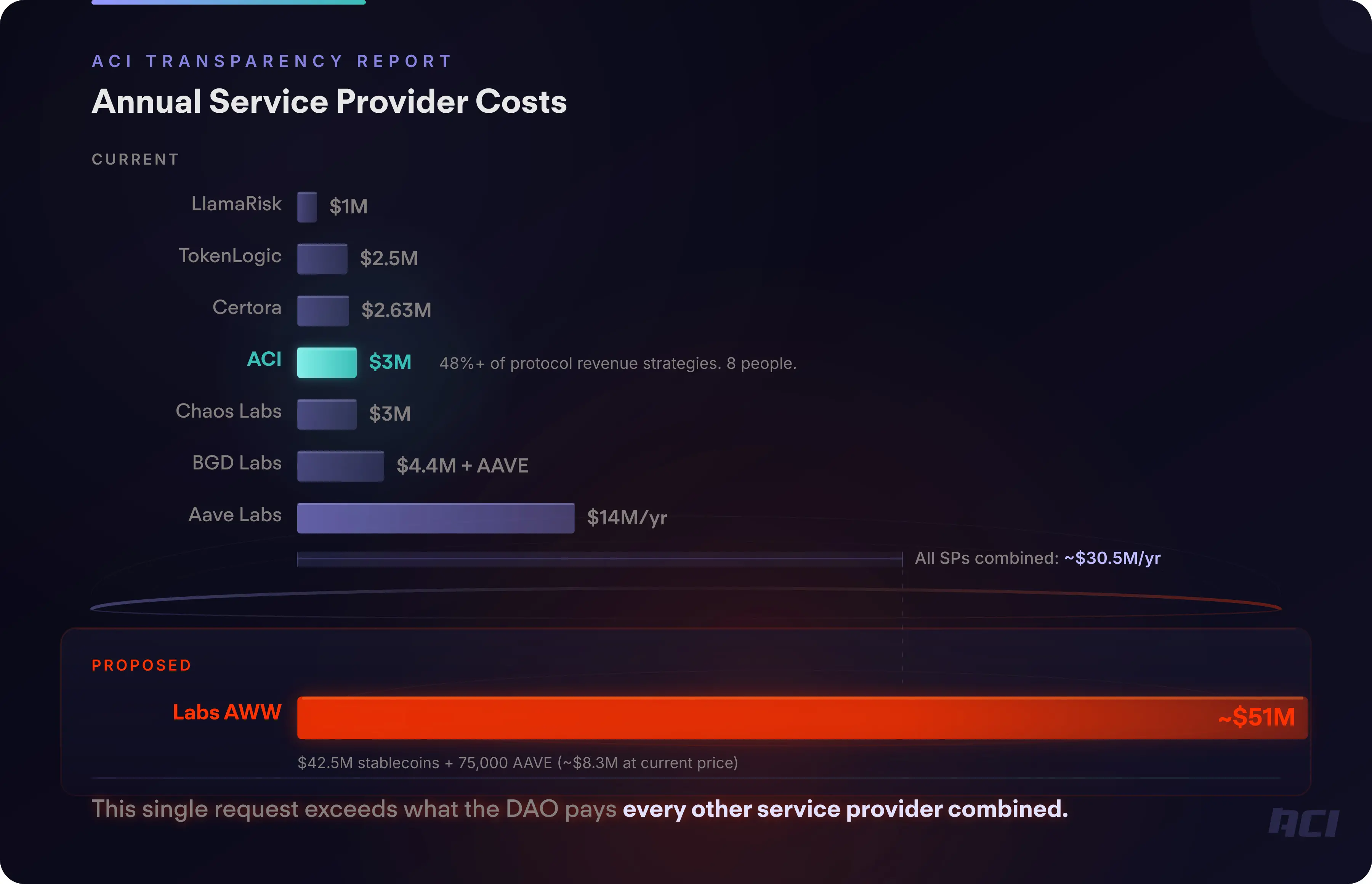
The entire service provider ecosystem costs about $30.5M annually, generating $142.9M in protocol revenue. ACI’s cost is $3M—about 10%—covering growth, incentives, partnerships, and governance execution.
What if there was no ACI?
That’s a reasonable question. Token holders should ask each service provider this.
Without us:
No incentive management. The $101M activity (DAO + partner funding) wouldn’t be designed, deployed, or optimized. Every competitor runs their own incentive programs. Without our mechanisms, Aave’s TVL growth stalls, and competitors narrow the gap.
No LRT yield engine. The $37M annual cycle engine wouldn’t be built. weETH wouldn’t launch. Reserve rate optimization wouldn’t happen. WETH loans would stay at $1.1B instead of $5.87B.
No capture of Ethena funds. At peak, Aave had $6.8B. Without us, these funds would flow to Morpho, which would generate zero protocol revenue.
No Skywards channels. Asset onboarding would rely on individual proposers navigating governance alone. Launches like RLUSD, EURC, USDe, and dozens of others would be delayed or impossible.
No GHO growth engine. The sGHO framework, cross-chain expansion, and $12M incentives are joint contributions with TokenLogic. Without us, the growth engine stalls.
No MASIv partnerships. Without a team managing these relationships, $80M in external partner funds wouldn’t flow into Aave.
No governance throughput. Losing 61% of governance actions (845 snapshots and AIPs) since ACI’s founding, plus hundreds of forum replies. Without these, governance bottlenecks occur, and the protocol can’t adapt.
No cross-SP coordination. Asset onboarding, chain deployment, and economic reforms require coordination among risk, tech, treasury, and governance teams. Without someone driving these, proposals stall, partner funds delay, and opportunities close before discovery.
No Plasma. $2.3B TVL and $5.9M annual income are directly due to our deployment coordination and incentive management.
Execution is not a one-time event. Revenue engines decline without ongoing effort. If channels aren’t prepared with the next strategy, growth reverses.
Conclusion
Since November 2022, we’ve spent a total of $4.625 million of Aave DAO funds. Protocol annual revenue grew from $5.2M to $141.8M. Active loan market share rose from below 50% to over 65%. GHO grew from $35M to $527M. At current 30-day run rate (annualized $218.8M), the protocol can earn back all our three-year compensation in about a week. For every dollar of protocol revenue growth, ACI’s DAO cost is just 3.4 cents.
Ask any entity using DAO funds these three questions:
What have you delivered? Provide verifiable on-chain evidence, governance infrastructure, coordination work, and partnerships that produced these results.
What are the costs? Fully disclose total compensation.
What is the return? Revenue generated, TVL created, governance output.
Our answers are above.
The DAO is currently evaluating a $51 million funding request from Aave Labs—more than all other service providers combined. Before voting, token holders should ask the same three questions. This is the deliverable of $4.625 million over three years, with on-chain evidence. Apply the same standard to the $51 million request.